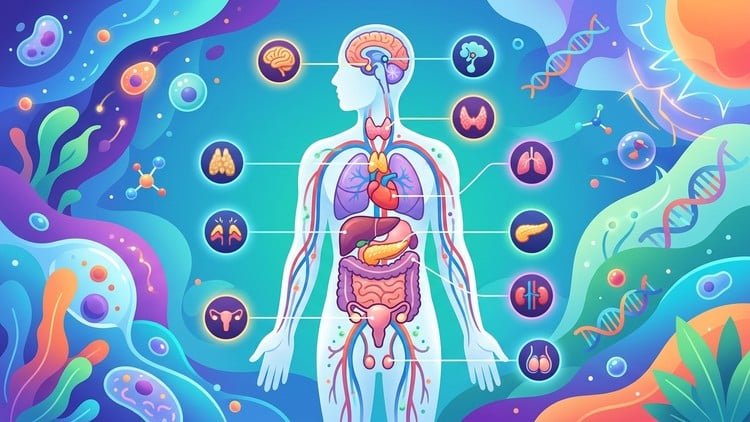
Practice MCQs on Hormones, Glands, Endocrine Disorders, and Human Physiology with Detailed Explanations
What You Will Learn:
- Identify major endocrine glands and explain the main hormones they produce and their roles in the human body.
- Explain how hormones, receptors, feedback loops, and endocrine signals help control body functions.
- Review the functions of the pituitary, thyroid, parathyroid, adrenal glands, pancreas, and other endocrine tissues.
- Use multiple-choice practice questions to test endocrine system knowledge and find topics that need more study.
- Improve exam readiness by reviewing clear explanations for questions about hormones, glands, and endocrine functions
Alright, let’s talk about the ‘Endocrine System Practice Test 2026: Hormones & Glands.’ As a tech pro who’s seen a few iterations of learning platforms, my antenna always goes up when I see “practice test” front and center. Is it just rote memorization, or does it actually build foundational understanding? For this one, I’m leaning heavily towards the latter, and I’ll explain why this isn’t just for future med school hopefuls but has surprising utility for anyone in healthcare tech or even just looking to sharpen their systemic thinking skills.
Overview
Let’s be blunt: a course on hormones and glands might seem like a sharp left turn for someone steeped in compilers and cloud architecture. But hear me out. The human endocrine system is, in essence, an incredibly complex, distributed biological signaling network. Thinking about it in terms of feedback loops, signals, receptors, and system-wide controls isn’t that far removed from debugging a microservices architecture or optimizing data flow in a distributed system. This isn’t just about memorizing gland names; it’s about understanding a sophisticated biological mechanism that maintains homeostasis – a kind of living load balancer, if you will. This course frames that complexity beautifully through its MCQ format. It’s less about just quizzing you and more about using questions to deconstruct the system. The detailed explanations are where the real value lies; they don’t just tell you *what* the answer is, but *why*, often elaborating on the physiological process in a way that solidifies your grasp of the topic. It’s a structured approach to mastering a critical biological system, moving you from a beginner’s grasp to a more advanced, nuanced understanding.
Prerequisites
You don’t need a medical degree to tackle this, but a basic grasp of high school-level biology would be beneficial. Understanding cell structure, fundamental biological processes, and maybe a smattering of chemistry (like what a protein or steroid is) will give you a solid runway. If you can define “mitochondria” without Googling, you’re probably good to go. This isn’t designed to be an intro to biology, but rather a focused deep dive into one of its most intricate systems.
Skills & Tools
While you won’t be using any traditional `industry-standard tools` like Python or Docker here, the course hones crucial `job-ready skills` that are transferable across any analytical domain. You’re developing acute `problem-solving` abilities by dissecting complex physiological scenarios. More importantly, it sharply refines your `critical thinking` and `pattern recognition` skills – vital for understanding how multiple hormones interact, how feedback loops operate, and how imbalances lead to disorders. The “tool” here is the structured learning methodology: leveraging multiple-choice questions for targeted self-assessment and the detailed explanations as a knowledge expansion engine. This approach is excellent for `certification prep` in any field, teaching you how to break down complex questions and identify the core concepts being tested.
Career Benefits & Job Roles
Alright, for the tech crowd, where does this fit? If your career trajectory even remotely touches the healthcare sector – think `healthcare tech` development, medical device software, AI in diagnostics, or electronic health records systems – this knowledge is invaluable. Understanding the underlying biology allows you to build more robust, more intuitive, and ultimately, safer systems. For data scientists or AI/ML engineers working with biological or medical datasets, this foundational knowledge is a must-have for contextualizing your data and building more accurate models. Beyond direct applications, the discipline of understanding a complex biological system, with all its intricate interdependencies and feedback mechanisms, is a powerful exercise in `system thinking` that benefits any `career growth` path. It teaches you to approach complex, multi-variable problems, akin to navigating `real-world projects` with myriad interconnected components.
Pros
- Comprehensive Coverage with Clarity: The course does an exceptional job of breaking down a vast and complex topic. It thoroughly reviews major endocrine glands, their hormones, and their physiological roles. The explanations are clear and concise, making complex concepts digestible for learners from `beginner to advanced`.
- Effective for Exam Readiness: This is pure `certification prep` gold. The MCQ format, coupled with detailed explanations, makes it incredibly effective for pinpointing areas of weakness and strengthening understanding. It’s designed to improve your performance on actual exams by simulating the experience and providing immediate, in-depth feedback.
- Focus on Core Concepts: It intelligently emphasizes how hormones, receptors, and feedback loops control body functions. This isn’t just rote memorization; it’s about understanding the “how” and “why,” which is crucial for true mastery and for applying this knowledge in `real-world projects` or diagnostic scenarios.
- Actionable Learning: By using practice questions to test knowledge, it actively helps you identify topics that need more study. This self-directed, diagnostic approach is far more efficient than passively consuming lectures.
Cons
- Lacks Traditional Hands-on Elements: As a practice test course, it inherently lacks `hands-on labs` or simulations that might appeal to those who learn by doing in a more tangible sense. While it’s excellent for theoretical mastery and conceptual application, don’t expect to be “coding” hormone pathways or running virtual experiments. It’s a knowledge assessment and reinforcement tool, not an interactive simulation environment.