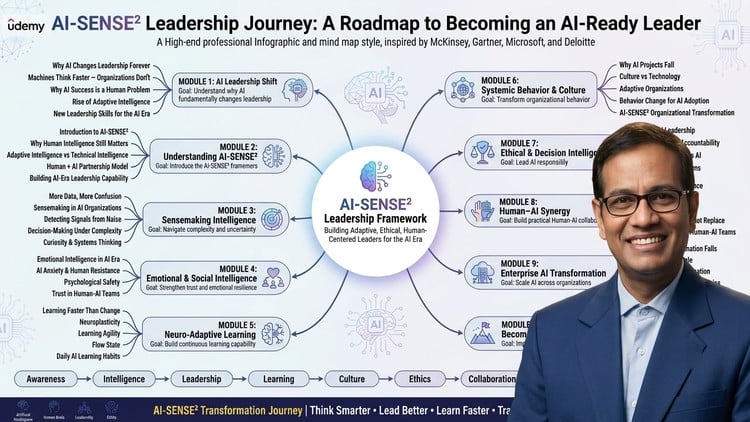
Master the AI-SENSE² framework to build human-AI synergy, drive culture change, and navigate organizational complexity.
What You Will Learn:
- Lead confidently in the AI era by mastering adaptive intelligence, Human–AI collaboration, and future-ready leadership skills.
- Apply the AI-SENSE²™ Framework to navigate complexity, make better decisions, and lead AI-driven transformation.
- Build emotional resilience, psychological safety, and trust to lead high-performing teams during AI and digital transformation.
- Develop learning agility using neuroscience, neuroplasticity, and continuous learning habits to stay relevant in a changing world.
- Use sensemaking techniques to filter information overload, recognize patterns, and make strategic decisions with confidence.
- Design effective Human–AI workflows by combining AI capabilities with human creativity, judgment, ethics, and leadership.
- Show more
Overview: Navigating the Leadership Debt in the Age of Silicon
Let’s be real for a second—most “AI for Leaders” courses out there are glorified tutorials on how to write a half-decent ChatGPT prompt. They treat AI like a shiny new screwdriver when it’s actually more like a fundamental shift in the tectonic plates of business. After spending a decade in the tech trenches, I’ve seen enough “innovation theater” to last a lifetime. That’s why I was skeptical about AI Leadership: Adaptive Intelligence for the Future of Work. However, this isn’t just another buzzword-heavy lecture series; it’s a rigorous deep-dive into the AI-SENSE²™ Framework, and it addresses the “leadership debt” most executives are currently accruing.
The core philosophy here is that digital transformation fails not because the tech is bad, but because the “human operating system” hasn’t been patched. This course moves away from the beginner to advanced technical spectrum and focuses on adaptive intelligence—the ability to pivot your strategy as quickly as a new LLM drops on GitHub. Instead of teaching you how to build a neural network, it teaches you how to lead a hybrid workforce where your best “employee” might be an autonomous agent. The focus on sensemaking is particularly sharp; it’s about filtering the noise of 24/7 AI hype to find the actual strategic ROI.
Prerequisites: What You Actually Need Before Hitting Play
You don’t need to be a Python wizard or have a PhD in data science to get value here. However, this isn’t for the “fresh out of college” crowd either. To truly grasp the organizational complexity discussed, you need some “skin in the game.” I’d say a minimum of 3-5 years in a management or high-level individual contributor role is the sweet spot. You should have a baseline understanding of what machine learning is, but more importantly, you need to have felt the pain of a failed change management initiative. If you’ve ever tried to implement a new tool and had your team revolt, you’re ready for this course.
Skills & Tools: Building the Modern Leader’s Toolkit
While the course stays high-level on the “code,” it’s incredibly hands-on regarding industry-standard tools for decision-making and workflow design. You’ll be working through real-world projects that involve:
- Human–AI Workflow Design: Mapping out processes to identify where human judgment is non-negotiable versus where AI can handle the heavy lifting.
- Neuroplasticity Techniques: Practical exercises based on neuroscience to improve learning agility and cognitive flexibility.
- Psychological Safety Audits: Tools to measure and build trust within teams who are (rightfully) terrified that AI will take their jobs.
- AI Ethics Frameworks: Moving beyond “don’t be evil” to actual algorithmic bias mitigation and governance.
- Strategic Sensemaking: Using pattern recognition tools to navigate information overload and make high-stakes calls with confidence.
Career Benefits & Job Roles: The ROI of Being AI-Fluent
The career growth potential here is massive because we are currently in a massive “leadership vacuum” regarding AI. Companies are desperate for people who can bridge the gap between the IT department and the C-suite. Completing this course serves as excellent certification prep for those looking to pivot into roles like Chief AI Officer (CAIO), VP of Digital Transformation, or AI Strategy Lead. These are job-ready skills that distinguish you from the “prompt engineers” who don’t understand unit economics or culture change. Whether you’re at a startup or a Fortune 500, being the person who can architect human-AI synergy makes you virtually unfireable in the current market.
Pros: Why This Course Sticks the Landing
- The AI-SENSE²™ Framework is a Game Changer: It’s a proprietary, structured mental model that gives you a repeatable process for tackling AI-driven transformation. It’s not just theory; it’s a blueprint.
- Deep Focus on Emotional Resilience: Most tech courses ignore the “fear factor.” This course spends significant time on psychological safety and emotional intelligence, acknowledging that leading AI is 90% psychology and 10% technology.
- Grounded in Neuroscience: I loved the section on neuroplasticity. It provides a scientific basis for why we struggle with change and how to literally “rewire” your brain for continuous learning habits.
- Real-World Scenarios: The hands-on labs don’t feel like academic exercises. They feel like the actual fires you have to put out on a Tuesday afternoon at a mid-sized tech firm.
Cons: The Honest Truth
If I have one gripe, it’s that the course can be cognitively exhausting. Because it touches on everything from neuroscience to strategic leadership, it’s not something you can just “Netflix and chill” through. If you’re looking for a quick “how-to” on specific industry-standard tools like Midjourney or Claude, you’ll be disappointed. This is a “heavy lift” for your brain, and if you aren’t prepared to do the internal work on your own leadership style, the frameworks might feel a bit abstract.