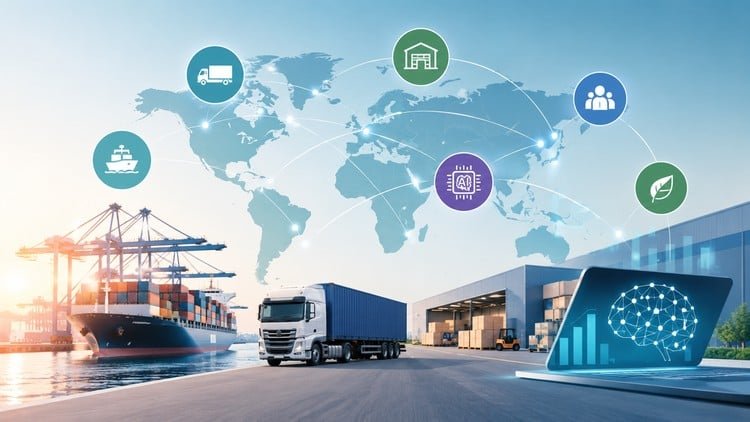
Master modern supply chain strategies, demand forecasting, inventory, resilience, and AI for peak performance and career
What You Will Learn:
- Understand the strategic foundations of modern supply chains, including resilience, agility, demand forecasting, and planning.
- Analyse supply chain data and apply practical approaches to inventory, risk, supplier, logistics, and network optimisation.
- Understand how AI, analytics, optimisation, and technology are transforming supply chain visibility, performance, and decision-making.
- Apply practical frameworks for managing disruption, improving performance, making better decisions, and adapting to an AI-enabled workplace.
Overview
Let’s be real, the supply chain world has been on a rollercoaster these past few years. From unprecedented disruptions to the accelerating pace of technological change, standing still simply isn’t an option. That’s precisely why ‘Supply Chain Management: AI, Optimisation & Resilience’ isn’t just another course; it’s a crucial survival guide for modern professionals. What really struck me here wasn’t just the sheer breadth of topics, but how intelligently they’ve woven together the strategic bedrock of SCM with the bleeding-edge capabilities of AI and advanced optimization techniques. This isn’t theoretical fluff; it’s a pragmatic deep dive into navigating today’s complex global networks, understanding how to predict and prevent failures, and most importantly, how to leverage technology to turn challenges into competitive advantages. It’s about building supply chains that don’t just react, but proactively evolve and thrive, fundamentally shifting your perspective from problem-solver to strategic innovator in the face of constant flux.
Prerequisites
Honestly, while the course title suggests mastering advanced concepts, I found it surprisingly accessible. You don’t need a Ph.D. in Operations Research or years of hands-on logistics experience to get value. A foundational understanding of general business processes or a keen analytical mindset will serve you well. It balances foundational concepts, making it accessible even for those relatively new to the SCM field (truly bridging `beginner to advanced`), while still providing enough depth and advanced insights to challenge and enlighten seasoned professionals looking to update their skill set. If you’re comfortable with basic data concepts and have a desire to understand complex systems, you’re good to go. For me, coming from a tech background, it was the perfect bridge into the operational side of the business without feeling overwhelmed.
Skills & Tools
This course arms you with an impressive toolkit, not just for today but for the future of SCM. On the skills front, you’ll develop a robust understanding of `strategic supply chain planning`, advanced `demand forecasting` methodologies, sophisticated `inventory optimisation` techniques, and critical `risk management` frameworks. A significant portion focuses on applying analytical thinking to real-world scenarios, improving decision-making across the entire value chain. While it emphasizes methodologies over getting lost in proprietary software, the principles taught are directly applicable to `industry-standard tools` like SAP, Oracle SCM, and various planning platforms. You’ll gain conceptual mastery of how AI/ML models enhance visibility and predictability, learn practical approaches to `network optimisation`, and grasp the power of simulation for resilience. Expect to engage with the concepts in a way that feels like `hands-on labs` even if specific software isn’t always the focus, honing your ability to critically assess and implement solutions.
Career Benefits & Job Roles
If you’re looking for genuine `career growth` in a field undergoing massive `digital transformation`, this course delivers. The `job-ready skills` you acquire here are highly coveted across industries. You’ll be well-positioned for roles such as a Supply Chain Analyst or Manager, Demand Planner, Logistics Specialist, Operations Consultant, or even roles focused on `AI integration` within an SCM context. The emphasis on `resilience strategies` and `risk management` is particularly valuable, making you an indispensable asset in volatile markets. This isn’t just about understanding existing processes; it’s about becoming an architect of future-proof supply chains. For tech professionals, it opens doors to understanding the business impact of your work more deeply, allowing for more strategic contributions and fostering leadership potential.
Pros
- Future-Proofing Focus: This course brilliantly integrates AI and optimisation, making it incredibly relevant for anyone serious about staying ahead in modern supply chain management. It doesn’t just teach you what is, but what will be.
- Practical & Actionable Insights: Forget pure theory; the curriculum is packed with practical frameworks and approaches you can immediately apply. It’s about making better decisions and improving performance right away, not just pondering hypotheticals.
- Holistic Perspective: It masterfully blends strategic foundations with tactical execution, covering everything from demand planning to network optimisation and risk. This comprehensive view ensures you understand the interconnectedness of all supply chain elements.
- Strong Foundation for Certification: Though not explicitly a `certification prep` course for specific SCM exams, the comprehensive curriculum absolutely fortifies your knowledge base, making you exceptionally well-prepared for any professional SCM certification you might pursue.
Cons
- Limited Deep Dive into Specific Tools: My only minor gripe is that while it covers the principles behind `industry-standard tools` and technologies, it doesn’t provide extensive hands-on training with specific vendor software (e.g., SAP, Oracle SCM Cloud, specific Python libraries for optimisation). For those looking for highly specialized, tool-specific `hands-on labs`, some supplementary learning might be necessary.