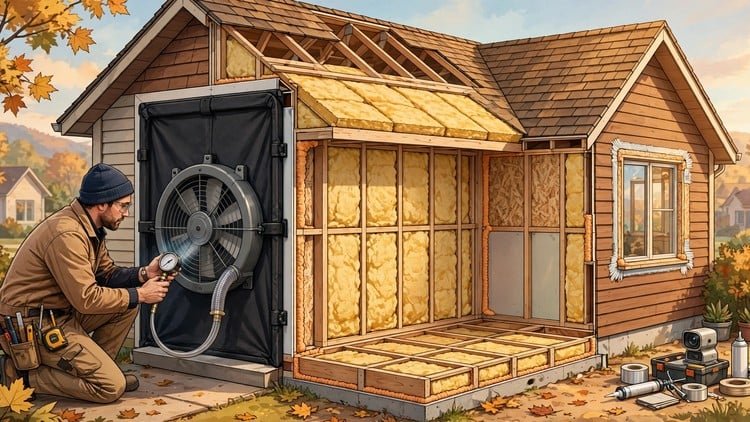
Practice for the BA-T field exam with 560 multiple-choice questions, detailed explanations, and self-paced study.
What You Will Learn:
- Apply building science fundamentals, heat transfer, moisture, and airflow for home performance work.
- Identify envelope and construction details, thermal boundaries, and pressure boundaries in a home.
- Apply HVAC, ventilation, and indoor air quality concepts for mechanical system assessment decisions.
- Apply combustion safety, CAZ testing, spillage, and carbon monoxide action levels for field work.
- Interpret blower door, zonal pressure, and pressure pan results for airflow diagnostics.
Overview
Alright, let’s talk about the ‘BPI Building Analyst Technician (BA-T) Practice Tests 2026.’ If you’re looking to truly nail your BA-T field exam, this isn’t just another set of questions; it’s a critical piece of your **certification prep** arsenal. What immediately jumped out at me wasn’t just the sheer volume – 560 multiple-choice questions is no joke – but the promise of *detailed explanations*. That’s where the rubber meets the road. Anyone can churn out questions, but without understanding *why* an answer is correct (or incorrect), you’re just memorizing, not learning.
This practice test suite is designed to get you thinking like a seasoned analyst out in the field. It pushes you beyond textbook definitions and forces you to apply concepts like **heat transfer**, **moisture dynamics**, and **airflow** to real-world scenarios. It’s about building that muscle memory for making sound diagnostic decisions. The self-paced nature is also huge for working professionals. You can chip away at it whenever you have a moment, reinforcing those complex concepts without the pressure of a classroom schedule. This is about building **job-ready skills** and confidence before you even step foot into a client’s home or the testing center. For anyone serious about home performance, this isn’t just practice; it’s essential simulation.
Prerequisites
To get the most out of these practice tests, you shouldn’t be starting from square one. Think of this as the final polishing phase, not an introduction. Ideally, you’ve already completed a comprehensive BPI BA-T training course or have a solid foundation in **building science fundamentals**. If terms like “thermal boundary,” “pressure boundary,” or “combustion appliance zone (CAZ) testing” sound completely foreign, you might want to hit the books (or a full course) first.
This suite is perfect for those who are transitioning from a **beginner to advanced** understanding in energy auditing. You should have some theoretical knowledge of how homes work as systems, how HVAC operates, and the basics of diagnostic tools. While the explanations are good, they won’t substitute for the initial learning phase or **hands-on labs** where you actually operate a blower door or a combustion analyzer. This assumes you’ve got a baseline understanding and are now looking to fine-tune your knowledge for exam-specific application.
Skills & Tools
While these are practice *tests*, the skills you refine are entirely practical. You’ll sharpen your ability to interpret diagnostic data – think **blower door**, **zonal pressure**, and **pressure pan results** – which is crucial for identifying airflow leaks and understanding pressure dynamics within a home. You’ll get better at spotting common envelope and construction issues, and understanding their implications for energy efficiency and comfort.
The questions will push your knowledge of **HVAC, ventilation, and indoor air quality (IAQ) concepts**, priming you to make informed mechanical system assessment decisions. And critically, you’ll drill down on **combustion safety protocols**, including proper CAZ testing, understanding spillage, and acting on carbon monoxide (CO) action levels. This isn’t just about passing a test; it’s about confidently using **industry-standard tools** (or interpreting their results) and applying these principles in **real-world projects**. You’re essentially honing your diagnostic capabilities and critical thinking, which are invaluable for any home performance pro.
Career Benefits & Job Roles
Securing that BPI BA-T certification is a significant boost for your **career growth** in the home performance industry. These practice tests are your direct route to achieving that. A BPI certification isn’t just a piece of paper; it’s a widely recognized mark of competency and professionalism. With it, you open doors to a variety of specialized **job roles**.
You’ll be qualified as a certified **Energy Auditor**, capable of conducting comprehensive home energy assessments. It’s a must-have for **Home Performance Contractors** looking to differentiate themselves and expand their services. Many **HVAC Technicians** use this certification to deepen their understanding of whole-house systems and offer more holistic solutions. You could also find yourself in roles like a **Weatherization Specialist**, **Quality Assurance Inspector**, or even consulting on sustainable building practices. The credibility you gain directly translates into more opportunities, potentially higher earning potential, and the ability to tackle more complex and rewarding **real-world projects**.
Pros
- Comprehensive and Up-to-Date: With 560 questions tailored for the 2026 exam, you’re getting thorough coverage of every topic, ensuring you’re ready for current BPI standards.
- Detailed Explanations are a Game Changer: This isn’t just about getting the answer right; it’s about understanding *why*. The explanations deepen your grasp of building science, making you a better analyst, not just a test-taker.
- Self-Paced Flexibility: Life gets busy. Being able to study on your own schedule is invaluable, allowing you to fit rigorous **certification prep** into your existing commitments.
- Directly Targets the Field Exam: Many struggle with applying theoretical knowledge. These questions are designed to simulate the practical, application-based scenarios you’ll face on the actual BA-T field exam, helping you develop crucial **job-ready skills**.
Cons
- Not a Standalone Course: Let’s be honest, these are *practice tests*, not a full BPI BA-T training program. While excellent for honing knowledge, they assume you’ve already got a foundational understanding and have potentially undergone **hands-on labs** or field experience. If you’re coming in cold, you’ll still need that primary learning.