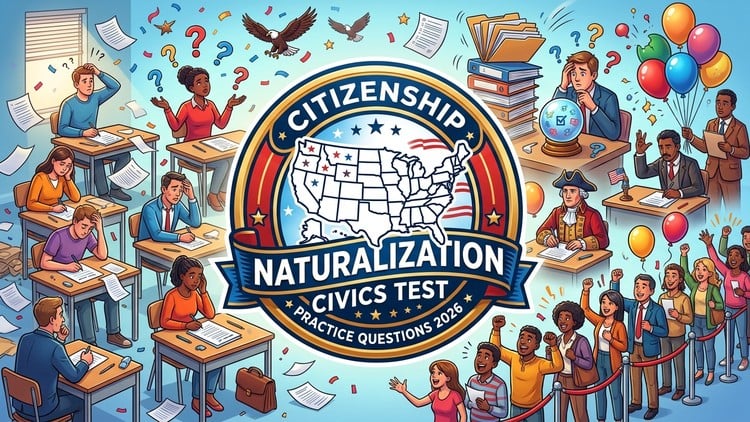
Prepare for the USCIS Civics Test with Realistic Practice Questions, Detailed Explanations, and Easy Self-Paced Learning
What You Will Learn:
- Understand the principles of American democracy, the Constitution, and the basic structure of the U.S. government.
- Identify the roles of Congress, the President, the Supreme Court, and state governments.
- Recognize the rights and responsibilities of U.S. citizens required for the naturalization process.
- Recall important events, people, and documents from American history that appear on the civics test.
- Build confidence for the U.S. Citizenship Naturalization Civics Test through realistic practice questions and explanations.
‘U.S. Citizenship Naturalization Civics Test Exam Prep 2026’ – An Honest Take
So, I recently dove into the ‘U.S. Citizenship Naturalization Civics Test Exam Prep 2026’ course. Now, as a seasoned tech pro, my usual haunts are stacks of documentation, sprawling codebases, and maybe the occasional deep dive into a new framework. This was a departure, to say the least. But honestly, I found myself surprisingly engaged, perhaps because the underlying principles of understanding a system—even a governmental one—resonate with my day-to-day. Think of it as a highly specialized, incredibly important certification prep for a life-changing credential.
Overview
This isn’t your typical dry textbook read. The course frames the civics test not just as a hurdle to clear, but as a fundamental understanding of the operating system of American democracy. It breaks down the core functionalities – the legislative, executive, and judicial branches – in a way that’s surprisingly akin to understanding how different components of a complex software system interact. They emphasize that this isn’t just about memorizing facts; it’s about grasping the ‘why’ behind the rules, the historical context that shaped them, and the rights and responsibilities that come with being a stakeholder in this particular nation-state. The focus on realistic practice questions really drove home the “exam prep” aspect, making it feel less like a theoretical exercise and more like building job-ready skills for a specific, high-stakes examination. It’s about deconstructing a known problem set and developing a strategy for success.
Prerequisites
Honestly, the main prerequisite is a genuine desire to become a U.S. citizen and a willingness to put in the study time. No prior political science degree or deep historical knowledge is required. They really do start from the ground up, assuming no prior familiarity with American civics beyond what a new user might pick up. If you can read and understand English, you’re good to go. Think of it as onboarding for a new platform – the documentation is clear, and the core concepts are introduced progressively.
Skills & Tools
The primary “skill” you’ll develop is a comprehensive understanding of U.S. civics as it pertains to the naturalization test. This includes recognizing the structures of government, historical milestones, and civic duties. The “tools” are primarily the course materials themselves: the practice questions, the explanations, and the structured learning modules. It’s not about learning new software or programming languages, but rather about mastering the curriculum. If I were to draw a parallel to tech, it’s like going through intensive certification prep that focuses on understanding a very specific, critical set of knowledge, rather than learning a new industry-standard tool. The self-paced learning aspect is a big plus, allowing you to revisit concepts as needed, much like debugging a particularly tricky piece of code.
Career Benefits & Job Roles
This might seem a bit outside my usual domain, but the “career benefits” here are profound and direct. Becoming a U.S. citizen opens doors to a vastly expanded range of employment opportunities, allowing access to jobs that require citizenship, opening up pathways for federal employment, and providing greater career mobility. It’s the ultimate enabler for long-term professional career growth within the United States. While the course doesn’t teach you to code or design a database, it equips you with the fundamental requirement to pursue almost any career path within the country.
Pros
- Realistic Practice Questions: This is the standout feature. The questions are designed to mimic the actual test, which is invaluable for building confidence and identifying weak areas. It’s like running extensive unit tests before a major deployment.
- Clear & Concise Explanations: The material is broken down into digestible chunks with detailed explanations that go beyond simple memorization. This approach fosters true understanding, not just rote learning.
- Flexible Self-Paced Learning: The ability to learn at your own speed is crucial. You can revisit modules, focus on challenging topics, and fit your studies around your existing commitments. This adaptability is key for efficient knowledge acquisition.
- Comprehensive Topic Coverage: The course hits all the essential areas required for the civics test, ensuring you’re well-prepared across the board. No unexpected gaps in knowledge.
Cons
- Limited Real-World Application Beyond the Test: While the content is essential for the citizenship exam, the direct applicability of the specific facts and figures learned to *other* professional or technical contexts is, by design, limited. It’s a very specific knowledge set for a specific purpose, akin to studying for a niche technical certification that doesn’t directly translate to broader development skills.
In conclusion, if you’re on the path to U.S. citizenship and need to conquer the civics test, this course is a solid, well-executed piece of educational software. It’s designed for its purpose and does it well. Definitely worth the investment in time and resources.