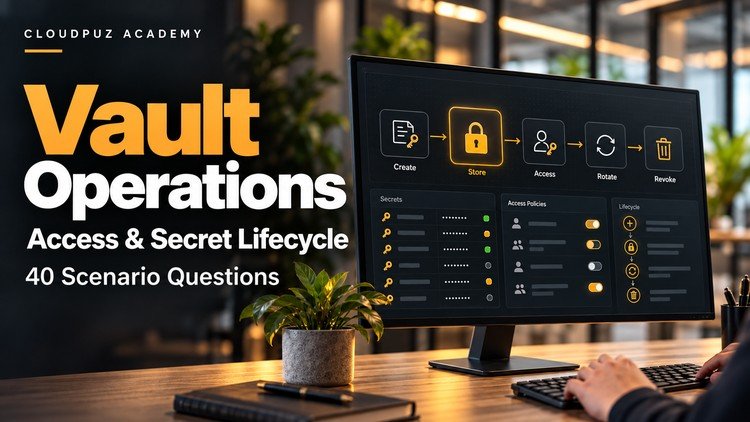
Practice policies, KV versioning, token and lease handling, audit availability and recovery decisions
What You Will Learn:
- Diagnose path-based authorization and token access issues.
- Distinguish KV version recovery from dynamic credential lifecycle.
- Evaluate lease renewal, revocation and application rotation behavior.
- Identify audit, seal and backup dependencies in operational incidents.
Alright, let’s talk about this Vault Operations: 40 Access and Secret Lifecycle Scenarios course. As someone who’s spent more than a few late nights wrestling with secrets management (and trust me, there’s always more wrestling to do), I was genuinely curious to see what this course offered beyond the usual theoretical fluff. I’ve seen a lot of “intro to Vault” type training, and frankly, they often leave you feeling like you’ve just read a manual. This one, though, felt a bit different. It promises to get down and dirty with the nitty-gritty of actually running Vault in production, which is where the real headaches – and the real learning – happen.
Overview
The core promise here is moving beyond just understanding what Vault *is* to knowing how to *operate* it. They’re not just covering basic setup; they’re diving deep into the messy realities of managing secrets at scale. The emphasis on 40 distinct scenarios is a big selling point. It hints at practical, problem-solving exercises, and that’s exactly what we need when we’re talking about production environments. Think less about the “why” and more about the “how to fix it when it breaks.” The course aims to equip you with the diagnostic chops to figure out why an application can’t get its credentials, or why a specific path in KV isn’t accessible, and more importantly, how to resolve it. It also tackles the often-confusing interplay between different Vault features, like distinguishing how KV version recovery differs from the lifecycle of dynamic secrets – a crucial point for anyone managing diverse secret types.
Prerequisites
Honestly, if you’re walking into this course expecting to learn what a secret is, you’re probably going to be a bit lost. They’re assuming a foundational understanding of HashiCorp Vault itself. You should be comfortable with the basics: installing Vault, understanding its core concepts like authentication engines, policies, and the KV store at a functional level. Some familiarity with basic infrastructure concepts, like networking and how applications interact with services, is also a must. This isn’t a “Vault for absolute beginners” course; it’s for those who’ve dabbled and are ready to get their hands truly dirty in operational challenges.
Skills & Tools
This course is all about building practical, job-ready skills. You’ll hone your ability to diagnose path-based authorization and token access issues, which is basically a daily task for any Vault administrator. The ability to evaluate lease renewal, revocation, and application rotation behavior is critical for maintaining secure and efficient secrets management. You’ll also get a solid grasp on the dependencies between various operational components, like understanding how audit, seal, and backup strategies directly impact your ability to recover from incidents. The implicit tools are, of course, Vault itself, and you’ll likely be interacting with its CLI and potentially its API. Familiarity with shell scripting or a scripting language for automation tasks would be a bonus, though not explicitly required.
Career Benefits & Job Roles
For anyone looking to level up their DevOps, SRE, or Security Engineering career, this course is a no-brainer. In today’s cloud-native world, secrets management isn’t just a nice-to-have; it’s a fundamental pillar of a secure and reliable infrastructure. Mastering Vault operations will make you a significantly more valuable asset. This training is excellent for certification prep, especially for HashiCorp certifications, and it provides hands-on experience that translates directly into real-world projects. Job roles that directly benefit include DevOps Engineer, Site Reliability Engineer (SRE), Security Engineer, and Cloud Infrastructure Engineer. It opens doors to positions requiring deep expertise in infrastructure security and automation.
Pros
- Scenario-Based Learning: The sheer volume and practical nature of the 40 scenarios are fantastic. This isn’t just theory; it’s about tackling problems you’ll actually encounter.
- Deep Dive into Operations: It goes beyond surface-level setup and gets into the critical operational aspects that often trip people up in production.
- Career-Enhancing Skills: The skills you gain are highly sought after and directly translate to better job prospects and career growth in the cloud-native ecosystem.
Cons
My one honest critique is that, given the depth and the practical nature, the course could feel overwhelming for someone who only has a cursory understanding of Vault. While they state prerequisites, I’d emphasize that a solid, practical grasp of Vault fundamentals is absolutely essential to get the most out of this. If you’re still figuring out what a token is, you might want to hit a more introductory course first.