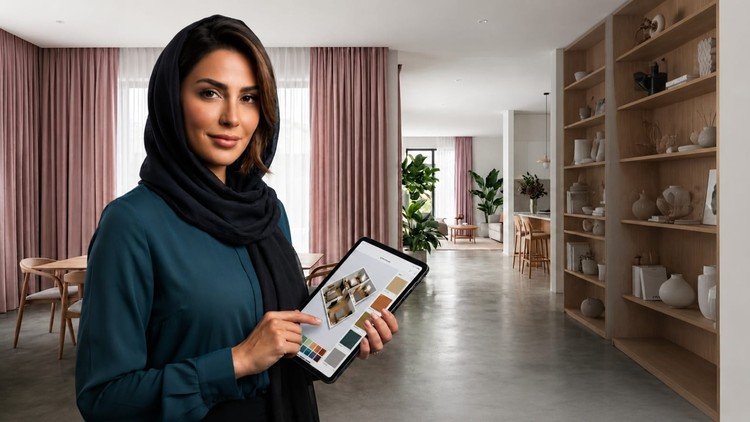
Master space design foundations and learn the 3 golden rules to professional home decor ,styling and balance.
What You Will Learn:
- Understand the core principles of minimalist interior design.
- Master the 60/40 rule to create perfect spatial balance and negative space.
- Apply the 10-second rule to audit and control room first impressions.
- Use the vertical triangle point of focus to add dynamic layers to spaces.
Overview: Why Clean Lines Are the New Clean Code
Let’s be real for a second—as someone who spends the majority of my life staring at a monitor, the physical space around me is either a source of Zen or a massive distraction. I’ve always appreciated the “less is more” aesthetic, but whenever I tried to DIY my home office or living area, it ended up looking less like a professional interior and more like I just ran out of money for furniture. That’s why I picked up “The Interior Designer’s Eye.” I wanted to see if there was a repeatable, beginner to advanced framework that could bridge the gap between “messy hobbyist” and job-ready skills.
The course doesn’t just tell you to throw away your stuff. It treats interior design like a system. It’s about the psychology of space. Instead of the usual fluff you see on social media, this curriculum focuses on the structural logic of how our eyes track a room. It feels less like an art class and more like a hands-on lab where you’re auditing the “UI” of your home. The instructor breaks down the concept of intentionality—moving away from buying items because they look “cool” and instead selecting them because they serve the architectural integrity of the floor plan.
Prerequisites
The beauty of this course is that you don’t need a degree from Parsons to get started. However, you do need a willingness to be ruthless with your own belongings. If you’re looking for certification prep for a formal license, this is a great foundational supplement, but the only true requirement is a basic understanding of spatial measurements. Having a digital camera or a high-quality smartphone is also recommended, as you’ll be performing visual audits that require a “lens-eye” view of your progress.
Skills & Tools: Beyond the Mood Board
While many entry-level tutorials stop at color swatches, this course pushes you toward industry-standard tools and methodologies. You aren’t just picking paints; you’re learning how to manipulate light and volume.
- Spatial Mapping: Learning how to calculate the 60/40 ratio without needing complex CAD software, though the principles translate perfectly if you use those tools.
- Visual Hierarchy: Mastering the “Vertical Triangle” which is essentially the real-world project version of F-pattern scanning in web design.
- Audit Frameworks: Using the 10-second rule to identify “visual noise” and friction points in a high-traffic environment.
- Compositional Balance: Understanding how to weight a room so it feels grounded rather than lopsided.
Career Benefits & Job Roles
I’ll be honest: I took this for personal growth, but the career growth potential here is massive for anyone in the creative or real estate sectors. If you are looking to build job-ready skills, this course acts as a bridge.
- Home Staging: For those looking to enter the real estate market, these rules are the “bread and butter” of making properties sell.
- UX/UI Design: There is a surprising amount of overlap between spatial balance and digital interface design. Understanding “negative space” in a room makes you significantly better at utilizing whitespace on a screen.
- Freelance Interior Consultant: This course provides enough real-world project experience to start taking on small-scale residential consultations or e-design gigs.
- Visual Merchandising: The rules regarding focal points and the 10-second rule are directly applicable to retail floor layouts.
Pros: The “Aha!” Moments
- Practicality over Theory: This isn’t a history lesson on the Bauhaus movement. It’s a tactical guide. You can apply the 60/40 rule to your desk setup five minutes after finishing the module.
- High-Level Logic: I appreciated the “Vertical Triangle” concept. It’s a sophisticated way to add depth without adding “stuff,” which is the hardest part of minimalism to master.
- Efficiency: The course is punchy. It respects your time, focusing on high-impact rules that deliver immediate visual results in real-world projects.
Cons: An Honest Critique
The only real drawback is that it might feel a bit too “clinical” for those who prefer a maximalist or eclectic bohemian style. If your idea of professional home decor involves layers of vintage clutter and “organized chaos,” these rules might feel like a straitjacket. It’s a very specific school of thought, and it doesn’t leave much room for sentimental hoarding. It’s about the industry-standard look of modern, high-end minimalism, which can sometimes feel a bit cold if you don’t intentionally inject your own personality into the 40% of the space you’re allowed to fill.