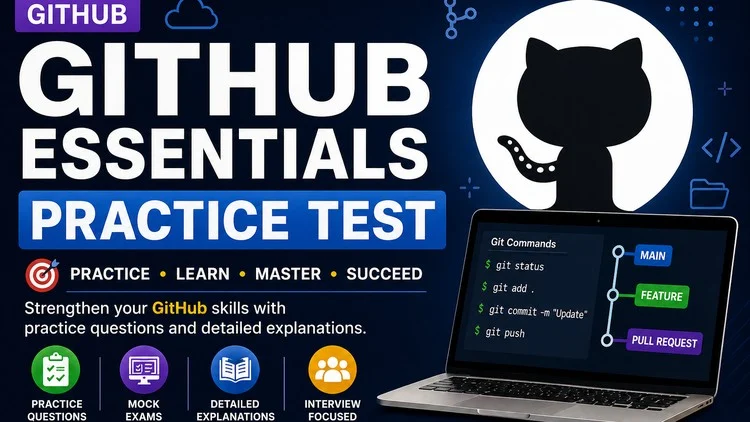
Learn GitHub with scenario-based questions, mock tests, and clear explanations to boost your confidence
👥 47 students
🔄 April 2026 update
Add-On Information:
- Comprehensive Course Overview
- Certification Readiness Strategy: This program is specifically engineered to bridge the gap between casual platform usage and professional mastery, focusing on the specific logic required to clear industry-standard technical assessments.
- Interview-Centric Pedagogy: Beyond mere theory, the curriculum adopts a conversational and analytical tone that prepares candidates to articulate complex technical decisions during high-stakes job interviews at top-tier tech firms.
- Enterprise Ecosystem Analysis: Participants explore how GitHub functions within a corporate infrastructure, looking at the hierarchy of organizations, teams, and permission levels that govern professional software development.
- Logical Framework Development: The course shifts the focus from memorizing syntax to understanding the underlying “graph theory” and data structures that drive version control, enabling students to predict outcomes of complex operations.
- Scenario-Based Assessment: Instead of static slides, the course utilizes a dynamic question-and-answer format that places learners in the role of a Lead Developer or DevOps Engineer tasked with maintaining code integrity.
- Documentation Standards: Learners will delve into the nuances of maintaining a professional digital presence, emphasizing the importance of clear communication through structured documentation and contribution guidelines.
- Modern DevOps Integration: The course explores the intersection of versioning and automation, providing a high-level view of how code transitions from a local machine to a global production environment.
- Collaboration Psychologies: It examines the socio-technical aspects of open-source and private development, teaching how to handle code reviews and feedback loops with professional maturity.
- Requirements / Prerequisites
- Foundational Computing Literacy: A solid understanding of how files and folders are managed within an operating system like Windows, macOS, or Linux is essential for success.
- Terminal Familiarity: While not requiring expert status, a basic comfort level with entering text-based commands into a shell or command prompt will significantly flatten the learning curve.
- Pre-Configured Environment: Students should have a verified account on the platform and a local installation of the core engine to follow along with the practical demonstrations provided in the explanations.
- Analytical Mindset: A willingness to engage with abstract logic and “state changes” is necessary, as the course deals heavily with how codebases evolve over time.
- Hardware Consistency: Access to a stable computer with administrative privileges is required to install various plugins and helper tools used throughout the professional lifecycle.
- English Language Proficiency: As the vast majority of technical documentation and exam questions are presented in English, a functional command of the language is required for interpreting nuanced questions.
- Skills Covered / Tools Used
- Command Line Interface (CLI) Mastery: The course emphasizes the use of specialized terminal tools that allow developers to interact with their cloud-based profiles without leaving their code editor.
- Advanced Security Protocols: Students will learn how to implement and manage SSH keys and GPG signing to ensure that every contribution is authenticated and secure against impersonation.
- GitHub Desktop and GUI Utilities: For visual learners, the course covers various graphical interfaces that help visualize the history and relationship between different versions of a project.
- Markdown and Technical Writing: Training includes the use of specialized formatting languages to create high-quality README files, wikis, and issue templates that improve project transparency.
- GitHub Pages Deployment: Learners gain insight into hosting static websites directly from their repositories, turning code into live, shareable web projects instantly.
- Issue Tracking and Project Management: The curriculum covers the use of digital kanban boards and automated tracking systems to manage team tasks and milestones effectively.
- Package Management: An introduction to how software dependencies are stored and distributed using specialized registry services integrated into the development workflow.
- Audit Logs and Compliance: For those aiming for management roles, the course introduces tools used to monitor repository activity and ensure adherence to company policies.
- Benefits / Outcomes
- Elevated Professional Visibility: Completing this course allows developers to transform their public profiles into high-quality portfolios that serve as living resumes for potential employers.
- Streamlined Team Productivity: Graduates will be able to implement standardized workflows that reduce the time wasted on administrative overhead and manual code synchronization.
- Advanced Troubleshooting Capabilities: By understanding the “why” behind the “how,” learners gain the ability to recover lost work and navigate complex state errors that would stall most junior developers.
- Accelerated Career Pathing: Mastery of these essential tools acts as a force multiplier, making the developer an asset in any DevOps, Full-Stack, or Backend engineering role.
- Standardized Best Practices: Participants will leave with a toolkit of industry-standard habits that ensure their code remains clean, readable, and easy for others to contribute to.
- Global Collaboration Readiness: The skills gained enable developers to contribute confidently to massive open-source projects, regardless of geographic or temporal boundaries.
- Security Awareness: Learners will become proactive in identifying leaked secrets and vulnerabilities within their code history, protecting their organizations from potential breaches.
- PROS
- High-Yield Learning: The focus on exam-style questions ensures that every minute spent studying directly contributes to passing certifications or acing technical interviews.
- Up-to-Date Content: The material is frequently refreshed to reflect the latest UI changes and feature releases from the platform providers.
- Practical Context: Explanations are rooted in real-world scenarios rather than abstract syntax, making the knowledge immediately applicable to daily work.
- Efficiency-First Design: The course avoids unnecessary filler, focusing instead on the “20% of tools that do 80% of the work” in a professional setting.
- Versatile Skill Set: The concepts taught are applicable across all programming languages and frameworks, providing a universal foundation for any software career.
- CONS
- Intense Theoretical Rigor: Because the course is designed for exam preparation, it may feel overly technical or demanding for hobbyists who only wish to perform basic file uploads without understanding the underlying mechanics.
Learning Tracks: English,Development,Programming Languages