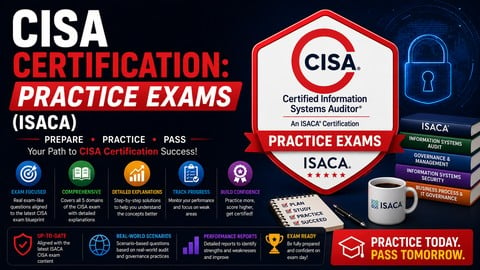
Master IT audit, control, and governance with 200+ realistic practice questions aligned with CISA domains.
What You Will Learn:
- Test your readiness for the official ISACA CISA certification exam.
- Identify specific knowledge gaps in IT governance, risk management, and audit methodologies.
- Practice time management by taking full-length, scenario-based mock exams under pressure.
- Master the auditor’s mindset required to interpret complex IT compliance scenarios.
Learning Tracks: English
Note➛ Make sure your 𝐔𝐝𝐞𝐦𝐲 cart has only this course you're going to enroll it now, Remove all other courses from the 𝐔𝐝𝐞𝐦𝐲 cart before Enrolling!
Add-On Information:
- Course Overview
- Provides a comprehensive and high-fidelity simulation environment designed specifically to mirror the latest ISACA CISA exam job practice areas, ensuring a seamless transition from study materials to the actual testing interface.
- Integrates a deep-dive exploration into the five core domains of information systems auditing, ranging from the initial audit planning phases to the final reporting and follow-up activities required in professional environments.
- Offers a structured pedagogical approach that emphasizes the ISACA perspective, which often prioritizes strategic organizational alignment and risk-based decision-making over purely technical implementation details.
- Facilitates a holistic understanding of how Information Technology serves as the backbone for modern business processes, requiring a rigorous evaluation of both automated and manual control mechanisms.
- Includes detailed rationales for every correct and incorrect answer choice, allowing students to understand the underlying logic and Professional Standards that dictate the best course of action for an auditor.
- Ensures currency with contemporary IT trends, including cloud computing security, the impact of Artificial Intelligence on audit trails, and the complexities of auditing decentralized distributed ledger technologies.
- Requirements / Prerequisites
- A foundational understanding of Enterprise Architecture and the general principles of internal controls is recommended to derive the maximum utility from these advanced practice simulations.
- Candidates should ideally be familiar with the COBIT framework and the ITIL service management lifecycle, as these standards frequently inform the logic behind CISA exam questions.
- Basic knowledge of information security principles, such as the CIA Triad (Confidentiality, Integrity, Availability) and the Defense in Depth strategy, is essential for tackling domain-specific scenarios.
- While not strictly required, having access to the official CISA Review Manual serves as an excellent theoretical companion to these practical, question-based assessments.
- A commitment to rigorous self-study and a mindset geared toward Critical Thinking are necessary to navigate the nuanced distractors found in professional-level certification exams.
- Skills Covered / Tools Used
- Risk-Based Audit Planning: Developing the ability to prioritize audit resources based on the materiality of threats and the potential impact on Business Objectives.
- Governance Framework Evaluation: Assessing the effectiveness of the IT Steering Committee, organizational structures, and the alignment of IT strategies with corporate vision.
- Systems Development Life Cycle (SDLC) Oversight: Evaluating project management methodologies, including Agile, DevSecOps, and Waterfall, to ensure security is integrated at every phase.
- Business Continuity and Disaster Recovery: Testing the robustness of BCP and DRP strategies, including the calculation of Recovery Time Objectives (RTO) and Recovery Point Objectives (RPO).
- Identity and Access Management (IAM): Auditing the lifecycle of user credentials, focusing on the principle of Least Privilege and the implementation of Multi-Factor Authentication (MFA).
- Network Infrastructure Auditing: Assessing the security of routers, switches, firewalls, and Intrusion Detection Systems (IDS) to ensure the perimeter remains resilient against external threats.
- Evidence Collection Procedures: Mastering the techniques for gathering reliable, relevant, and sufficient evidence through CAATs (Computer-Assisted Audit Techniques) and physical inspections.
- Benefits / Outcomes
- Achieve a state of Professional Readiness by simulating the mental stamina required to remain focused throughout the rigorous four-hour official ISACA examination window.
- Gain Global Credibility as a recognized expert capable of advising executive leadership on the nuances of IT Compliance and regulatory requirements like GDPR or HIPAA.
- Enhance your Career Trajectory by qualifying for high-level roles such as IT Audit Manager, Information Security Officer, or External Consultant within Big Four accounting firms.
- Develop a refined ability to communicate technical Vulnerabilities in a way that resonates with non-technical stakeholders, translating risk into financial and operational terms.
- Cultivate a standardized Auditing Methodology that can be applied across various industries, from financial services and healthcare to government agencies and tech startups.
- Foster a proactive approach to Cybersecurity Governance, moving beyond simple compliance to create a culture of continuous improvement and risk mitigation.
- PROS
- Current Content: Regularly updated to reflect the most recent ISACA job practice updates, ensuring you are not studying obsolete technology or outdated regulations.
- Detailed Explanations: Every question serves as a mini-lesson, breaking down the Compliance Logic and helping you avoid common traps set by examiners.
- Realistic Question Weighting: The distribution of questions across the five domains matches the official exam blueprint, providing a balanced study experience.
- Mobile Accessibility: The practice platform allows for On-the-Go Learning, making it easy to squeeze in study sessions during commutes or breaks.
- CONS
- Conceptual Focus: Because this course focuses on the CISA exam, it prioritizes theoretical auditing frameworks over hands-on technical configuration or deep-level coding forensics.