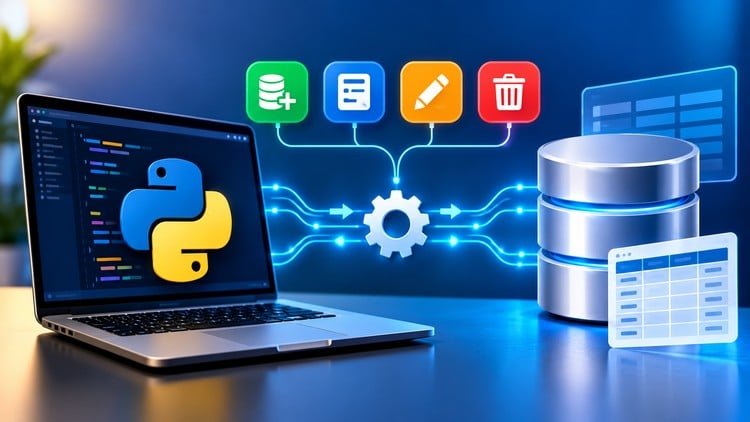
Learn Python Database Connectivity with SQLite, SQL, CRUD Operations, Transactions, Exception & Real-World Projects
What You Will Learn:
- • Understand the fundamentals of Python Database Connectivity
- • Connect Python applications with SQLite databases
- • Use Python’s built-in sqlite3 module
- • Create databases and tables using Python
- • Insert records into database tables
- • Retrieve data using SQL SELECT queries
- • Use fetchone(), fetchmany(), and fetchall()
- • Update existing database records using Python
- Show more
The Reality of Moving Beyond Simple Scripting
Let’s be honest: you can write the most elegant Python logic in the world, but if your data disappears the moment you close your terminal, you aren’t building a product—you’re just running a calculation. In my years in the industry, the biggest “level up” for any junior developer is the transition from volatile memory to persistent storage. This course on Python Database Connectivity focuses on exactly that pivot point. It takes the mystery out of the “plumbing” that connects your application logic to a disk-based storage system.
What I find refreshing about this specific curriculum is that it doesn’t hide behind heavy abstractions like Django’s ORM or SQLAlchemy right away. Instead, it forces you to get your hands dirty with the sqlite3 module. Understanding the raw communication between Python and a database is a job-ready skill that differentiates a “coder” from a “software engineer.” This course provides that foundational layer, showing you how to manage the lifecycle of a connection and how to handle the nuances of data types between two very different environments.
Prerequisites for Success
You don’t need to be a senior architect to take this on, but you shouldn’t be a total “Day 1” beginner either. You need a solid grasp of Python fundamentals—things like lists, dictionaries, and especially exception handling (try/except blocks), because databases love to throw errors when you least expect it. A basic understanding of what a table is will help, but the course is generous enough to walk you through the SQL basics needed to survive. If you know how to write a function and pass arguments, you’re ready to start these hands-on labs.
Essential Skills & Industry-Standard Tools
The course centers on SQLite, which is the industry-standard tool for local storage, mobile apps, and prototyping. Because SQLite is serverless and built directly into Python, the friction to start is near zero. You’ll master the full CRUD (Create, Read, Update, Delete) lifecycle, which is the bread and butter of any backend role.
Key technical skills you’ll walk away with include:
- Database Schema Design: Learning how to structure tables so they don’t become a tangled mess later.
- SQL Query Optimization: Writing SELECT statements that don’t crawl when the data grows.
- Python-to-SQL Mapping: Using the cursor object effectively to execute commands and fetch results using fetchone() and fetchall().
- Transaction Management: Understanding commit() and rollback() so you don’t corrupt your data mid-operation.
Career Benefits & Job Roles
Mastering database connectivity is a non-negotiable step for career growth in the tech sector. Whether you are aiming for certification prep or just trying to build a portfolio piece, this knowledge is a prerequisite for roles like Backend Developer, Data Engineer, and Automation Specialist.
In a professional setting, we rarely work with “mock data.” We work with live, breathing databases. Being able to prove you can securely connect, query, and update records is what makes you a job-ready candidate. If you’re looking to move from beginner to advanced, you have to bridge the gap between “code that runs” and “code that persists.” This course acts as that bridge, giving you the confidence to talk about data persistence during technical interviews.
Why This Course Works (The Pros)
- Zero-Config Environment: Using SQLite means you don’t have to spend three hours configuring a local server or managing Docker containers just to write your first INSERT statement. You hit the ground running.
- Deep Dive into Exception Handling: Most tutorials assume everything goes right. This course acknowledges that database connections fail, keys collide, and types mismatch. Learning to handle DatabaseError properly is a vital real-world project skill.
- Focus on the Cursor: The course does a great job explaining the “Cursor” object. Many beginners find this concept abstract, but the hands-on labs clarify how it acts as the pointer between your Python environment and the database engine.
The Honest Truth (The Cons)
If I have one critique, it’s that the course stays strictly within the realm of SQLite. While this is perfect for learning the ropes, the real world often uses PostgreSQL or MySQL for high-concurrency applications. While 90% of the logic carries over, you’ll eventually need to learn about connection pooling and specific drivers like psycopg2 for enterprise-scale real-world projects. Treat this course as the perfect starting line, but know that the race continues into more complex server-client architectures.