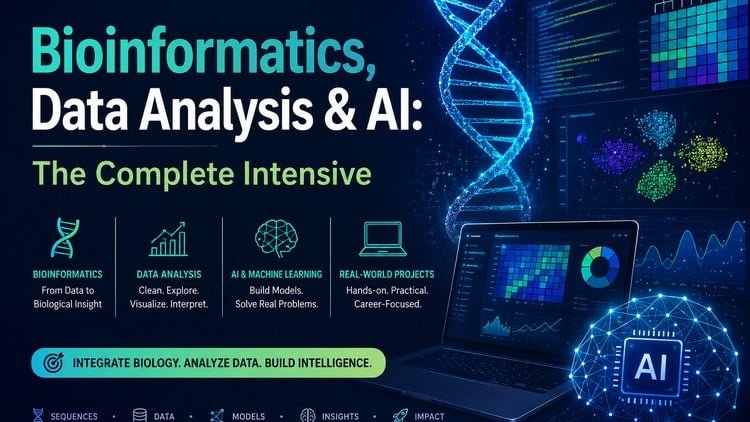
Master genomic sequencing, RNA-seq, machine learning, and 1D CNNs with 60 exam-ready practice questions, 26 interactive
What You Will Learn:
- Clean, wrangle, and analyze real biological and clinical datasets using Python, pandas, and core statistical methods
- Build a working sequence alignment and variant-calling pipeline using BLAST, BWA, and samtools on real genomic data
- Use AI tools responsibly in scientific work — verifying outputs and catching hallucinated citations or subtly wrong code.
- Train and validate machine learning and deep learning models on gene expression and DNA sequence data without overfitting.
The Reality of the “Wet Lab to Dry Lab” Transition
Let’s be honest: the days when a biologist could get away with just knowing how to pipet are long gone. If you aren’t comfortable in a terminal or a Jupyter notebook, you’re essentially leaving half your data on the table. I’ve seen plenty of “Intro to Bioinformatics” courses that are basically just fancy biology lectures, but this Bioinformatics, Data Analysis & AI curriculum is a different beast entirely. It’s designed for those of us who want to get our hands dirty with real-world projects rather than just memorizing the structure of a nucleotide. What caught my eye immediately was the focus on the intersection of high-throughput sequencing and deep learning—specifically using 1D CNNs for genomic patterns. That’s not “intro” stuff; that’s the actual industry-standard tools stack used in modern drug discovery and clinical diagnostics.
The course takes a pragmatic approach to the “AI hype.” Instead of just throwing a library at you and telling you to “predict the outcome,” it forces you to think about responsible AI. In a field like genomics, where a “hallucinated” result could literally misguide a clinical trial, learning how to verify LLM-generated code and spot fake citations is a job-ready skill that most bootcamps completely ignore. This is a course for people who want to actually build pipelines, not just talk about them.
Who Should Actually Sign Up? (Prerequisites)
While the course claims to take you from beginner to advanced, I’d suggest having at least a baseline comfort with logic. You don’t need to be a software engineer, but if you’ve never seen a Python script before, you’ll want to do a quick weekend crash course on syntax first. On the biology side, a basic understanding of the Central Dogma (DNA to RNA to Protein) is essential. The course does the heavy lifting of teaching you the data science, but it assumes you know why a variant-calling pipeline matters in the first place. It’s the perfect bridge for a wet-lab scientist looking to move into a dry-lab role or a data scientist trying to pivot into the biotech sector.
The Toolkit: Industry-Standard Software
This isn’t a “point-and-click” interface course. You are going to be working in the trenches with the same tools used at Broad Institute or Illumina. The curriculum focuses on:
- Python & Pandas: The bread and butter for data wrangling and cleaning messy clinical datasets.
- BLAST, BWA, & Samtools: The “holy trinity” for building a genomic sequencing pipeline from scratch.
- Scikit-learn & TensorFlow: For training machine learning models that actually generalize to new data without overfitting.
- 1D Convolutional Neural Networks (CNNs): Specifically applied to DNA sequence data, which is where the real career growth is happening right now.
Career Benefits & Job Roles
If you’re looking for certification prep that actually holds weight during a technical interview, the 60 exam-ready practice questions here are a massive help. They don’t just test definitions; they test your ability to troubleshoot a failing RNA-seq analysis. Completing this course puts you in the running for roles like Bioinformatics Scientist, Computational Biologist, or Genomic Data Analyst. We are seeing a massive surge in AI-driven drug discovery startups, and they are desperate for people who understand both the biological context and the machine learning mechanics. Having a hands-on labs portfolio showing you can build a variant-calling pipeline is basically your ticket past the HR filter.
Why This Course Works (The Pros)
- Real-World Data: You aren’t working with “perfect” classroom datasets. You’re dealing with the noise, missing values, and weird formatting of real biological data. This is where the actual learning happens.
- AI Literacy: The module on responsible AI is a game-changer. Teaching students to catch “subtly wrong” AI-generated code is a brilliant bit of hands-on instruction that I haven’t seen elsewhere.
- The 1D CNN Deep Dive: Most AI courses focus on images (2D). Applying 1D CNNs to gene expression is a niche, high-value skill that makes your resume stand out in a sea of generic data scientists.
The Honest Truth (The Cons)
The pace is intensive. This isn’t a course you can “Netflix and chill” in the background. If you don’t stay on top of the interactive labs, the complexity of the deep learning modules can feel like a vertical climb. It requires a serious time commitment—expect to spend at least 10-15 hours a week if you really want to master the computational biology pipelines rather than just skimming the surface.