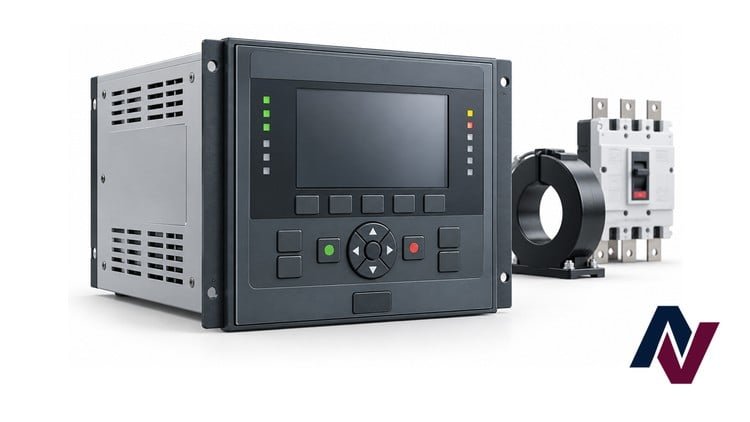
Understand protective relaying for electrical power systems from principles and settings to testing and troubleshooting
What You Will Learn:
- Explain how protective relaying detects faults, isolates affected equipment, and supports selective, reliable power-system operation.
- Analyze power-system faults, grounding methods, sequence quantities, and fault-current behavior for protection applications.
- Interpret protection zones, primary and backup schemes, redundancy, and standards to define dependable protection coverage.
- Evaluate CTs, VTs, DC systems, trip circuits, relay logic, and schematics for correct protection-system operation.
- Apply overcurrent, earth-fault, directional, differential, distance, voltage, frequency, and related relay functions appropriately.
- Select suitable protection schemes for feeders, lines, transformers, generators, motors, busbars, and other station equipment.
- Show more
Alright, let’s talk about the ‘Protective Relaying: Principles and Applications’ course. As someone who’s been in the trenches of power systems for a good while now, I’ve seen my fair share of courses, and this one is a solid contender for anyone looking to truly understand the backbone of grid reliability. It’s not just about memorizing settings; it’s about grasping the ‘why’ behind the ‘how,’ which is crucial for genuine expertise.
Overview
This course dives deep into the nitty-gritty of protective relaying, and I mean deep. It’s not a fluff piece. They really push you to understand the fundamental physics of what’s happening during a fault – from the initial disturbance to how the relay eventually isolates it. What impressed me was the consistent emphasis on the interplay between different components. They don’t just teach you about relays in isolation; they meticulously connect them to instrument transformers (CTs and VTs), DC systems, and even the physical wiring of trip circuits. This holistic approach is what separates a good relay technician from a truly valuable engineer. It’s about seeing the entire puzzle, not just individual pieces.
Prerequisites
You’re not going to walk into this blind. This course assumes a foundational understanding of electrical engineering principles, particularly AC circuit analysis, Ohm’s Law, and basic power system concepts like voltage, current, and impedance. A grasp of three-phase systems is pretty much a must-have. If you’re still figuring out what a phasor diagram is, you might want to brush up on that first. Think of it as needing solid high-school math before tackling calculus; you need the basics before you can build on them.
Skills & Tools
This is where the course really shines for building job-ready skills. You’ll walk away with a solid understanding of how to interpret complex protection schemes, which is vital for troubleshooting in the field. The course covers a wide array of relay functions – overcurrent, distance, differential, directional, you name it. They also touch on applying these to various equipment like transformers and generators, which is essential for a well-rounded understanding. While the course itself is theoretical, it lays the groundwork for using industry-standard tools like relay test sets (think Omicron, Megger) and modern digital relay configuration software. You’ll gain the theoretical knowledge needed to actually use these tools effectively, rather than just pushing buttons.
Career Benefits & Job Roles
For anyone aiming for career growth in the power utility sector, substations, or industrial power systems, this course is a no-brainer. It’s practically certification prep for roles like Relay Technician, Protection Engineer, or System Protection Specialist. The knowledge gained is directly applicable to maintaining grid stability, reducing downtime, and ensuring safety. If you’re looking to move up the ladder, mastering protective relaying is a key step. It opens doors to more complex, higher-paying roles that require a deep understanding of system integrity.
Pros
- Comprehensive Coverage: This course doesn’t shy away from the tough stuff. It covers a vast range of relaying principles and applications, from basic fault analysis to advanced schemes, giving you a truly thorough understanding.
- Practical Application Focus: While it’s theory-heavy, the course is always driving towards practical application. You’ll learn how these principles translate into real-world protection designs and settings.
- Foundation for Advanced Learning: It builds a rock-solid foundation that makes understanding more niche or advanced topics in power system protection much more accessible. It’s a great stepping stone for anyone pursuing further specialized knowledge or certifications.
Cons
My main critique, and it’s an honest one, is that while the course gives you the principles and applications, you really need to supplement it with hands-on labs or real-world experience to fully cement the skills. The schematics and theory are excellent, but physically interacting with relays, wiring them up, and performing tests is where the true mastery happens. Without that practical component, you’re only getting half the picture, and that initial learning curve with actual hardware can be steeper than you’d anticipate based on the course material alone.