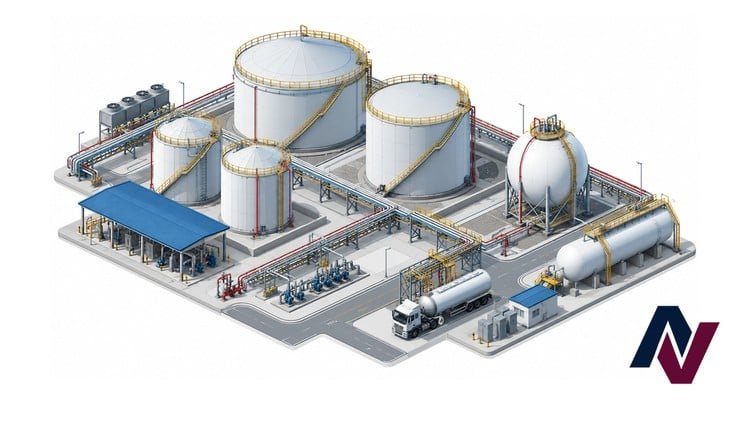
Understand how industrial storage tanks are selected, designed, built, operated, inspected, maintained, and repaired.
What You Will Learn:
- Explain storage tank functions, classifications, operating limits, lifecycle stages, hazards, and performance requirements.
- Interpret product properties, capacity, pressure, temperature, and operating levels as key inputs to storage decisions.
- Identify major tank types and evaluate their operating principles, service suitability, limitations, and failure risks.
- Interpret major tank codes and standards and determine their applicability to design, operation, inspection, and repair.
- Explain the functions, load paths, interfaces, and common vulnerabilities of tank shells, bottoms, roofs, openings, and access systems.
- Evaluate design inputs to select suitable tank types, dimensions, materials, foundations, anchorage, venting, and containment.
- Show more
Alright, let’s dive into the ‘Industrial Storage Tanks: Design, Operation & Maintenance’ course. As someone who’s spent more than a few late nights staring at P&IDs and worrying about shell integrity, I was genuinely curious about what this course had to offer. It promises a holistic view, from the napkin sketch to the final demolition, and frankly, in the world of process industries, understanding the full lifecycle of a storage tank is non-negotiable. This isn’t just about theory; it’s about keeping things running safely and efficiently, which translates directly to bottom-line impact.
Overview
What really sets this course apart, in my book, is its commitment to the entire lifecycle. So many courses focus on just the design phase, or perhaps just on maintenance. This one bridges that gap admirably. It doesn’t just tell you *what* a tank is, but *why* it’s designed that way, *how* it’s supposed to perform under various conditions, and crucially, *what can go wrong* and how to prevent it. We’re talking about everything from material selection based on product properties (corrosivity, flammability – the usual suspects) to understanding the intricacies of foundation design and the critical importance of proper venting. The way they break down the components – shells, bottoms, roofs, even those often-overlooked openings – is detailed enough to give you a real appreciation for the engineering involved. It feels like they’re preparing you for the real challenges, not just a multiple-choice exam. If you’re aiming for certification prep, this course lays a solid groundwork.
Prerequisites
Honestly, you don’t need to be a seasoned tank engineer to walk into this. If you’ve got a decent grasp of basic engineering principles – think thermodynamics, fluid mechanics, and a general understanding of material science – you’ll be in good shape. A bit of familiarity with the process industries is helpful, but the course does a good job of explaining the context for those new to the field. Think of it as building on a foundation of general engineering knowledge.
Skills & Tools
This is where the rubber meets the road. You’ll come away with a solid understanding of how to interpret product properties and translate them into tank specifications. The course covers key operating parameters like capacity, pressure, and temperature, and how they dictate design choices. You’ll learn to navigate major tank codes and standards (think API 650, AWWA D100 – if you’re serious about this field, these are your bibles), which is crucial for compliance and safety. They emphasize evaluating operating principles and limitations of different tank types, which is vital for selecting the right equipment for the job. The insights into common vulnerabilities and load paths for various tank components are particularly valuable. While I didn’t see explicit mentions of specific industry-standard tools for modeling or simulation, the conceptual understanding of design principles is strong. If this course incorporated more hands-on labs or case studies using common software, it would be even stronger.
Career Benefits & Job Roles
This course is a fantastic springboard for anyone looking to specialize in asset integrity, mechanical engineering, or operations within the chemical, oil & gas, petrochemical, or water/wastewater sectors. The knowledge gained directly translates to roles like Storage Tank Inspector, Reliability Engineer, Mechanical Integrity Specialist, or even Project Engineer involved in tank farm development. The emphasis on the full lifecycle, including inspection and maintenance, makes you a more well-rounded candidate, ready to tackle a broader range of responsibilities. This is the kind of training that can accelerate your career growth by providing you with practical, in-demand skills.
Pros
- Comprehensive Lifecycle Coverage: The course excels at covering the entire journey of an industrial storage tank, from initial concept and design through operation, inspection, and maintenance. This holistic approach is invaluable for true understanding.
- Emphasis on Codes and Standards: A significant portion dedicated to interpreting and applying industry codes is a major plus for anyone working in regulated environments.
- Practical Application of Concepts: The course does a great job of explaining *why* things are designed a certain way and the practical implications of various operating parameters and material properties.
Cons
My one honest critique is that while the course covers the principles of design and operation extremely well, I would have loved to see more explicit integration of modern real-world projects or specific job-ready skills related to advanced inspection techniques or digital maintenance platforms. While the theoretical foundation is excellent, a bit more exposure to the cutting-edge tools and methodologies used in the field today would have elevated it from great to exceptional.