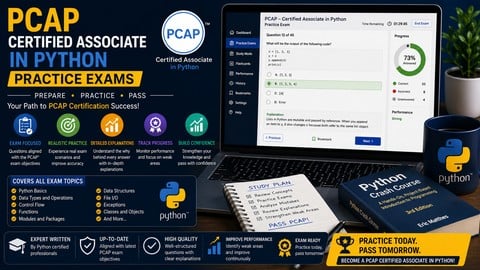
Assess your coding knowledge and pass the official Python Institute PCAP-31-03 exam with highly realistic mock tests.
What You Will Learn:
- Test your readiness for the official Python Institute PCAP-31-03 certification exam.
- Identify specific knowledge gaps in Python syntax, loops, data structures, and OOP concepts.
- Practice reading and debugging Python code snippets under strict exam time constraints.
- Learn from your mistakes through in-depth, technical explanations for every code output.
Learning Tracks: English
Note➛ Make sure your 𝐔𝐝𝐞𝐦𝐲 cart has only this course you're going to enroll it now, Remove all other courses from the 𝐔𝐝𝐞𝐦𝐲 cart before Enrolling!
Add-On Information:
- Course Overview
- Experience a comprehensive architectural breakdown of the PCAP-31-03 syllabus through a series of strategically engineered mock simulations that mirror the actual testing environment. This course is designed as a rigorous final checkpoint for candidates, offering a variety of question formats including multiple-choice, single-choice, and drag-and-drop scenarios. Each practice set is calibrated to match the Python Institute difficulty curve, ensuring that learners are exposed to the “trick” questions and subtle logic puzzles that often appear in the official exam. The curriculum focuses on the heuristic evaluation of code, forcing students to think like a Python interpreter. By simulating the high-pressure atmosphere of a Pearson VUE testing center, the course helps in building the psychological stamina required to maintain focus over the 65-minute duration. The structure avoids simple memorization, instead prioritizing the deductive reasoning necessary to solve complex problems involving multifaceted Python libraries and core language features. Every assessment set serves as a diagnostic instrument, providing a granular report on your performance across the four major domains: Control and Evaluations, Data Aggregates, Functions and Modules, and Classes and Objects.
- Requirements / Prerequisites
- Candidates should possess a functional understanding of Python 3.x syntax and basic programming logic, as these exams are intended for those who have already completed an introductory study phase. A baseline familiarity with computational thinking and the ability to trace code execution manually is essential for navigating the complex logic puzzles presented. There is no requirement for high-end hardware; any device capable of running a modern web browser is sufficient to access the testing platform. Prospective students should be prepared for independent study and have the mental discipline to review technical documentation when faced with incorrect answers. While not mandatory, having a Python IDE (like PyCharm or VS Code) or the IDLE environment installed on your local machine is recommended to verify the code snippets and experiment with the logic explained in the feedback sections. A prerequisite mindset of curiosity and persistence is vital, as the practice exams are designed to challenge even those who feel confident in their coding abilities.
- Skills Covered / Tools Used
- This course delves into advanced Package Management, teaching you how to navigate the internal structure of modules and the nuances of the
importstatement variations. You will master the Method Resolution Order (MRO) and the intricacies of inheritance, including how Python handles multiple parent classes and private attributes. The practice sets cover the Standard Library in depth, specifically focusing on themath,random,platform, andsysmodules. You will gain proficiency in Exception Hierarchy, learning to distinguish betweenTypeError,ValueError, and custom-defined exceptions. The course also explores String Manipulation using various methods and the File I/O lifecycle, including the differences between text and binary modes. Special attention is given to Lambda functions, map-filter-reduce patterns, and the behavioral differences between generators and list comprehensions. Furthermore, you will refine your ability to interpret Bitwise operators and the complex interactions between different data types during implicit and explicit type casting. - Benefits / Outcomes
- Upon completion, you will have developed a high level of cognitive endurance, enabling you to parse and debug complex code blocks quickly and accurately. The primary outcome is a significant reduction in test anxiety, as the familiarity with the question phrasing and exam interface provides a sense of calm during the actual certification attempt. Beyond the certificate, this course builds professional credibility, ensuring that you can speak the language of Python experts and understand the “under-the-hood” mechanics of the language. You will emerge with a refined technical portfolio, as the knowledge gained here directly translates to writing cleaner, more efficient, and more PEP 8-compliant code in a professional setting. The course fosters a metacognitive approach to learning, where you not only learn the right answers but also understand the specific logical fallacies that lead to common programming errors. This makes you a more valuable asset to development teams, as you will be better equipped to conduct peer code reviews and troubleshoot production-level bugs.
- PROS
- The course offers unlimited retakes, allowing you to refine your knowledge until you achieve a perfect score on every simulation.
- Explanations include visual code traces and logical breakdowns that bridge the gap between theory and practical execution.
- The question bank is continuously updated to reflect the latest changes and trends in the official PCAP-31-03 exam guidelines.
- Mobile-friendly access enables you to practice and review key Python concepts during your commute or in short bursts of free time.
- CONS
- This is a practice-centric resource and does not include traditional video lectures or a “zero-to-hero” teaching style for absolute beginners.