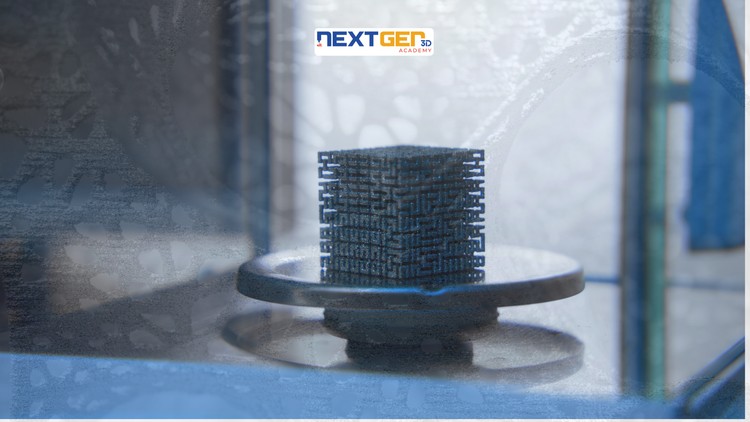
Master MJF technology, materials, design, post-processing, applications, and cost analysis for professional 3D printing.
What You Will Learn:
- Explain how HP Multi Jet Fusion works and how it differs from SLS and FDM
- Configure the MJF workflow from pre-processing to post-processing for quality parts
- Select appropriate MJF materials based on mechanical and application requirements
- Apply design guidelines for wall thickness, features, tolerances, and orientation
- Plan and execute effective post-processing, finishing, coloring, and assembly steps
- Evaluate applications and industry use cases suitable for MJF production
- Analyze total cost of ownership, part cost, and ROI for MJF investments
- Compare service bureau versus in-house MJF production for your business
Overview: Bridging the Gap Between Prototyping and Production
If you’ve been in the additive manufacturing space for more than five minutes, you know the frustration of “the wall.” You design something brilliant on an FDM machine, but it lacks the isotropic strength for functional use, or you try SLS, but the lead times and surface finish don’t quite hit the mark for end-use consumer goods. Enter the Multi Jet Fusion (MJF) 3D Printing Masterclass. After spending a decade navigating the hype cycles of 3D printing, I can tell you that this course isn’t just another “how-to” manual—it’s a deep dive into the technology that is finally making bridge manufacturing a reality for the average engineering firm.
What I appreciated most about this masterclass is that it doesn’t treat MJF as a vacuum. It treats it as a business decision. The course moves quickly past the “cool factor” of HP’s voxel-level control and gets straight into the grit of industrial-grade production. We’re talking about moving from a beginner to advanced understanding of how powder bed fusion actually scales. The instructor doesn’t just show you how to hit “print”; they force you to think about the thermal management of the build volume and how nesting density affects your bottom line. It’s an opinionated, no-fluff look at why you’d choose a 4200 or 5200 series machine over a fleet of hobbyist printers, and more importantly, when you shouldn’t.
The curriculum is heavily weighted toward real-world projects, which is a breath of fresh air. Instead of printing calibration cubes, you’re looking at topological optimization for automotive brackets and pressurized housings. It’s about career growth in a world where “additive engineer” is becoming a standard title at Fortune 500 companies. If you’re looking to move beyond “tinkering” and into a role where you’re managing a digital factory, this is the blueprint.
Prerequisites
- Foundational CAD Knowledge: You should be comfortable with industry-standard tools like Fusion 360, SolidWorks, or nTop. You don’t need to be an expert, but you need to understand parametric design.
- Basic Additive Awareness: A baseline understanding of 3D printing (FDM or Resin) is helpful to appreciate the leap in complexity MJF offers.
- Mechanical Aptitude: Understanding material properties (tensile strength, elongation at break) will make the materials selection modules much more impactful.
Skills & Tools You’ll Master
- HP SmartStream Build Manager: Deep-dive training on the software that dictates your nesting efficiency and part quality.
- DFAM (Design for Additive Manufacturing): Learning the specific constraints of MJF, such as powder evacuation holes and wall thickness optimization.
- Post-Processing Equipment: Hands-on labs (virtual and video-guided) covering the Processing Station, bead blasting, and automated dyeing solutions like Dyemansion.
- Cost Estimation Models: Mastering the total cost of ownership—calculating refresh rates, agent usage, and labor costs per part.
- Quality Control: Using 3D scanning and metrology to verify tolerances against your original digital twin.
Career Benefits & Job Roles
Completing this masterclass is essentially certification prep for the next generation of manufacturing. The industry is starving for people who don’t just know how to print, but who understand the ROI for MJF investments. Having this on your resume signals that you’re job-ready for high-stakes environments. Potential roles include:
- Additive Manufacturing Engineer: Leading the transition from CNC or injection molding to 3D production.
- Production Manager: Overseeing a fleet of MJF machines in a service bureau or in-house facility.
- Application Engineer: Consulting with clients to determine if their parts are candidates for MJF based on mechanical requirements.
- Product Designer: Specialized in high-performance polymers and complex geometries that traditional manufacturing can’t touch.
Pros
- Focus on Isotropic Properties: The course does a stellar job explaining why MJF parts are functionally superior to FDM in terms of Z-axis strength, which is vital for functional prototyping.
- Economic Realism: It doesn’t shy away from the high entry cost. The section on service bureau versus in-house production is worth the price of admission alone for business owners.
- Advanced Nesting Strategies: You’ll learn how to maximize your “pack” to drive down part cost, a skill that separates the pros from the amateurs.
- End-to-End Workflow: It covers the “boring” stuff that actually matters—like powder management and post-processing—which most courses skip.
Cons
- The “HP Ecosystem” Bias: Since MJF is HP’s proprietary tech, the course can sometimes feel like a high-level manual for HP hardware. While the design guidelines are universal for powder bed fusion, you won’t get much insight into competing technologies like SLS unless it’s for comparison purposes.