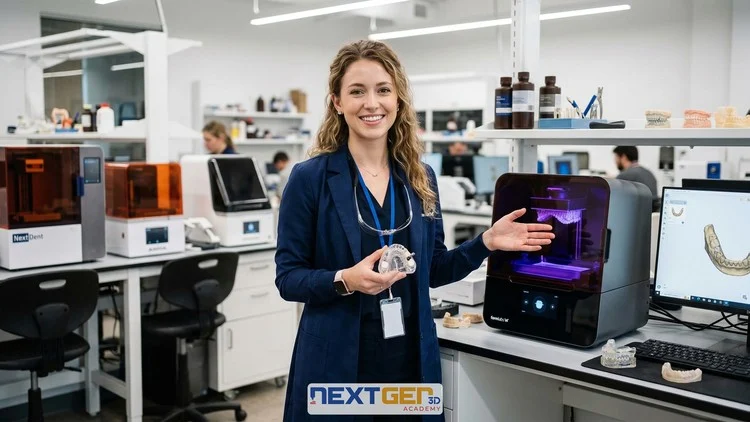
3D Printing in Dentistry: Complete Digital Workflow from Scan to Clinical Applications – Future
⏱️ Length: 2.6 total hours
👥 9 students
Add-On Information:
Note➛ Make sure your 𝐔𝐝𝐞𝐦𝐲 cart has only this course you're going to enroll it now, Remove all other courses from the 𝐔𝐝𝐞𝐦𝐲 cart before Enrolling!
- Course Overview
- This forward-looking course, ‘Application of 3D Printing Technology in Dentistry (2030)’, is meticulously designed to immerse dental professionals in the revolutionary capabilities of additive manufacturing, positioning them at the forefront of digital dentistry by the end of the decade.
- Beyond foundational knowledge, this program delves into the strategic implementation and profound impact of 3D printing on daily dental practice, showcasing its potential to redefine treatment planning, patient care, and clinical outcomes.
- Participants will explore how 3D printing facilitates a paradigm shift from conventional methods to highly personalized, precise, and efficient digital workflows, preparing them to seamlessly integrate these advanced technologies into their clinics or laboratories.
- Focusing on practical application, the course demystifies the integration process, offering a clear roadmap for leveraging this transformative technology to address complex dental challenges and enhance overall patient experience.
- Discover how to not just adapt, but to innovate within the evolving landscape of dental medicine, embracing a future where custom-fabricated devices are the standard, not the exception.
- Requirements / Prerequisites
- A foundational understanding of basic dental anatomy, terminology, and clinical procedures is essential to grasp the contextual applications of the technology.
- Participants should possess general computer literacy and be comfortable navigating digital environments, as the course extensively involves software interaction and digital file management.
- While no prior expertise in additive manufacturing or 3D design software is required, an enthusiastic interest in adopting innovative digital technologies and an analytical mindset will significantly enhance the learning experience.
- Access to a stable internet connection and a computer capable of running basic software applications will be necessary for engaging with course materials and simulated exercises.
- An openness to embrace digital transformation and explore cutting-edge solutions for modern dental challenges is key for maximizing the benefits of this specialized training.
- Skills Covered / Tools Used
- Skills Covered:
- Mastering the design and customization of intricate patient-specific surgical guides, ensuring unparalleled precision in implantology and other surgical interventions.
- Developing proficiency in creating complex orthodontic appliances, occlusal splints, and temporary restorative components using advanced digital modeling techniques.
- Acquiring expertise in optimizing digital models (STL files) for maximum print accuracy, surface finish, and structural integrity, crucial for clinical reliability.
- Implementing robust data management protocols for secure storage, retrieval, and sharing of digital patient impressions and printed models, adhering to privacy regulations.
- Navigating the evolving regulatory frameworks and compliance standards pertinent to the in-house manufacturing of medical devices through 3D printing.
- Formulating efficient in-house manufacturing workflows, from digital file preparation to post-processing, minimizing waste and maximizing throughput.
- Troubleshooting common printing artifacts and failures, developing systematic approaches to diagnose and resolve issues for consistent quality output.
- Evaluating and selecting appropriate post-processing techniques, including washing, curing, and finishing, specifically tailored for various dental resin applications.
- Strategically assessing the integration of 3D printing data with existing practice management and patient communication software for a holistic digital ecosystem.
- Developing strategies for communicating the benefits and processes of 3D printed solutions to patients, enhancing trust and understanding.
- Tools Used (Conceptual/Categories):
- Specialized dental CAD (Computer-Aided Design) software platforms for designing custom prosthetics, orthodontic models, and surgical templates.
- Advanced slicing engines and print preparation software to convert 3D models into printer-readable instructions, optimizing build orientation and support structures.
- Digital calibration tools and measurement software for ensuring dimensional accuracy of printed objects relative to digital designs.
- Various dental-specific resin materials, understanding their properties, handling, and application for different clinical needs (e.g., biocompatible resins, castable resins).
- Automated post-processing units, including ultrasonic cleaners or IPA wash stations, and high-intensity UV light curing chambers for material polymerization.
- Digital project management tools and secure cloud storage solutions for collaborative design and workflow coordination.
- Basic hand tools for support removal and initial finishing of printed parts, ensuring smooth surfaces and precise fits.
- Quality assurance instruments for verifying print accuracy and material integrity, such as digital calipers and optical comparators.
- Skills Covered:
- Benefits / Outcomes
- Elevate your clinical precision and predictability across a spectrum of dental treatments, leading to superior patient outcomes and reduced chair time.
- Streamline your laboratory and clinical workflows, significantly reducing turnaround times for custom appliances and potentially increasing patient throughput.
- Unlock new revenue streams by expanding your service offerings with in-house fabrication of specialized devices, attracting a broader patient base.
- Cultivate a reputation as a tech-forward, innovative practitioner or laboratory, setting your practice apart in an increasingly competitive dental market.
- Contribute to a more sustainable dental future by optimizing material usage and reducing waste associated with traditional manufacturing processes.
- Gain the confidence and expertise to make informed decisions regarding capital investments in 3D printing technology, ensuring a positive return on investment.
- Enhance patient satisfaction through quicker delivery of highly customized, comfortable, and aesthetically pleasing dental solutions.
- Position yourself as a thought leader in digital dentistry, ready to adapt to future technological advancements and lead practice innovation.
- PROS
- Small Class Size: The limited student count of 9 ensures personalized attention and an optimal interactive learning environment.
- Future-Proofing Curriculum: Specifically designed to equip professionals for dentistry in 2030, offering highly relevant, forward-thinking skills.
- Direct Applicability: Focuses on immediate, practical integration of advanced technology into real-world dental practice.
- Comprehensive Yet Concise: Delivers a full digital workflow understanding in a manageable 2.6 hours, respecting busy professional schedules.
- Competitive Edge: Provides a unique skill set that significantly enhances marketability and practice capabilities in an evolving industry.
- CONS
- The rapid pace of technological advancements in 3D printing necessitates continuous self-learning and updates beyond the course duration to stay at the absolute forefront.
Learning Tracks: English,Design,3D & Animation
Found It Free? Share It Fast!