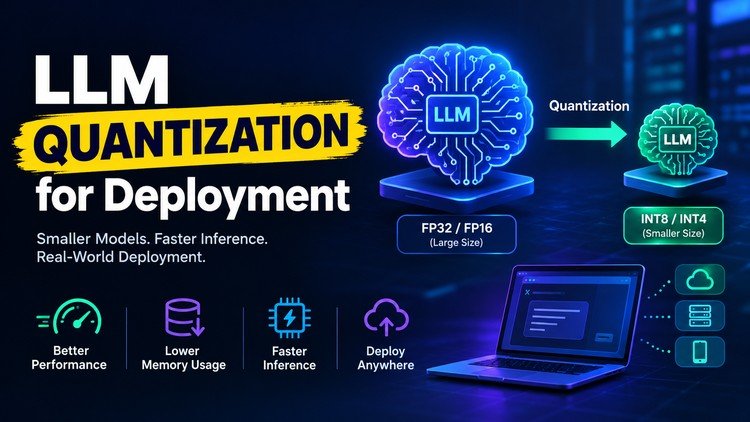
Master GPTQ, AWQ, GGUF, precision formats, calibration & deployment with 600 practice questions
What You Will Learn:
- Explain core quantization concepts — bit width, calibration, PTQ vs QAT — and how each affects a model’s size, speed, and accuracy.
- Compare quantization techniques like GPTQ, AWQ, and GGUF, and numerical formats like INT8, INT4, FP16, and BF16 to choose the right fit.
- Design an effective calibration strategy and apply quantization-aware training to recover accuracy lost during precision reduction.
- Deploy a quantized model with frameworks like vLLM and llama.cpp, then evaluate it using standardized benchmarks and bias audits.
Overview
In the burgeoning world of large language models, the mantra often seems to be “bigger is better.” But anyone who’s tried to deploy a gargantuan LLM knows the cold, hard truth: bigger is also more expensive, slower, and a massive drain on GPU resources. That’s where ‘LLM Quantization for Deployment’ steps in, acting as a crucial survival guide in the wild west of LLM inference. This isn’t just another theoretical ML course; it’s a deeply practical deep dive into how to make these beasts perform efficiently without breaking the bank or your patience. The course provides a rigorous framework for understanding the trade-offs involved in reducing model size and computational cost, ensuring that you can actually get your LLMs off the research bench and into production. It addresses a critical industry need, equipping you with the know-how to solve real-world bottlenecks in LLM inference, memory footprint, and latency. If you’ve been grappling with how to scale your LLM applications, this course offers genuine, actionable solutions.
Prerequisites
While the course covers foundational concepts, I wouldn’t recommend it for someone just starting their machine learning journey. To truly thrive, you’ll need a solid grasp of Python programming, particularly with data structures and object-oriented concepts. Familiarity with core deep learning concepts – neural networks, transformers, and training loops – is essential. Ideally, you should have some hands-on experience with a deep learning framework like PyTorch (though TensorFlow users will still benefit from the concepts). A basic understanding of how LLMs work under the hood, even conceptually, will also be a major advantage. Think of it as moving from understanding *what* LLMs do to understanding *how* to optimize them for practical use cases.
Skills & Tools
By the end of this program, you’ll possess a formidable arsenal of job-ready skills and proficiency with industry-standard tools. You’ll become adept at:
- Understanding and implementing various quantization techniques, including Post-Training Quantization (PTQ) and Quantization-Aware Training (QAT).
- Mastering specific state-of-the-art quantization algorithms like GPTQ and AWQ, and the versatile GGUF format for CPU deployment.
- Working with different numerical precision formats (INT8, INT4, FP16, BF16) and strategically choosing the right one for diverse deployment scenarios.
- Designing and executing effective calibration strategies to mitigate accuracy loss during quantization.
- Deploying quantized LLMs using high-performance inference frameworks such as vLLM for GPU acceleration and llama.cpp for efficient CPU inference.
- Evaluating model performance post-quantization through standardized benchmarks and crucial bias audits, ensuring ethical and robust deployments.
Career Benefits & Job Roles
This course is a significant accelerator for anyone looking to specialize in the practical deployment of LLMs. It directly addresses the critical need for efficient AI systems, making you an invaluable asset in a field where computational resources are always at a premium. Acquiring these skills can significantly boost your career growth and open doors to specialized roles such as:
- MLOps Engineer: Focusing on optimizing and deploying LLMs at scale.
- Deep Learning Engineer: Specializing in model optimization and inference acceleration.
- AI Infrastructure Engineer: Building robust and efficient platforms for LLM services.
- Research Scientist (Applied): Bridging the gap between cutting-edge models and practical deployment.
- Data Scientist/Machine Learning Engineer: Empowering them to deploy their LLM solutions more cost-effectively and performantly.
The expertise gained here translates directly into tangible business value through reduced operational costs and improved application responsiveness, making it a compelling addition to any technical resume.
Pros
- Unparalleled Practicality & Hands-On Learning: With over 600 practice questions and a strong emphasis on real-world projects, the course goes far beyond theoretical explanations. You’re not just learning about quantization; you’re actively applying it, which is invaluable for building true competency and confidence for certification prep and job interviews.
- Comprehensive Coverage of Modern Techniques: The curriculum doesn’t just skim the surface. It meticulously covers a wide array of crucial techniques from GPTQ and AWQ to GGUF, ensuring you understand the landscape of modern LLM quantization and can select the right tool for the job. This holistic approach makes it suitable for learners looking to go from beginner to advanced in this niche.
- Direct Relevance to Industry Pain Points: The course tackles the most pressing challenges in LLM deployment head-on: memory limits, inference speed, and cost. Mastering these concepts means you’ll be equipped to deliver efficient, deployable LLM solutions, a skill set highly sought after in today’s AI-driven market.
- Focus on Deployment & Evaluation: It’s not enough to quantize; you need to deploy and verify. The inclusion of frameworks like vLLM and llama.cpp, alongside rigorous benchmarking and bias audits, provides a full lifecycle understanding, making your skills immediately applicable in a production environment.
Cons
- Steep Learning Curve for Some: While well-structured, the course moves at a significant pace and assumes a certain level of comfort with deep learning concepts and Python coding. If your foundational ML or Python skills are shaky, you might find yourself needing to pause frequently to catch up, potentially extending the overall completion time. This isn’t a flaw in the course itself, but rather a realistic expectation for learners not fully prepared for its intensity.