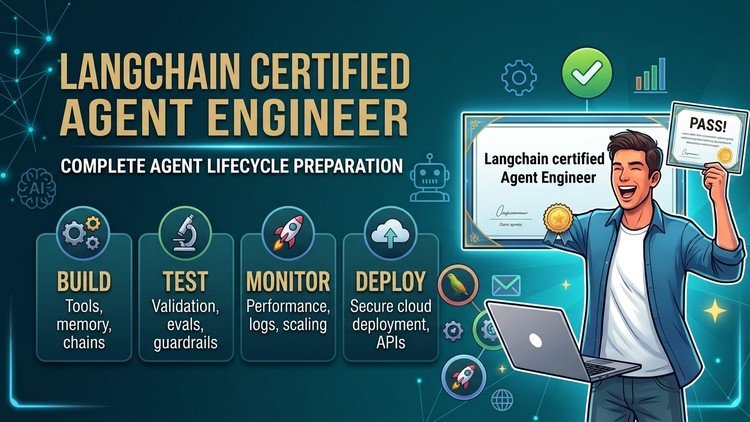
6 full-length practice exams · 240 questions for the LangChain Certified Agent Engineer (LCAE) certification
What You Will Learn:
- Sit six full-length LCAE practice exams under real conditions: 40 questions, 120 minutes, four domains weighted at 25% each.
- Pinpoint your weakest domain across Build, Test, Deploy and Monitor before you pay to sit the real certification exam.
- Practise the hands-on LangSmith questions: read error rates, cost attribution, latency and sentiment off a real traced project.
- Trace every answer back to the official LangChain, LangGraph and LangSmith documentation page it came from.
- Recognise select-all-that-apply traps and the wording patterns the certification uses to distinguish similar concepts.
- Build exam stamina by repeating full 40-question sittings rather than drilling isolated questions.
Overview
Alright, let’s talk about the LangChain Certified Agent Engineer (LCAE) certification prep. As someone who’s been in the trenches with LLMs and agent development for a while, I approached this with a healthy dose of skepticism and a keen eye for what actually translates into job-ready skills. This isn’t your average fluff-and-puff certification prep; it’s a focused, almost brutal, dive into the practicalities of building, testing, deploying, and monitoring LangChain agents. The emphasis on simulating real exam conditions with six full-length practice exams is a major selling point. You’re not just memorizing facts; you’re training your brain to perform under pressure, which is critical for any high-stakes tech assessment.
What really impressed me was the depth of the LangSmith integration. We’re talking about analyzing real traced projects, not hypothetical scenarios. Being able to pull out metrics like error rates, cost attribution, and latency directly from a traced run is the kind of hands-on experience that truly solidifies understanding. This isn’t just about understanding theory; it’s about mastering the industry-standard tools that power modern agent development. The inclusion of direct links back to official documentation for every answer is a godsend for those who want to go beyond just passing the exam and actually gain a deep, foundational knowledge.
Prerequisites
- A solid understanding of Python programming.
- Familiarity with fundamental concepts of Large Language Models (LLMs) and their applications.
- Basic knowledge of software development lifecycle concepts (build, test, deploy, monitor).
- While not strictly required, prior exposure to LangChain or similar orchestration frameworks will be highly beneficial.
Skills & Tools
This certification prep is designed to hone your skills in:
- Agent Design and Development using LangChain.
- Effective Testing and Debugging of agent behavior.
- Strategies for Deploying LangChain agents into production environments.
- Monitoring and maintaining agent performance using LangSmith.
- Understanding and analyzing cost attribution and latency in LLM-powered applications.
- Recognizing and mitigating common pitfalls in LLM agent development.
The core toolset revolves around LangChain, LangGraph, and crucially, LangSmith.
Career Benefits & Job Roles
Earning the LCAE certification positions you for a variety of exciting roles in the rapidly expanding AI landscape. It’s a tangible demonstration of your ability to build and manage sophisticated AI agents. This can open doors to positions such as:
- AI Engineer
- Machine Learning Engineer
- Prompt Engineer
- LLM Application Developer
- AI Solutions Architect
In today’s competitive job market, having a certification that validates practical skills in emerging technologies like agent engineering is a significant differentiator. It signals to employers that you’re not just theory-minded, but capable of delivering tangible results, which is key for career growth.
Pros
- Unmatched Practicality: The focus on simulating real exam conditions with full-length tests and deep dives into LangSmith traces is invaluable. It moves beyond theoretical knowledge to build true, hands-on labs experience.
- Documentation-Centric Learning: Tracing every answer back to the official documentation fosters a deeper understanding and encourages good development practices, rather than just rote memorization.
- Strategic Exam Preparation: The approach of repeating full sittings rather than drilling isolated questions builds the necessary exam stamina for a challenging assessment.
- Clarity on Nuances: Explicitly addressing “select-all-that-apply” traps and wording patterns is a smart move that prepares you for the subtle but critical distinctions the certification tests.
Cons
The only real “con,” and it’s a minor one if you’re serious about this certification, is that the rigor of this prep demands a significant time commitment. This isn’t a weekend cram session; it’s a serious investment for those aiming to master agent engineering from a beginner to advanced level.