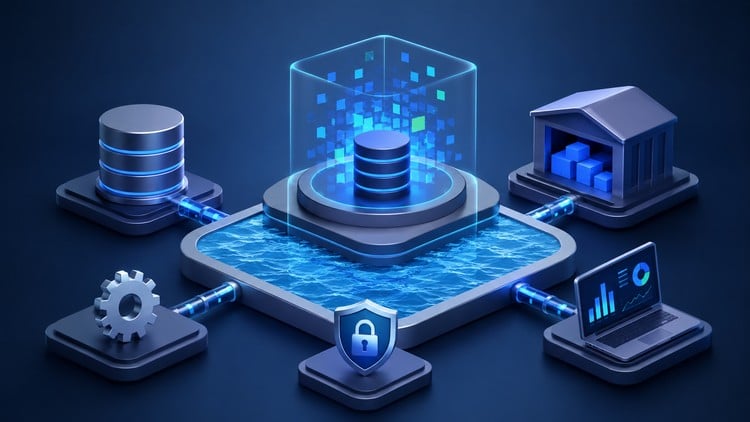
Master Delta Lake, Apache Iceberg, Data Lakes, Data Warehouses, Open Table Formats, ETL, Analytics & Governance
What You Will Learn:
- Understand Lakehouse Architecture principles and how they combine data lakes and data warehouses into a unified analytics platform.
- Design scalable Lakehouse solutions using open table formats, cloud storage, and modern data engineering best practices.
- Build reliable data pipelines, implement governance, optimize performance, and manage transactional data workflows.
- Apply Lakehouse concepts to real-world analytics, machine learning, business intelligence, and enterprise data platforms.
Beyond the Buzzwords: An Honest Look at Lakehouse Architecture
If you have spent any significant time in the data trenches, you know the “Great Divide.” For years, we were forced to choose between the structured, high-performance world of data warehouses and the vast, often messy, scalability of data lakes. This separation created a fragmented nightmare of redundant data, inconsistent governance, and high operational costs. When I first saw the syllabus for ‘Lakehouse Architecture: A Practical Guide’, I was skeptical. Most courses in this niche tend to be 40-hour marketing pitches for specific vendors. However, this course cuts through the noise and treats the Lakehouse as a legitimate engineering paradigm rather than just a shiny new label.
The core strength of this curriculum is its refusal to stay at the surface level. It acknowledges that the shift to a Lakehouse isn’t just about installing a new tool; it is a fundamental change in how we handle transactional data workflows on top of low-cost cloud storage. It moves the needle from beginner to advanced by focusing on the “why” before diving into the “how.” The instructor clearly understands the fatigue of modern data engineers who are tired of managing complex ETL pipelines that break every time a schema changes. By focusing on industry-standard tools, the course provides a blueprint for building a unified analytics platform that actually survives production-grade workloads.
Who Should Sign Up? (Prerequisites)
Let’s be clear: this isn’t an “Introduction to Computers” class. To get the most out of these real-world projects, you should have a foundational grip on the following:
- SQL Proficiency: You should be comfortable with complex joins and window functions.
- Basic Programming: A working knowledge of Python or Scala is essential for the hands-on labs involving Spark.
- Cloud Fundamentals: Familiarity with AWS S3, Azure Data Lake Storage (ADLS), or Google Cloud Storage will help you navigate the infrastructure sections.
- Data Modeling: A basic understanding of star schemas and relational database concepts.
The Toolkit: Skills & Industry-Standard Tools
The course is surprisingly tool-agnostic where it counts, but it doubles down on the tech that currently dominates the job market. You won’t just hear about Open Table Formats; you will actually get under the hood with them. Key areas covered include:
- Storage Layers: Deep dives into Delta Lake and Apache Iceberg, comparing their metadata handling and file management.
- Processing Engines: Using Apache Spark and Trino to execute high-performance analytics directly on the lake.
- Data Governance: Implementing Unity Catalog or similar frameworks to manage security and compliance across the board.
- Workflow Orchestration: Building resilient ETL and ELT pipelines that support ACID transactions on object storage.
- Optimization: Techniques like Z-Ordering, data skipping, and partition evolution to keep your cloud costs from spiraling.
Career Benefits & Job Roles
In the current market, “Data Engineer” is a broad title. Companies are specifically looking for professionals who can migrate legacy architectures into modern, cost-effective frameworks. Completing this course is excellent certification prep for those aiming for Databricks or AWS data specialty exams. It provides the job-ready skills needed to transition into high-paying roles such as:
- Data Architect: Designing the high-level strategy for an enterprise’s data ecosystem.
- Analytics Engineer: Bridging the gap between raw data engineering and Business Intelligence.
- Machine Learning Engineer: Leveraging the Lakehouse to provide clean, versioned data for model training.
- Big Data Consultant: Helping organizations reduce their Total Cost of Ownership (TCO) by moving away from expensive proprietary warehouses.
The Pros: Why This Course Stands Out
- Focus on Open Formats: I love that the course emphasizes Delta Lake and Apache Iceberg. It teaches you how to avoid vendor lock-in, which is a massive talking point in career growth discussions right now.
- Hands-on Labs: This isn’t just death by PowerPoint. The hands-on labs force you to troubleshoot real errors, which is where the actual learning happens.
- Architectural Depth: It covers the “boring” but vital stuff like governance, schema enforcement, and data quality—topics often skipped in favor of sexier, more superficial tutorials.
The Cons: An Honest Critique
- Steep Learning Curve for Beginners: While it claims to cover beginner to advanced topics, the jump in complexity when discussing concurrency control and compaction algorithms can be jarring if you don’t have a solid background in distributed systems. A few more “bridge” lessons for the non-engineers would have been helpful.
Overall, if you are looking to future-proof your career in data, this course is a solid investment. It moves beyond the hype and gives you a repeatable framework for building scalable Lakehouse solutions that actually work in the real world.