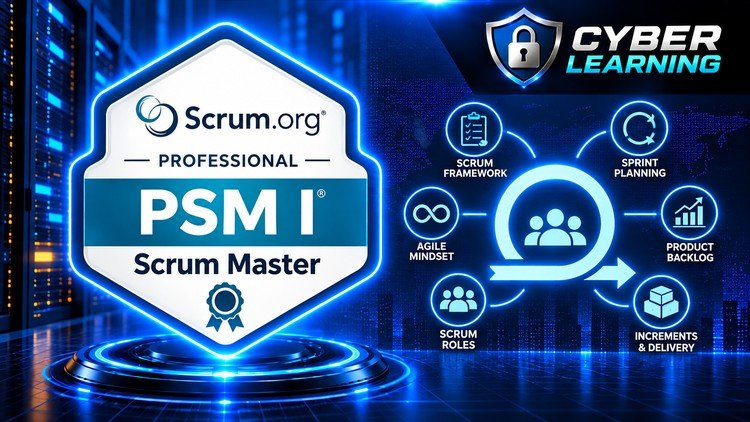
6 Objective-Focused Practice Exams with 480 Questions and Detailed Explanations to Help You Prepare for the PSM I exam
What You Will Learn:
- Assess your knowledge of Scrum theory, values, accountabilities, events, and artifacts through realistic practice questions.
- Strengthen your understanding of Scrum Master responsibilities, team effectiveness, and the practical application of Scrum.
- Identify knowledge gaps across specific Scrum focus areas through structured, objective-focused practice exams.
- Prepare for the PSM I assessment with 480 practice questions and detailed answer explanations.
Alright folks, let’s talk about something that’s been on a lot of minds in the tech space lately: Scrum Master certification. Specifically, I recently dove deep into a set of practice exams titled ‘Professional Scrum Master (PSM I) Practice Exam Questions’. My goal was to see if this resource could genuinely help someone like me, who’s been in the trenches for a while, to nail that PSM I exam, or more importantly, to reinforce practical understanding beyond just passing a test.
Overview
This isn’t just another PDF dump of questions; it’s presented as a structured approach to certification prep. The core idea here is to simulate the PSM I exam experience with a significant volume of questions – we’re talking 480 questions across six distinct practice exams. What caught my eye immediately was the emphasis on objective-focused questions, implying a direct alignment with the exam’s structure and the underlying principles of Scrum. It’s not about trick questions or obscure trivia; it’s about testing your comprehension of Scrum theory, the Scrum Guide’s specifics, and how a Scrum Master operates in the wild. The promise of detailed explanations is crucial here, as simply getting an answer wrong isn’t as valuable as understanding *why* it’s wrong and what the correct application of Scrum principles is.
Prerequisites
Honestly, you don’t need much to *start* with these practice exams, but to *benefit* from them? That’s a different story. Ideally, you should have at least a foundational understanding of the Scrum Guide itself. If you’re coming in completely cold, these questions might feel like a foreign language. It’s like trying to do hands-on labs without having read the manual first. So, while technically anyone can buy and attempt these, I’d recommend having gone through the Scrum Guide at least once, perhaps alongside a good introductory Scrum course, before diving headfirst into these practice sets. It bridges the gap from beginner to someone ready to tackle advanced concepts.
Skills & Tools
The primary skill these practice exams hone is your comprehension and application of the Scrum framework. You’ll be tested on your understanding of the Scrum Master’s accountabilities, the dynamics of Scrum Events (Sprint Planning, Daily Scrum, Sprint Review, Sprint Retrospective), and the purpose of Scrum Artifacts (Product Backlog, Sprint Backlog, Increment). Beyond that, these questions aim to build your intuition around fostering team effectiveness, servant leadership, and problem-solving within a Scrum context. In terms of tools, the “tool” here is your brain and your understanding of Scrum principles. While these don’t teach you specific project management software (like Jira or Azure DevOps, which are often considered industry-standard tools), they solidify the theoretical underpinnings you’ll apply when using those tools.
Career Benefits & Job Roles
Passing the PSM I exam is more than just a badge; it’s a tangible step towards many agile-focused roles. For aspiring Scrum Masters, it’s almost a baseline expectation. It also opens doors for Agile Coaches, Product Owners looking to deepen their understanding of the team’s process, and even Project Managers transitioning into agile environments. This certification signals to employers that you have a solid grasp of agile principles and can contribute to effective team delivery. It’s a direct investment in your career growth, demonstrating a commitment to professional development and making you more competitive in the job market, especially for roles demanding job-ready skills.
Pros
- Volume and Depth: 480 questions across six exams provide ample practice. The detailed explanations are the real value, offering insights into Scrum theory and practical application that go beyond rote memorization.
- Realistic Simulation: The questions feel very much aligned with the style and difficulty I’ve encountered in actual certification exams. This is crucial for building confidence and refining your exam strategy.
- Targeted Knowledge Gaps: The structure allows you to identify specific areas where your understanding is weak, enabling you to focus your study efforts effectively. This is far more efficient than random studying.
- Focus on Practicality: While theoretical, the questions often pose scenarios that require you to think about the *application* of Scrum principles, which is essential for real-world projects.
Cons
The only real drawback, and it’s a significant one for some, is that these practice exams are solely text-based. While they excel at testing knowledge of the Scrum Guide and Scrum Master accountabilities, they don’t offer any hands-on labs or simulations of actual Scrum events in action. You’re not getting experience *doing* Scrum, only *knowing* about it. This is fine for passing the PSM I, but for true mastery and readiness for complex real-world projects, you’ll need to supplement this with practical experience and perhaps collaborative learning.