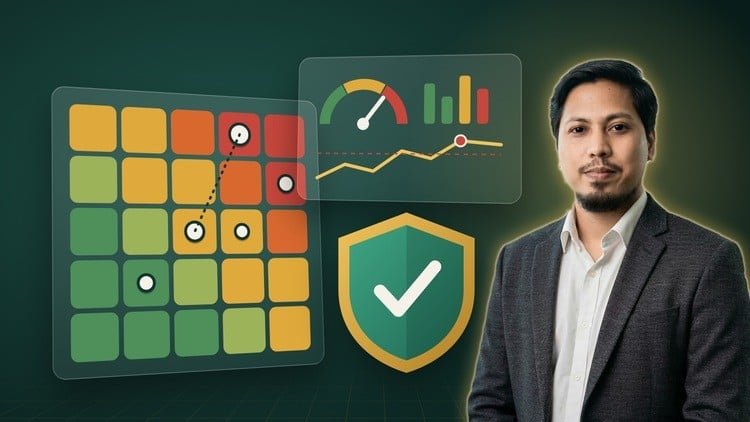
Risk assessment, third-party risk management, compliance, COSO ERM, internal audit and risk registers, with 15 templates
What You Will Learn:
- Explain governance, risk and compliance (GRC) and enterprise risk management (ERM) in plain English
- Apply ISO 31000 and COSO ERM together and put a risk management framework on one page
- Map accountability with the Three Lines Model, a responsibility map and a policy register
- Set risk appetite and risk tolerance and turn them into measurable limits
- Identify risks and keep a clear, usable risk register
- Carry out a risk assessment with heat maps, bow-ties and scenarios, and prioritise your top risks
- Show more
Alright, let’s talk about the ‘GRC Complete Guide: Enterprise Risk Management & ISO 31000’ course. As someone who’s been navigating the murky waters of tech and business for a while, I’ve seen my share of courses promising the moon and delivering pebbles. This one, however, genuinely surprised me. If you’re looking to get your head around the often-intimidating world of Governance, Risk, and Compliance (GRC) and Enterprise Risk Management (ERM), this course cuts through the jargon and gets down to business.
Overview
From the get-go, what impressed me was the course’s commitment to making complex subjects accessible. Forget dry, academic lectures that put you to sleep. This guide aims to demystify GRC and ERM, presenting them not as abstract concepts, but as practical, actionable strategies. It does an excellent job of bridging the gap between theoretical frameworks like ISO 31000 and COSO ERM and their real-world application. The instructor doesn’t just explain these standards; they show you how to integrate them into a cohesive, one-page risk management framework – a genius move for conceptual clarity. This isn’t just theory; it’s about building job-ready skills you can immediately apply. Whether you’re a complete beginner or looking to formalize existing knowledge, the progression from foundational explanations to advanced application makes it truly a beginner to advanced learning path. It’s less about memorizing definitions and more about developing a strategic mindset for risk. The focus on practicality, especially with the inclusion of 15 templates, transforms abstract principles into concrete deliverables, setting you up for significant career growth.
Prerequisites
Honestly, you don’t need to be a GRC guru to start this course. If you have a basic understanding of how businesses operate, a dash of curiosity about organizational resilience, and a willingness to learn, you’re good to go. It’s designed to explain complex topics in “plain English,” so you won’t feel lost if you’re new to the specific terminology. That said, if you’ve had some exposure to project management, business analysis, or even just an interest in organizational efficiency and security, you’ll likely find yourself picking up the concepts even faster. It truly caters to those eager to grasp the fundamentals and build a solid foundation.
Skills & Tools
This course packs a punch when it comes to practical skills and the use of industry-standard tools (or templates that mimic them). You’ll learn to:
- Explain and articulate GRC and ERM concepts confidently.
- Apply both ISO 31000 and COSO ERM principles to create a unified risk management framework.
- Map accountability using the Three Lines Model and craft comprehensive responsibility and policy registers.
- Define and quantify risk appetite and risk tolerance, turning abstract limits into measurable metrics.
- Conduct thorough risk assessments using techniques like heat maps, bow-ties, and scenarios, enabling effective prioritization of top risks.
- Develop and maintain clear, actionable risk registers using the provided templates, fostering effective third-party risk management and internal audit processes.
The 15 templates provided are essentially your hands-on labs, allowing you to practice creating vital GRC documentation. This emphasis on practical application ensures you’re not just learning theory, but actively building portfolios of real-world projects.
Career Benefits & Job Roles
For anyone serious about making an impact in a modern enterprise, understanding GRC and ERM is non-negotiable. This course directly contributes to substantial career growth by equipping you with highly sought-after expertise. It provides the foundational knowledge crucial for various roles, including:
- Risk Analyst/Manager: Directly applying risk identification, assessment, and mitigation strategies.
- Compliance Officer/Manager: Ensuring adherence to regulatory requirements and internal policies.
- Internal Auditor: Leveraging risk registers and accountability maps to evaluate internal controls.
- GRC Specialist/Consultant: Guiding organizations in establishing robust governance and risk frameworks.
- Information Security Manager: Particularly valuable for managing cyber and third-party risks.
- Project Manager: Integrating risk management into project lifecycles for successful outcomes.
The comprehensive coverage also makes it an excellent resource for certification prep for various industry accreditations, giving you a competitive edge in the job market.
Pros
- Practical, Template-Driven Learning: The 15 templates are a goldmine. They turn abstract concepts into tangible outputs, allowing for immediate application and practice. It’s like having hands-on labs for every key concept.
- Seamless Framework Integration: The course masterfully blends ISO 31000 and COSO ERM, showing how they complement each other rather than being disparate standards. This holistic view is incredibly valuable for real-world scenarios.
- Clarity and Accessibility: Explaining complex topics like governance, risk and compliance (GRC) and enterprise risk management (ERM) in “plain English” is a huge win. The instructor avoids jargon where possible, making it digestible for a broad audience.
- Actionable Accountability Mapping: The deep dive into the Three Lines Model, responsibility mapping, and policy registers provides clear, actionable steps for establishing strong governance and ensuring accountability within an organization.
Cons
While the course excels at providing practical templates for documentation, one minor point to consider is that its “hands-on” nature is primarily focused on understanding and filling out these templates. It doesn’t delve into the specifics of using actual GRC software platforms (like Archer, ServiceNow GRC, or MetricStream). While the conceptual understanding gained is invaluable for using any such platform, learners expecting to master a specific GRC software tool might find this aspect missing. The focus is on the methodology and artifacts, not the software itself.