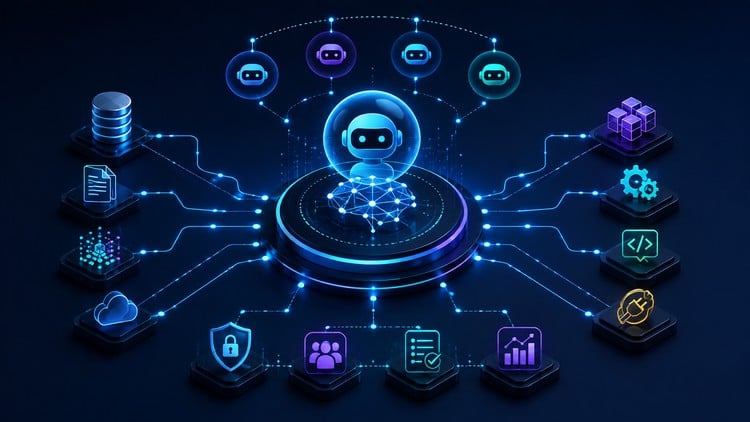
Design Production-Ready AI Agents with RAG, MCP, Multi-Agent Systems, Security, Governance, Evaluation & Observability
What You Will Learn:
- Design production-ready Agentic AI architectures for complex enterprise use cases and business workflows
- Architect AI agents using reasoning, memory, tools, RAG, orchestration, APIs, MCP and enterprise systems.
- Design secure multi-agent systems with human oversight, authorization, governance and responsible autonomy.
- Apply observability, evaluation, resilience, scalability and cost controls to operate Agentic AI in production.
- Select appropriate agent patterns, autonomy levels and integration approaches for different enterprise scenarios.
- Translate Agentic AI business requirements into practical end-to-end enterprise architecture and production designs
The Shift from Wrappers to Real Workhorses
Let’s be real for a second: the honeymoon phase of “AI wrappers” is officially over. Last year, everyone was impressed by a basic chatbot that could summarize a PDF. Today, if your AI can’t actually execute tasks, navigate a complex database, and respect corporate security protocols, it’s basically just a glorified toy. That’s exactly why I dove into the Enterprise Agentic AI Architecture: Design to Production course. I wanted to see if it actually tackled the “Day 2” problems—the stuff that happens after the demo ends and the real architectural headaches begin.
What struck me most about the curriculum isn’t just the focus on building agents, but the focus on orchestration. In a corporate environment, you don’t just want one agent; you want a specialized workforce. This course treats AI agents like high-level employees who need a manager, a set of tools, and very strict boundaries. It moves away from the “black box” approach and leans heavily into deterministic workflows combined with agentic reasoning. It’s about building a system that’s smart enough to handle ambiguity but disciplined enough to pass an audit.
Prerequisites for Success
This isn’t exactly a “zero to hero” course for someone who has never touched a line of code. To get the most out of the hands-on labs, you should ideally have a solid grasp of Python and some experience with REST APIs and Cloud Infrastructure (AWS, Azure, or GCP). You don’t need to be a PhD-level data scientist, but you do need to understand the basics of Large Language Models (LLMs) and how Vector Databases work. This is designed for beginner to advanced learners who are ready to bridge the gap between “I built a script” and “I designed a system.”
Mastering the Modern AI Stack
The industry-standard tools covered here are what you’ll actually see in a modern enterprise tech stack. You’ll spend time looking at LangGraph, CrewAI, and PydanticAI, but the real star of the show for me was the deep dive into the Model Context Protocol (MCP). Learning how to standardize the way agents talk to local data sources and third-party tools is a massive job-ready skill right now. Key focus areas include:
- Agentic RAG: Going beyond simple retrieval to iterative research and self-correction.
- Observability: Using tools like Arize Phoenix or LangSmith to actually see where an agent goes off the rails.
- Evaluation Frameworks: Moving past “vibe checks” to automated, scalable LLM-as-a-judge metrics.
- Governance: Designing Human-in-the-Loop (HITL) systems that ensure no agent spends $5,000 on API calls or deletes a production database overnight.
Career Growth & Strategic Roles
If you’re looking for career growth, the title “AI Architect” is currently one of the most lucrative paths in tech. This course functions effectively as certification prep for those aiming for high-level consulting or lead engineering roles. As companies move their real-world projects out of the “Proof of Concept” (PoC) graveyard, they need people who understand scalability and cost controls.
Graduates are well-positioned for roles like AI Solutions Architect, Principal Machine Learning Engineer, or Agentic Workflow Designer. It’s about proving you can handle the end-to-end enterprise architecture, not just the “cool” parts of the model.
The Pros: Why This Stands Out
- Focus on Production, Not Hype: The course spends an honest amount of time on security, authorization, and governance. It’s the “boring” stuff that actually makes a project successful in a regulated industry.
- Architectural Patterns: Instead of just showing you one way to build, it compares multi-agent patterns (like supervisor vs. peer-to-peer) so you can choose the right level of responsible autonomy for your specific use case.
- MCP Integration: The inclusion of the Model Context Protocol is a forward-thinking move. It’s a game-changer for enterprise systems integration and is rarely covered in this much depth elsewhere.
The Honest Con: A Lot to Digest
If I have one complaint, it’s that the course is a literal firehose of information. Trying to master RAG, MCP, and multi-agent orchestration all at once can feel overwhelming if you aren’t actively building a project alongside the modules. This isn’t a course you can just “watch” in the background; if you don’t do the hands-on labs, you’ll likely lose the thread of the more complex orchestration lessons within a week.