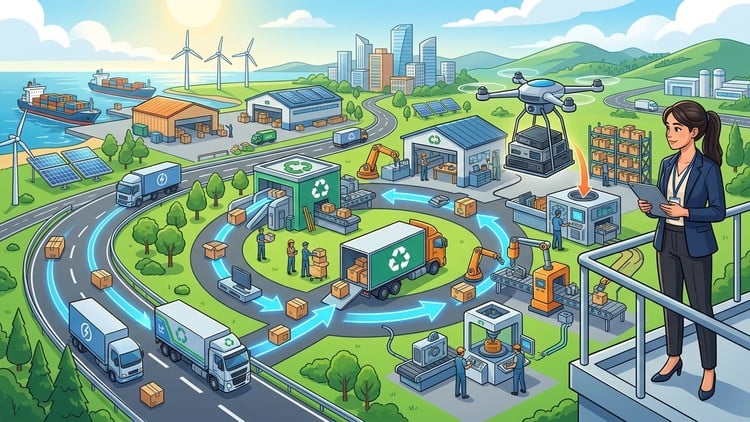
Pass your APICS CSCP certification with realistic practice tests, detailed explanations, and fully updated 2026 content
What You Will Learn:
- Pass the 2026 APICS CSCP exam using realistic practice tests and detailed explanations.
- Build and manage global supply chains while following modern sustainability laws.
- Track carbon emissions and create circular economy models to reduce daily waste.
- Predict customer demand and keep perfect inventory levels without running out of stock.
- Protect your factory from disasters, cyberattacks, and sudden global shipping delays.
The Raw Truth About Masterng the 2026 CSCP Shift
Let’s be real for a second: the supply chain world isn’t what it was five years ago. We’ve moved past the “just-in-time” obsession and crashed headfirst into an era defined by volatility, ESG mandates, and digital fragility. If you’re looking at the APICS CSCP certification, you probably already know it’s the “gold standard,” but most study materials are honestly stuck in 2019. This course, “Prepare For APICS CSCP Exam: Supply Chain & Circular Economy,” caught my eye because it specifically claims to bridge the gap between traditional logistics and the 2026 sustainability requirements.
I’ve seen plenty of certification prep programs that just read the APICS ECO (Exam Content Outline) back to you in a monotone voice. This isn’t that. It approaches the Certified Supply Chain Professional journey as a strategic pivot. It recognizes that in 2026, a supply chain manager isn’t just moving freight; they are managing a circular economy model where waste is a design flaw and carbon footprints are a liability. The course leans heavily into real-world projects and scenarios that force you to think about risk mitigation—not just in terms of a ship getting stuck in a canal, but in terms of cyberattacks on your ERP and the shifting sands of global trade laws.
Prerequisites: Who Should Actually Buy This?
While the course is structured to take you from beginner to advanced levels, I’d argue you need a foundational “business logic” mindset to get the most out of it. You don’t need a Master’s in Logistics, but if you don’t know the difference between a balance sheet and a Bill of Materials, you’ll be doing some extra Googling. It’s ideal for:
- Mid-level professionals looking for career growth into director-level roles.
- Tech-focused ops people who need to understand industry-standard tools.
- Anyone transitioning from pure manufacturing into a holistic end-to-end supply chain role.
Developing Job-Ready Skills & Mastering Tools
The meat of this course lies in its hands-on labs approach to theory. You aren’t just memorizing definitions of Demand Forecasting; you’re looking at how to maintain inventory levels when your lead times are fluctuating by 40%. The course dives deep into S&OP (Sales and Operations Planning) and how to integrate carbon tracking into your existing KPIs.
In terms of tools, it prepares you to interact with high-level ERP systems, TMS (Transportation Management Systems), and WMS environments. It’s less about “click this button” and more about the job-ready skills of interpreting the data these tools spit out. You’ll learn how to build a resilient supply chain that can survive a “Black Swan” event without the company going under.
Career Benefits & Job Roles
Let’s talk money and titles. The APICS CSCP is often a prerequisite for high-six-figure roles. By focusing on the 2026 content, this course positions you for modern roles that didn’t exist a decade ago, such as:
- Supply Chain Sustainability Manager: Focusing on circular economy and waste reduction.
- Global Logistics Director: Navigating the complexities of global shipping delays and customs.
- Operations Risk Consultant: Protecting the digital supply chain from cyberattacks.
- Inventory Strategist: Using predictive analytics to balance service levels with carrying costs.
The career growth potential here is massive because you’re proving you can handle the “Triple Bottom Line”: People, Planet, and Profit.
The Pros: Why This Course Stands Out
- Laser-Focused Practice Tests: The realistic practice tests are the MVP here. They don’t just ask “what is a warehouse?” They mirror the “best-answer” style of the actual APICS CSCP exam, which is notoriously tricky.
- Future-Proofed Content: Most courses ignore the circular economy. This one puts it front and center, which is exactly where the 2026 exam is heading.
- Deep Explanations: Instead of just telling you that you got a question wrong, the course provides detailed explanations that teach you the “APICS way” of thinking, which is crucial for passing on your first attempt.
- Holistic Risk Coverage: I appreciated the inclusion of cybersecurity. In today’s tech-heavy ops world, a hacked SaaS platform can be more damaging than a physical storm, and this course treats it with the weight it deserves.
The Cons: An Honest Critique
If there’s one gripe, it’s the sheer density of the material. This isn’t a “weekend crash course.” Because it covers everything from beginner to advanced and adds the 2026 sustainability laws, the volume of information can be overwhelming. If you aren’t prepared to put in 40-60 hours of focused study, the realistic practice tests will likely humble you very quickly. It’s a marathon, not a sprint, and the course doesn’t do much “hand-holding” for those who aren’t disciplined.