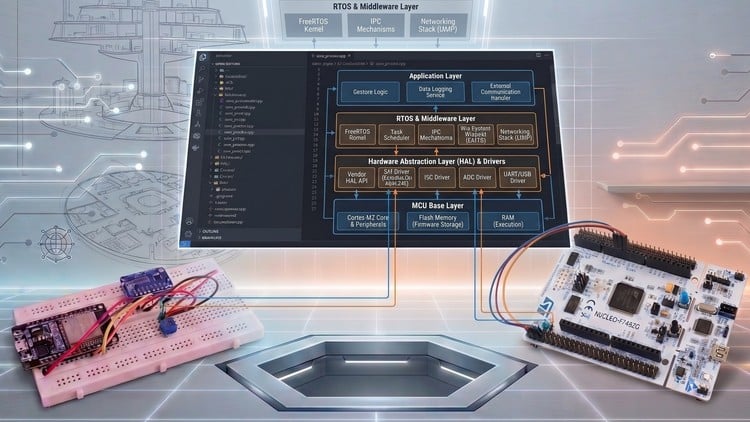
Embedded C Firmware Modular Development and Best Practice
What You Will Learn:
- Firmware Architecture
- Modular Design
- C Best Practice
- Layered Structure
- Embedded Firmware
- Layered Structure
Course Review: Embedded C Firmware Architecture – A Modular Approach
Alright, let’s talk about this ‘Embedded C Firmware Architecture – A Modular Approach’ course. As someone who’s been in the embedded trenches for a while, I’ve seen a lot of “best practices” come and go, and frankly, a lot of them are just buzzwords. So, when I saw this course advertised, with its focus on architecture and modularity in C, I was intrigued but also a healthy dose of skeptical. Did it deliver on its promise of building robust, maintainable firmware? Let’s dive in.
Overview
The core of this course really sinks its teeth into the *why* behind structured firmware development. It’s not just about writing C code; it’s about how you organize that code to make it scalable, testable, and ultimately, less of a nightmare to debug. The “modular approach” isn’t just a catchy title; it’s the guiding principle. We’re talking about breaking down complex systems into smaller, manageable, and **reusable components**. This course emphasizes building firmware with a clear **layered structure**, which is crucial for managing dependencies and isolating functionalities. Think of it like building with Lego blocks instead of trying to sculpt a whole statue from a single chunk of clay. The instructors do a good job of illustrating how this translates into real-world embedded systems, from simple microcontrollers to more complex embedded Linux devices. They touch upon design patterns that are particularly relevant in embedded contexts, like state machines and event-driven architectures, and how to implement them cleanly in C. For anyone looking to move beyond basic scripting and into building foundational firmware that can stand the test of time and audits, this is where you’ll find solid ground.
Prerequisites
To get the most out of this, you’re not expected to be a firmware guru from day one, but a decent foundation is key.
- Solid understanding of C programming: This is non-negotiable. You should be comfortable with pointers, memory management, data structures, and general C syntax.
- Basic microcontroller knowledge: Familiarity with how microcontrollers work, including peripherals like GPIO, UART, timers, and interrupts, will be very helpful.
- Exposure to embedded development environments: You don’t need to be an expert in a specific IDE, but knowing your way around a compiler and debugger is a plus.
Skills & Tools
This course is geared towards equipping you with practical, **job-ready skills**. You’ll hone your abilities in:
- Firmware architecture design: Learning to plan and structure your firmware before you even start coding.
- Modular design principles: Creating self-contained modules with well-defined interfaces.
- C best practices for embedded systems: Writing clean, efficient, and maintainable C code that’s suitable for resource-constrained environments.
- Layered software design: Implementing a robust, hierarchical structure for your firmware.
- Debugging and testing strategies for modular code.
As for tools, while the course might use specific **industry-standard tools** for examples, the concepts are transferable. You’ll likely encounter discussions around:
- Embedded C compilers (e.g., GCC for ARM)
- Integrated Development Environments (IDEs) (e.g., VS Code with extensions, Keil, IAR)
- Debugging tools (e.g., JTAG/SWD debuggers)
- Version Control Systems (e.g., Git)
The emphasis is on the principles, so you can adapt them to your preferred toolchain.
Career Benefits & Job Roles
This is where the rubber meets the road. A strong grasp of firmware architecture is a significant differentiator in the embedded job market.
- Career Growth: Moving from a junior developer writing isolated pieces of code to a senior engineer designing entire systems is a natural progression that this course supports.
- Certification Prep: Understanding these architectural concepts can be invaluable for anyone aiming for certifications that require a deep understanding of software engineering principles in an embedded context.
- Improved Job Prospects: Companies are always looking for engineers who can build robust, maintainable, and scalable firmware, not just engineers who can “make it work.”
This course is excellent preparation for roles such as:
- Embedded Software Engineer
- Firmware Engineer
- Systems Engineer
- Software Architect (Embedded)
Pros
* Deep Dive into Architecture: This isn’t just a “how-to” on C; it genuinely explores the *architecture* of firmware, which is often the missing piece for many aspiring embedded developers. The emphasis on modularity and layering provides a mental framework that’s incredibly valuable.
* Real-World Applicability: The course does a commendable job of bridging the gap between theoretical concepts and practical implementation. You’ll see how these architectural patterns translate into actual code that can be deployed on hardware. The **hands-on labs** are a significant plus here, reinforcing what you learn.
* Promotes Maintainability and Scalability: By focusing on modular design and C best practices, the course instills habits that lead to firmware that’s easier to debug, update, and expand upon. This is crucial for long-term project success and reduces technical debt significantly.
* Builds a Strong Foundation for Advanced Topics: Mastering these architectural principles sets you up perfectly for tackling more complex embedded topics like RTOS, middleware, and even bare-metal optimizations, giving you a clear path for **beginner to advanced** learning.
Cons
* Can feel slightly theoretical at times: While the hands-on labs are good, occasionally the course leans heavily on abstract architectural discussions. If you’re purely looking for “write this specific driver” tutorials, you might find certain sections a bit high-level. However, I’d argue this is precisely what makes it valuable for *architecture*.
Overall, for anyone serious about building professional-grade embedded firmware, this course is a solid investment. It moves you beyond just writing code to understanding how to *design* and *build* it effectively. Highly recommended.