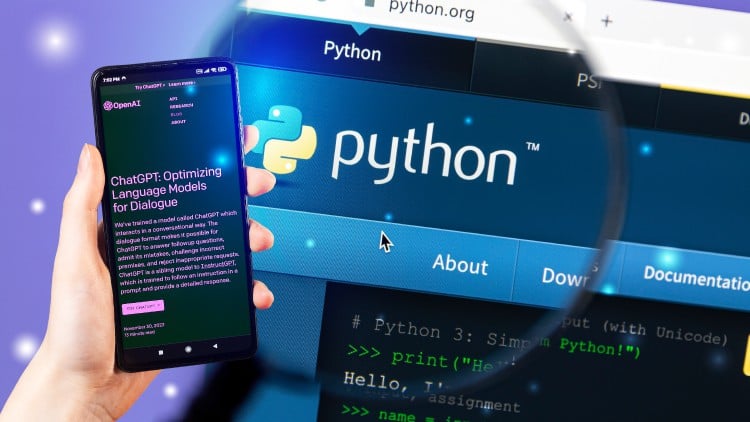
Utilizar ChatGPT como herramienta de Desarrollo para crear aplicaciones en Diferentes Lenguajes, Profesional y en minuto
What You Will Learn:
- Utiliza ChatGPT para impulsar aplicaciones Web
- Desarrolla aplicaciones Web en Python creando un Blog
- Desarrolla aplicaciones Web en Python creando Portafolio
- Desarrolla aplicaciones Web en Python creando un Control de Stock
- Desarrolla aplicaciones Web en Python creando una Gestion de Citas
- Desarrolla aplicaciones en Python usando Test
- Desarrolla aplicaciones en Python con automatizacion CSV
- Python con EXCEL
- Show more
Alright, let’s dive into this course: ‘Desarrolla Aplicaciones con ChatGPT. Con Proyectos reales’. I’ve been tinkering with AI tools for a while now, and the promise of using something like ChatGPT to genuinely accelerate development, not just for fun code snippets, is something I’m always keen to explore. This course aims to do just that, positioning ChatGPT as a development accelerator for real-world applications, and the title alone, with its emphasis on ‘Proyectos reales’, definitely caught my eye.
Overview
This course isn’t just about asking ChatGPT to write a few lines of Python. It’s positioned as a pathway to leveraging AI for practical application development across a range of scenarios. The core idea is to integrate ChatGPT into the development lifecycle, moving beyond simple code generation to more complex tasks like building entire web applications. We’re talking about creating functional pieces of software, from a personal blog and portfolio to more business-oriented tools like stock control and appointment management. The inclusion of topics like testing and data automation (CSV and Excel) suggests a move towards building robust, production-ready applications, which is a significant step up from basic AI prompts. The promise of building these in ‘minuto’ is, of course, a bold claim, but it hints at the efficiency gains the course intends to showcase. It’s less about teaching you Python from scratch and more about teaching you how to *use* AI to build with Python, which is a crucial distinction in today’s evolving tech landscape.
Prerequisites
To get the most out of this course, a foundational understanding of Python programming is absolutely essential. You don’t need to be a seasoned Pythonista, but you should be comfortable with basic syntax, data structures, and control flow. Familiarity with web development concepts, even at a high level, will also be beneficial, especially given the focus on web applications. If you’ve dabbled in HTML, CSS, and perhaps a front-end framework, that’s a bonus, though not strictly mandatory for the core Python development aspects. Think of it as needing to know the ingredients before you can ask an AI chef to help you cook a gourmet meal.
Skills & Tools
The primary skill you’ll hone here is the strategic application of ChatGPT for development. This involves learning how to frame prompts effectively to elicit accurate, functional, and maintainable code. You’ll also gain practical experience in building:
- Web applications using Python (likely with a framework like Flask or Django, though not explicitly stated in the topics, it’s implied for web app development).
- Data manipulation and automation with CSV and Excel files.
- Basic application testing methodologies.
The key tools will be Python itself, the ChatGPT interface (or its API, depending on the course’s technical depth), and any relevant Python libraries for web development, data handling, and testing. This is about integrating industry-standard tools with cutting-edge AI assistance.
Career Benefits & Job Roles
This course offers a clear path to enhancing your resume and demonstrating job-ready skills. In a market increasingly valuing efficiency and AI integration, proficiency in using AI as a development tool is a significant advantage. It can lead to roles such as:
- Junior Python Developer with AI-assisted capabilities.
- Web Developer proficient in rapid prototyping.
- Automation Specialist leveraging AI for data tasks.
- Potentially, a foundation for more specialized AI-assisted development roles.
This is about more than just learning a new tool; it’s about understanding how to leverage it for career growth and staying relevant in a rapidly evolving tech industry. It can even be a stepping stone for those preparing for certification prep, adding a modern edge to their skill set.
Pros
- Real-world Project Focus: The emphasis on ‘Proyectos reales’ is a major draw. Building functional applications like a blog, portfolio, stock control, and appointment manager provides tangible proof of skills and creates a strong portfolio.
- AI as a Productivity Booster: This course directly addresses a key trend: using AI to accelerate development. Learning to effectively prompt and integrate ChatGPT into your workflow can significantly speed up coding and problem-solving, which is invaluable.
- Broad Skill Application: Covering web development, data automation (CSV/Excel), and testing demonstrates a well-rounded approach to application development, making the acquired skills more versatile.
- Efficiency and Speed: The promise of developing applications quickly, while perhaps an exaggeration for complex tasks, highlights the course’s commitment to teaching efficient development practices, a crucial aspect of modern software engineering.
Cons
My main reservation, and it’s a significant one, is the inherent reliance on ChatGPT’s capabilities. While the course teaches you to *use* ChatGPT, it doesn’t deeply delve into the nuances of its potential limitations, biases, or the critical need for human oversight and debugging. There’s a risk that students might become overly dependent, assuming the AI-generated code is always correct or optimal without developing a strong underlying understanding of programming principles. This could lead to building applications that are functional but potentially brittle, insecure, or inefficient in the long run. True mastery comes from understanding *why* the code works, not just that it does work, and the course needs to ensure students are actively engaging with and validating the AI’s output, rather than passively accepting it.