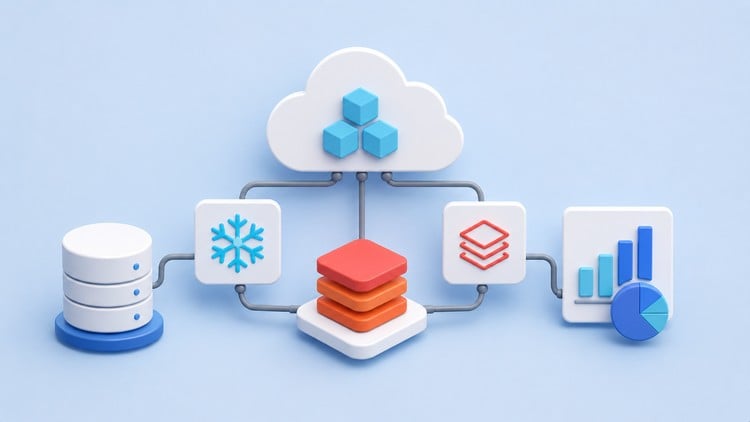
Ace your data engineering interviews with 200 realistic questions on Delta Lake, Snowpipe, and Spark Architecture.
What You Will Learn:
- Differentiate between traditional Data Lakes and modern Data Lakehouse architectures utilizing Databricks Delta Lake.
- Master Snowflake’s unique multi-cluster shared data architecture, understanding the separation of storage and compute.
- Architect continuous data ingestion pipelines using Snowflake Snowpipe and Databricks Structured Streaming mechanisms.
- Optimize massive datasets for querying performance by applying Delta Lake OPTIMIZE commands and Snowflake Micro-partitions.
My Honest Take: Why This Hybrid Approach Actually Works
Let’s be real for a second—the data engineering landscape is currently locked in a bit of a “cold war” between Snowflake and Databricks. Most courses force you to pick a side, but in the actual trenches of cloud data engineering, you’re rarely working in a vacuum. I’ve been through my fair share of certification prep materials, and honestly, most are just dry repetitions of documentation. What caught my eye about this specific course is that it refuses to treat these platforms as isolated islands. Instead, it positions them as complementary tools in a modern Data Lakehouse strategy.
The 200-question mock exam component isn’t just filler; it’s a gauntlet. If you’ve ever sat for the SnowPro Core or the Databricks Certified Data Engineer Associate, you know the questions aren’t just about “which button to click.” They test your fundamental understanding of big data bottlenecks and distributed computing logic. This course bridges the gap between watching a video and actually surviving a high-pressure technical interview. It’s less about “learning the tool” and more about “thinking like an architect.”
Prerequisites: Who Should Actually Sign Up?
While the course advertises itself as beginner to advanced, I’d argue you need a baseline level of comfort to really extract value. You don’t need to be a Python wizard, but you shouldn’t be scratching your head at a basic JOIN statement either. To get the most out of the hands-on labs, you should have:
- A foundational understanding of SQL (CTEs, Window Functions, and basic DDL).
- A high-level grasp of what a cloud environment (AWS, Azure, or GCP) looks like.
- Basic exposure to the concept of ETL pipelines—you don’t need to have built one yet, but you should know why we need them.
- The patience to troubleshoot; cloud data engineering is 20% building and 80% figuring out why your cluster didn’t spin up correctly.
The Toolkit: Skills & Industry-Standard Tools
This course is essentially a highlight reel of industry-standard tools that dominate the current market. It moves past the theoretical and dives straight into the configurations that actually matter in real-world projects. You’ll be spending a significant amount of time mastering:
- Snowflake Architecture: Going deep into the “secret sauce” of micro-partitions and how they eliminate the need for manual indexing.
- Databricks & Spark: Mastering the Spark Architecture (Driver vs. Workers) and how the Delta Lake storage layer brings ACID transactions to messy data lakes.
- Data Ingestion: Setting up Snowpipe for automated loading and Structured Streaming for those low-latency requirements.
- Performance Tuning: Learning when to use Z-Order clustering in Databricks versus when to let Snowflake’s query optimizer do the heavy lifting.
Career Benefits & Job Roles
If you’re looking for career growth, this is the sweet spot. We are seeing a massive shift where companies are migrating from legacy on-prem systems to the cloud, and they are desperate for engineers who can navigate both the “warehouse” world and the “spark” world. Completing this course and passing the 200-question mock exams puts you in a prime position for several job-ready skills heavy roles:
- Data Engineer: Designing the core ETL/ELT pipelines that keep the business running.
- Cloud Data Architect: Making high-level decisions on whether to store data in a Data Lakehouse or a traditional warehouse.
- Analytics Engineer: Using dbt or similar tools to transform raw data into business intelligence gold.
- Big Data Developer: Focusing on high-scale distributed computing and performance optimization.
The Pros: What They Got Right
- Interview-Centric Design: The 200 questions are brutal in a good way. They mimic the tricky wording you’ll find in actual certification prep exams and FAANG-style interviews.
- Architecture First: Instead of just showing you how to run a query, the course explains the *why*—specifically the separation of storage and compute, which is the cornerstone of modern cloud data warehousing.
- Dual-Platform Fluency: Being able to speak “Snowflake” and “Databricks” simultaneously makes you a much more versatile consultant or hire. It shows you aren’t a “one-trick pony.”
The Cons: An Honest Critique
If I have one gripe, it’s that the course moves fast. If you are a true beginner who has never seen a JSON file or a terminal, you might find yourself hitting the “pause” button every thirty seconds. It assumes a certain level of technical maturity, and while it covers beginner to advanced topics, the “beginner” section feels more like a refresher than a ground-up introduction. It’s a minor flaw, but one to keep in mind if you’re brand new to the tech world.