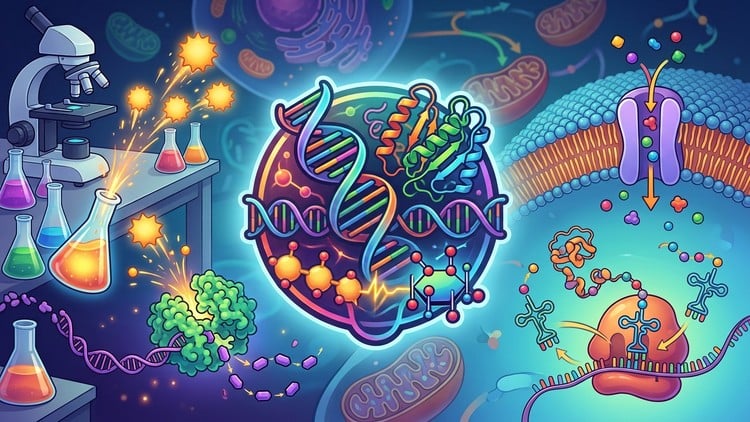
Pass your board exams easily with realistic multiple choice questions and very clear explanations.
What You Will Learn:
- You will learn how your cells make energy and use sugar to keep your body running safely.
- You will see exactly how your organs break down fats and clear out protein waste.
- You will spot common diseases caused by missing vitamins or broken enzymes in the body
- You will understand how your DNA copies itself and how hormones send signals in your blood
- You will practice real test questions to find your weak spots and fix them before test day.
My Take on the Biochemistry Practice Exam 2026
Let’s be real: most biochemistry prep feels like staring at a wall of hieroglyphics until your eyes bleed. I’ve spent years in the tech and data science space, and I’ve seen my fair share of bloated certification prep materials that promise the world but deliver a snooze-fest. When I sat down to look through the “Biochemistry Practice Exam 2026,” I was looking for one thing: signal over noise. We live in an era where industry-standard tools change every six months, and our bodies are essentially the ultimate legacy system. This course doesn’t treat you like a student; it treats you like a systems architect who needs to debug the human metabolic engine.
What struck me immediately is the tactical nature of this resource. It’s not just a content dump. Instead of just memorizing the Krebs cycle for the sake of it, this course forces you to apply logic to physiological failures. It feels more like a hands-on lab experience than a dry lecture. In the tech world, we value “breaking things to learn how they work,” and this practice exam adopts that exact philosophy. It challenges you to identify the “single point of failure” in a metabolic pathway, much like you’d hunt for a bug in a complex codebase. If you’re tired of “fluff” and want to get straight to the job-ready skills required to pass high-stakes boards, this is a solid pivot from the traditional textbook grind.
Prerequisites
You don’t need to be a Ph.D. in Molecular Biology to get started here, but this isn’t exactly “Biochemistry for Dummies.” To get the most out of this beginner to advanced curriculum, you should have a baseline understanding of general chemistry—think atoms, bonding, and basic pH balance. A passing familiarity with cellular biology will also save you a lot of Googling. If you’ve ever looked at a chemical structure and didn’t immediately close your laptop in fear, you’re probably ready. This is designed for those who are already in the certification prep mindset, so a disciplined study habit is your best asset.
Skills & Tools You’ll Master
- Diagnostic Logic: You’ll move beyond memorization to master the art of clinical correlation—essentially troubleshooting the human body.
- Metabolic Mapping: This is the equivalent of learning industry-standard tools for data flow, but for ATP and glucose instead of packets and pings.
- Data Interpretation: You’ll learn how to read lab results like a pro, identifying “out of bounds” values in protein waste and enzyme levels.
- Exam Strategy: You’ll develop the mental stamina needed for the 2026 board standards, focusing on high-yield questions that actually appear on the test.
- High-Pressure Decision Making: Practicing with realistic MCQs builds the muscle memory needed for real-world projects in a clinical or research setting.
Career Benefits & Job Roles
In today’s market, specialized knowledge is the only way to ensure career growth. Whether you are aiming for a career in medicine, pharmacy, or the rapidly growing field of bioinformatics, understanding the “how” behind human chemistry is non-negotiable. This course bridges the gap between theoretical knowledge and the job-ready skills employers are looking for in 2026.
Potential roles that benefit from this level of prep include:
- Biotechnician: Working on the front lines of real-world projects like vaccine development or gene therapy.
- Clinical Lab Scientist: Using industry-standard tools to analyze patient samples and provide critical data for diagnoses.
- Bioinformatics Analyst: Where biology meets tech; having a deep understanding of DNA replication is vital for genomic sequencing roles.
- Medical/Pharmacy Student: Perfecting your certification prep to ensure you hit those residency or licensing milestones.
Pros
- Zero Fluff: It respects your time. The explanations are “no-nonsense” and cut straight to the “why” behind every answer.
- Future-Proofed: Specifically tailored for the 2026 exam standards, so you aren’t studying outdated material from a decade ago.
- High-Yield Focus: It prioritizes the “weak spots” that most students fail on, making your career growth trajectory much smoother.
- Conversational Tone: Unlike a stiff textbook, the explanations feel like a mentor talking you through a tough problem, which makes the beginner to advanced transition way less intimidating.
Cons
- Strictly Exam-Focused: If you’re looking for a deep-dive, philosophical exploration of the origins of life, this isn’t it. This is a lean, mean certification prep machine—it’s built to help you pass, not to help you write a 500-page thesis on enzyme kinetics.