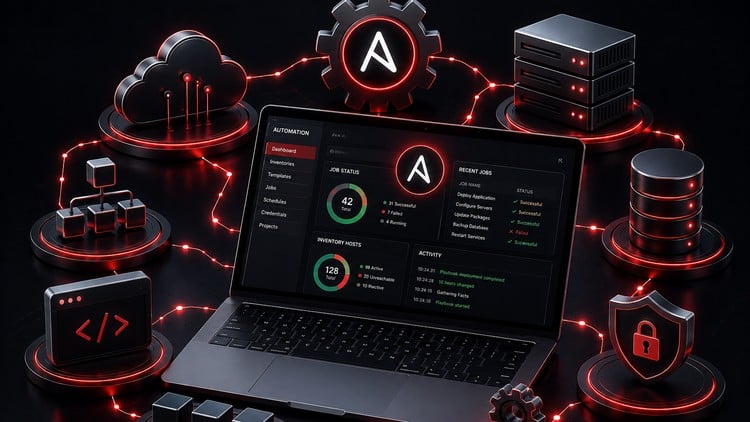
Practical automation training covering configuration management, infrastructure automation, and enterprise DevOps
What You Will Learn:
- Assess their readiness for Ansible Automation Platform certification-related objectives.
- Strengthen their understanding of automation concepts and enterprise automation workflows.
- Practice answering certification-style multiple-choice questions with confidence.
- Identify weak areas and focus their study efforts more effectively.
- Improve knowledge of inventories, variables, playbooks, roles, and automation strategies.
- Understand common troubleshooting scenarios encountered in automation environments.
- Reinforce Linux administration concepts related to automation tasks.
- Build confidence before attempting professional certification exams.
Overview: More Than Just Another Scripting Tutorial
Let’s be real for a second: the “manual era” of IT is effectively on life support. If you’re still SSH-ing into individual boxes to tweak config files, you aren’t just behind the curve—you’re basically a digital dinosaur. I’ve spent years in the trenches of System Administration and Enterprise DevOps, and the shift toward Infrastructure as Code (IaC) is the most significant pivot I’ve seen in a decade. This training on the Red Hat Ansible Automation Platform (AAP) isn’t just about learning syntax; it’s about shifting your mindset from being a “task-doer” to an “orchestrator.”
What I appreciated most about this specific curriculum is that it doesn’t treat IT automation like a hobby. It treats it like a mission-critical enterprise function. Unlike many beginner to advanced tutorials that stop at simple “hello world” playbooks, this training dives into the messy reality of enterprise automation workflows. We’re talking about how to manage complex inventories, secure your secrets with Ansible Vault, and structure your code using roles so you aren’t reinventing the wheel every Monday morning. It’s designed to turn you into a pro who understands how to scale operations across hybrid cloud environments without breaking a sweat.
Prerequisites
Before you jump into the deep end, you need to have your feet wet in Linux administration. If you don’t know your way around a BASH terminal or how permissions work in a *nix environment, you’re going to struggle.
- Foundational Linux Knowledge: You should be comfortable with command-line basics (Red Hat, CentOS, or Ubuntu).
- Basic Text Editing: Proficiency in Vim, Nano, or VS Code is non-negotiable since you’ll be living in YAML files.
- Networking Fundamentals: A basic grasp of SSH, IP addressing, and how systems talk to each other is essential.
- Logic & Flow: No heavy coding experience is required, but a “programmer’s logic” (if/then/else) will make your life much easier.
Skills & Tools You’ll Master
This course is a goldmine for anyone looking to stack their resume with industry-standard tools. You aren’t just learning a tool; you’re learning a ecosystem.
- Ansible Playbooks & YAML: Mastering the “language” of automation to ensure human-readable, repeatable configurations.
- Ansible Galaxy & Roles: Learning how to modularize your code for maximum reusability and scalability.
- Dynamic Inventories: Handling cloud computing instances that spin up and down in real-time.
- Jinja2 Templating: Creating highly flexible configuration files that adapt to different server environments.
- Troubleshooting & Debugging: Developing the job-ready skills to find out exactly why a task failed at 2:00 AM.
- Ansible Automation Controller: Getting a grip on the enterprise-grade “brains” formerly known as Tower for team-based execution.
Career Benefits & Job Roles
In today’s market, certification prep is one of the fastest ways to jump a pay grade. Companies are desperate for talent that can handle Infrastructure Automation because it directly impacts their bottom line. By completing this training, you’re positioning yourself for high-demand roles such as:
- DevOps Engineer: Bridging the gap between code and production with seamless CI/CD pipelines.
- Cloud Architect: Designing automated environments in AWS, Azure, or GCP.
- Site Reliability Engineer (SRE): Ensuring maximum uptime through automated self-healing systems.
- Automation Consultant: Helping legacy businesses modernize their configuration management strategies.
The career growth potential here is massive. Red Hat certifications are highly respected in the industry, and being “Ansible-fluent” is often the tie-breaker in hiring decisions for six-figure engineering roles.
Pros
- Certification Focused: The inclusion of certification-style multiple-choice questions is a game-changer. It removes the “exam anxiety” and ensures you actually understand the theory, not just the copy-paste commands.
- Hands-on Labs: This isn’t a “watch and forget” course. The hands-on labs simulate real-world projects, forcing you to solve problems in a sandboxed environment that feels like a production datacenter.
- Structured Progression: It successfully navigates the path from beginner to advanced without leaving you behind. The way it builds from basic ad-hoc commands to complex enterprise DevOps workflows is very logical.
Cons
- The Learning Curve: For those coming from a pure Windows background, the heavy reliance on Linux administration concepts can feel like a steep climb. It assumes a level of “terminal comfort” that might intimidate absolute novices who haven’t touched a CLI before.