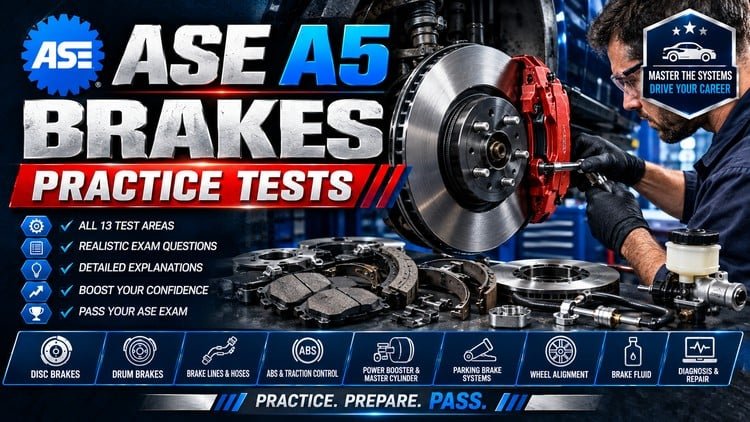
Prepare for ASE A5 with 600 practice questions covering hydraulic brakes, disc & drum brakes, ABS, TCS, ESC & diagnostic
What You Will Learn:
- Diagnose hydraulic brake system problems involving master cylinders, brake lines, hoses, valves, brake fluid, bleeding procedures, and hydraulic pressure.
- Identify causes of abnormal brake pedal conditions including low pedal, high pedal, hard pedal, spongy pedal, excessive travel, sinking pedal, and brake drag.
- Diagnose power-assist brake system problems involving vacuum boosters, booster check valves, vacuum supply systems, hydro-boost systems, and electronic brake as
- Evaluate parking brake systems, including mechanical cables, adjustment mechanisms, electronic parking brakes, indicators, switches, and integrated parking-brak
- Diagnose drum brake concerns including poor stopping, pulling, grabbing, dragging, noise, pulsation, shoe wear, wheel-cylinder problems, and adjustment faults.
- Inspect and evaluate brake drums, brake shoes, wheel cylinders, springs, adjusters, backing plates, bearings, seals, and related hardware.
- Show more
Overview: Beyond the Grease and Into the Logic
Let’s be real for a second—anyone can slap a set of pads on a commuter car and call it a day. But when you’re staring down a spongy pedal on a hydro-boost system or trying to figure out why an ABS pump is cycling when it shouldn’t, that’s where the “parts changers” get separated from the actual technicians. I’ve spent enough time on the shop floor to know that the ASE A5 exam isn’t just a test of what you know; it’s a test of how you think under pressure. This certification prep course, featuring 600 practice questions, is less of a textbook and more of a mental gym for guys like us who want to stop guessing and start diagnosing.
What I liked about this specific set of practice tests is that it doesn’t just throw “what is this part” questions at you. It forces you to navigate the “Technician A and Technician B” scenarios that are notorious for tripping people up. It covers the full spectrum from beginner to advanced diagnostic logic. Whether you’re dealing with industry-standard tools or interpreting a scan tool’s data stream for an Electronic Stability Control (ESC) fault, these tests mimic the actual exam environment better than most freebies you’ll find online. It’s about building those job-ready skills so when a complex brake job hits your bay, you aren’t scrolling through forums for an hour.
Prerequisites: What You Need Before You Click “Start”
While the course says it’s open to everyone, I’m going to give you my honest take: don’t walk into this if you’ve never bled a master cylinder. You need a foundation. Ideally, you should have:
- A basic understanding of Pascal’s Law and how hydraulic leverage works.
- At least six months of hands-on labs or real-world shop experience (turning wrenches helps the theory stick).
- Familiarity with industry-standard tools like micrometers, dial indicators, and basic OBD-II scanners.
- The patience to read questions twice—the ASE loves to hide the answer in the nuances of the “condition” described.
Skills & Tools: Mastering the Braking System
This prep course dives deep into the technical weeds. You aren’t just learning how to swap shoes; you’re learning how to evaluate the entire system as a living organism. Key areas include:
- Advanced Diagnostics: Tracing a sinking pedal back to an internal master cylinder leak or a faulty ABS modulator valve.
- Electronic Integration: Understanding how the Traction Control System (TCS) and Electronic Parking Brakes (EPB) interface with the mechanical components.
- Precision Measurement: Using industry-standard tools to check for rotor runout and drum out-of-roundness—skills that prevent those annoying “comebacks” due to pedal pulsation.
- Pressure Testing: Mastering the use of pressure gauges to diagnose hydro-boost and vacuum assist failures before you start tossing expensive parts at the problem.
Career Benefits & Job Roles
In this industry, career growth is directly tied to the patches on your sleeve. Getting your A5 isn’t just about a certificate; it’s about leverage. Shops are desperate for techs who can handle real-world projects without constant supervision.
- Lead Brake & Alignment Tech: Becoming the “go-to” person for complex brake vibrations and ABS electrical faults.
- Shop Foreman: Using your job-ready skills to mentor junior techs and oversee quality control.
- Increased Earning Potential: Most flat-rate shops offer a bump in your hourly “book rate” for every ASE certification you hold.
- Specialized Roles: Moving into high-performance tuning or heavy-duty fleet maintenance where advanced braking knowledge is a premium.
Pros: Why This Course Works
- Volume and Variety: With 600 questions, the sheer repetition ensures that the certification prep actually sinks in. You won’t see the same question twice, but you will see the same *logic* applied in different ways.
- Real-World Scenarios: The questions aren’t theoretical fluff. They feel like actual tickets you’d get at the service desk, focusing on symptoms like “grabbing,” “pulling,” or “low pedal.”
- Comprehensive ABS/TCS Coverage: Many older guides ignore the electronic side. This course keeps up with modern industry-standard tools and electronic systems, which is where most guys fail the actual exam.
Cons: The Honest Truth
The only real downside is that these are practice tests, not a “how-to” video series. If you’re a complete novice, you might find yourself frustrated by *why* an answer is correct. It provides the “what,” but you’ll need to supplement this with your own hands-on labs or a shop manual to truly grasp the “why” behind some of the more complex hydraulic valving sequences. It’s a tool for sharpening your blade, not for forging the steel from scratch.