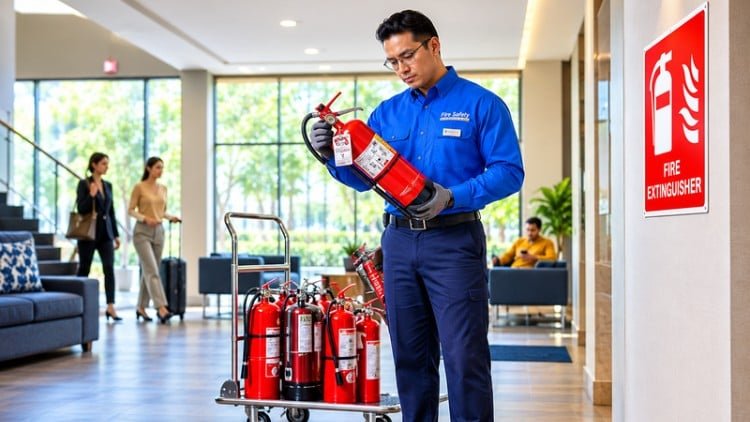
Learn hotel fire prevention, fire protection systems, emergency evacuation, guest safety and extinguisher awareness.
What You Will Learn:
- Identify common fire hazards and understand fire behaviour in hotels and hospitality environments.
- Explain fire prevention measures, building safety features and fire protection systems.
- Understand emergency response procedures and support the safe evacuation of hotel guests and staff.
- Identify different fire extinguisher types, fire classes and the limitations of portable extinguishers.
The Tech-Ops Perspective: Why Fire Safety Isn’t Just for Firefighters
Let’s be real—most people in the hospitality industry look at fire safety training as a “check the box” exercise. They think it’s just about knowing where the exits are and not burning the toast. But having spent years looking at the operational side of high-traffic buildings, I’ve realized that Fire Safety in Hotels & Hospitality is actually a masterclass in risk management and systems architecture. This course doesn’t just teach you how to stare at a smoke detector; it deconstructs the entire ecosystem of a building’s life-safety infrastructure.
From my vantage point, the most impressive part of this curriculum is how it bridges the gap between manual “boots on the ground” procedures and industry-standard tools. We aren’t just talking about buckets of water here. We’re talking about understanding the logic behind Fire Alarm Control Panels (FACP), integrated sprinkler triggers, and how Building Management Systems (BMS) respond when a sensor hits a specific threshold. If you’re looking for job-ready skills that make you indispensable to a hotel’s operations team, this is where the rubber meets the road. It’s a beginner to advanced deep dive that treats safety as a critical technical stack, not an afterthought.
Prerequisites
You don’t need an engineering degree to get started, but you do need a professional mindset. This course is designed to be accessible, though a basic familiarity with hotel layouts or facility management helps significantly. It’s ideally suited for:
- Current hospitality staff looking for career growth into supervisory roles.
- Facility managers who need a refresher on the latest compliance protocols.
- Safety officers who want a structured certification prep path.
- Entry-level employees who want to stand out by showing they take guest liability seriously.
Skills & Tools You’ll Master
The “tools” in this course aren’t just physical hardware; they are the frameworks used to prevent a catastrophe. You’ll get hands-on (metaphorically) with:
- Fire Classes & Extinguisher Specs: Knowing the difference between a Class A and a Class K fire is the difference between putting out a kitchen fire and exploding it.
- Emergency Response Planning: You’ll learn how to draft real-world projects like evacuation maps and staff duty rosters that actually work under pressure.
- Building Safety Systems: Understanding how pressurized stairwells and fire curtains function as part of a holistic fire protection system.
- Human Behavior Modeling: This was a surprise for me—learning how guests actually react during an alarm (hint: they often ignore it) and how to manage that “herd mentality” effectively.
Career Benefits & Job Roles
In an industry where litigation and insurance premiums are sky-high, being the person who actually understands fire dynamics is a massive career booster. This isn’t just about safety; it’s about career growth and moving into Occupational Health and Safety (OHS) or Director of Operations roles.
Common job titles that benefit from this training include:
- Hotel Duty Manager: The person responsible when the GM is off-site.
- Chief Engineer/Facilities Manager: Overseeing the industry-standard tools that keep the building breathing.
- Loss Prevention Officer: Focused on mitigating risk and guest safety.
- Event & Banquet Coordinator: Ensuring high-capacity gatherings meet strict safety codes.
The Pros
- Actionable Frameworks: This isn’t theoretical fluff. The course provides job-ready skills you can apply the second you walk back into your lobby. The modules on extinguisher awareness are particularly sharp, moving beyond “point and spray” to actual tactical application.
- Real-World Scenarios: I loved the focus on real-world projects. The course forces you to look at a hotel floor plan and identify the “choke points” where an evacuation could fail. It’s very pragmatic.
- Scalability: Whether you’re at a 10-room boutique B&B or a 1,000-room Vegas resort, the principles of fire behavior and emergency response remain the same. It scales perfectly.
- Comprehensive Resource Kit: The certification prep materials are top-notch, giving you checklists and templates that serve as a “safety bible” for your property.
The Cons
- Lack of Localized Legal Nuance: While the technical safety standards are universal, the course can’t cover every specific local fire code for every city in the world. You’ll get the global industry-standard tools, but you’ll still need to do a little homework on your specific municipal bylaws to be 100% compliant.