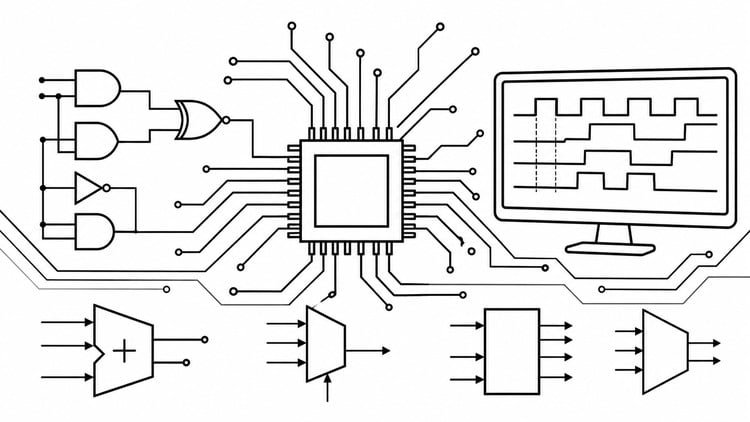
Master Verilog HDL, RTL coding, digital logic design, adders, ALU, multiplexers, decoders, encoders, and combinational
What You Will Learn:
- Understand Verilog HDL syntax, modules, ports, signals, and structural, behavioral, and dataflow modeling.
- Design combinational circuits using Verilog, including adders, subtractors, multiplexers, decoders, and encoders.
- Implement arithmetic circuits, comparators, code converters, and basic ALU designs using Verilog HDL.
- Understand Boolean expressions, conditional constructs, and the fundamentals of Verilog simulation and testbenches.
Overview: A Deep Dive into Silicon-Level Thinking
If you’ve spent any time in the software world, you’re used to code executing line-by-line. But the moment you step into the world of Verilog HDL, that mental model needs to be shattered. I’ve seen countless junior engineers struggle because they try to treat hardware description languages like Python or C++. That’s why I was particularly interested in “Verilog HDL for Beginners — Digital Logic & RTL Design.” It doesn’t just teach you syntax; it forces you to think in terms of gates, wires, and concurrency.
What makes this course stand out is its focus on RTL (Register Transfer Level) coding. In the current semiconductor landscape, we aren’t just looking for people who can write code; we’re looking for designers who understand how that code maps to actual physical hardware. This course bridges the gap between abstract Boolean logic and the industry-standard tools used in modern FPGA and ASIC design. It moves away from dry academic theory and pushes you toward job-ready skills by focusing on the “bread and butter” of digital systems: adders, ALUs, and multiplexers. It’s about building a solid foundation so that when you eventually hit complex real-world projects, you aren’t tripped up by basic synthesis errors.
Prerequisites: What You Actually Need
Don’t believe the hype that you need a Master’s degree in Electrical Engineering to start. However, you shouldn’t go in completely blind. To get the most out of these hands-on labs, you should have a basic grasp of binary numbers and basic logic gates (AND, OR, NOT). If you know what a flip-flop is, you’re ahead of the curve. From a technical standpoint, having a PC capable of running simulation software is a must, but the course does a great job of guiding you through the setup of industry-standard tools. This isn’t just a beginner to advanced journey; it’s a “zero to functional” path for anyone willing to put in the time.
Skills & Tools: The Modern Hardware Stack
This course isn’t just a lecture series; it’s a toolkit. You’ll spend a significant amount of time mastering structural, behavioral, and dataflow modeling. This is crucial because, in a professional environment, choosing the right modeling style can be the difference between a design that fits on a chip and one that fails timing analysis.
- Verilog HDL Syntax & Semantics: Mastering the “always” block and continuous assignments.
- Testbench Development: Learning how to write Verilog simulation scripts to verify your designs before they ever touch silicon.
- Combinational Logic Design: Building everything from simple decoders to complex ALU designs.
- Synthesis & Implementation: Understanding how Boolean expressions are translated into actual hardware gates.
Career Benefits & Job Roles: Why This Matters
Let’s talk money and career growth. The semiconductor industry is currently undergoing a massive resurgence. With the push for custom AI chips and localized manufacturing, hardware engineering roles are in high demand. Completing a course like this serves as excellent certification prep for entry-level roles or internal pivots within a tech company.
By mastering these fundamentals, you’re positioning yourself for roles such as:
- FPGA Design Engineer: Implementing custom logic for high-frequency trading or aerospace.
- RTL Design Engineer: Creating the building blocks of the next generation of processors.
- Verification Engineer: Using testbenches to ensure chip designs are bug-free.
- Digital Logic Designer: Working on the core architecture of ASIC projects.
The Pros: Where This Course Shines
- Logical Progression: It doesn’t overwhelm you. It starts with the “why” of Verilog HDL and moves systematically through combinational circuits, ensuring you don’t have gaps in your knowledge.
- Emphasis on Testbenches: Most beginner courses skip verification. This one treats it with the importance it deserves, teaching you how to actually prove your design works.
- Real-World Applicability: The focus on arithmetic circuits and ALUs means you’re building the exact components found in modern CPUs. These are job-ready skills that look great on a portfolio.
- Clear Coding Style: The instructor emphasizes clean, synthesizable code, which is a breath of fresh air compared to some of the “spaghetti” Verilog you’ll find in online forums.
The Cons: An Honest Critique
If I have one gripe, it’s that the course stays very much in the realm of combinational logic for the bulk of the content. While it’s the perfect beginner to advanced foundation, I would have liked to see a bit more “meat” on sequential logic (like FSMs) earlier on. It’s an essential part of digital logic design, and while the course covers the basics, you’ll definitely need a follow-up course to tackle complex state machines used in industry-standard applications. That said, as a “Beginner” focused course, it arguably does its job by not overcomplicating the starting line.