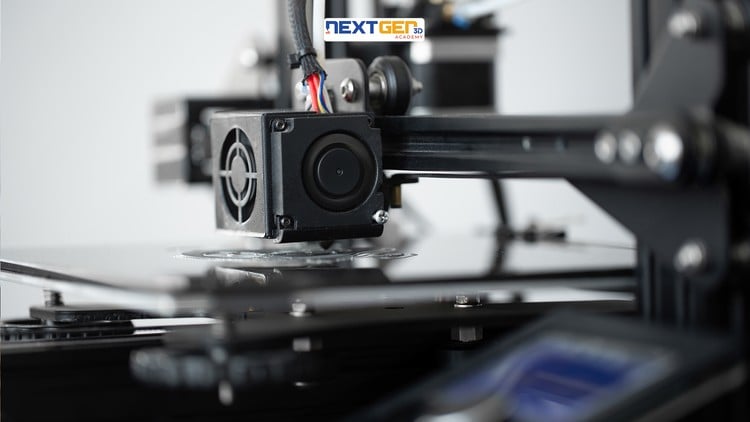
Master the Thermal Science Behind Additive Manufacturing Conduction, Convection, Radiation, Cooling, Warping & Cases.
What You Will Learn:
- Apply the First and Second Laws of Thermodynamics to additive manufacturing processes
- Analyze energy balance equations for FDM, MEX, and industrial 3D printing systems
- Understand temperature ranges, material states, and processing windows for PLA, ABS, PETG, and PEEK
- Master conduction, convection, and radiation heat transfer in 3D printing context
- Calculate heat flux, thermal conductivity, and temperature gradients using Fourier’s Law
- Interpret nozzle temperature profiles and optimize melt-zone behavior
- Show more
The “Hidden” Physics of Why Your Prints Actually Fail: An Honest Review
Let’s be real for a second: most people get into 3D printing by watching a few YouTube tutorials, downloading a “benchy,” and hoping for the best. But if you’re trying to move beyond the hobbyist stage and into Advanced Manufacturing, you eventually hit a wall. That wall is usually made of warping, delamination, and inconsistent material properties. I’ve spent years in the tech and engineering space, and I’ve realized that the difference between a “maker” and a Professional Additive Manufacturing Engineer is a deep understanding of thermal science. That’s exactly where the ‘Thermodynamics & Heat Transfer in 3D Printing Masterclass’ fits in.
This isn’t your typical “how to use a slicer” course. It’s a deep dive into the Energy Balance Equations that dictate whether a part succeeds or ends up in the trash. What I appreciated most was the shift from “guesswork” to “calculation.” Instead of just bumping up the bed temperature and praying, the course teaches you how to analyze the First and Second Laws of Thermodynamics specifically for Material Extrusion (MEX) and industrial systems. It’s about understanding the “why” behind the “how.” For anyone looking for certification prep or trying to build job-ready skills for the aerospace or medical device sectors, this level of detail is non-negotiable.
Prerequisites for Success
You don’t need a PhD in Mechanical Engineering to start, but this isn’t exactly a “Day 1” course for someone who just unboxed their first Ender 3. To get the most out of this, you should have a beginner to advanced comfort level with basic algebra and a general understanding of how 3D printers move. If you’ve heard of Fourier’s Law or know that heat moves from hot to cold, you’re halfway there. The course does a great job of bridging the gap, but be prepared to engage your brain—this is more about real-world projects and thermal modeling than it is about clicking “Print.”
High-Level Skills & Industry-Standard Tools
The syllabus is surprisingly robust, covering the full spectrum of thermal management. You’ll spend a significant amount of time mastering:
- Thermal Conductivity & Heat Flux: Learning how to calculate exactly how fast a layer cools before the next one is deposited.
- Material State Transitions: Understanding the “Processing Window” for high-performance polymers like PEEK and Ultem, which are notoriously difficult to print.
- Convection and Radiation: Analyzing how chamber heaters and cooling fans affect the crystallization of the plastic.
- Industry-Standard Tools: While the course focuses on the theory, you’ll apply these concepts using thermal modeling techniques and spreadsheet-based calculators to predict temperature gradients.
The focus on hands-on labs (even if they are digital/theoretical simulations) ensures that you aren’t just memorizing formulas, but actually learning how to optimize a nozzle temperature profile for industrial 3D printing systems.
Career Benefits & Job Roles
If you’re looking for career growth, this is the specialized knowledge that sets you apart. Companies like SpaceX, Boeing, or even high-end dental labs aren’t looking for “slicer operators”; they are looking for Additive Manufacturing Specialists who can troubleshoot a $100k industrial machine when it starts producing brittle parts. By finishing this masterclass, you’re positioning yourself for roles such as:
- R&D Engineer (Additive Manufacturing)
- Process Validation Engineer
- Materials Scientist
- Quality Assurance (QA) lead for 3D Printing Labs
This is the kind of hands-on expertise that makes a resume stand out in a sea of generalists. It’s about proving you can handle the thermal science required for flight-ready or biocompatible parts.
Pros: Why This Course Wins
- Deep Material Science: Most courses stop at PLA. This masterclass goes all the way to PEEK and ABS, explaining the “glass transition temperature” in a way that actually makes sense for print quality.
- Physics-Based Troubleshooting: You’ll stop treating “warping” like a mystery and start treating it like a thermal gradient problem that can be solved with math.
- Practical Application: The sections on nozzle temperature profiles and melt-zone behavior are pure gold for anyone trying to push their printer to higher speeds without sacrificing strength.
- Bridging the Gap: It successfully connects high-level Thermodynamics to the practical reality of FDM and industrial MEX.
Cons: The Honest Truth
The only real “con” here is the math-heavy nature of some modules. If you are looking for a quick, “fun” video series to watch while scrolling on your phone, this isn’t it. Some of the Energy Balance sections require you to sit down with a notebook and actually do the work. It’s a “Masterclass” in every sense of the word, which means it’s demanding. If you hate formulas, the middle section might feel like a bit of a slog, but it’s the “secret sauce” you need to actually master the craft.