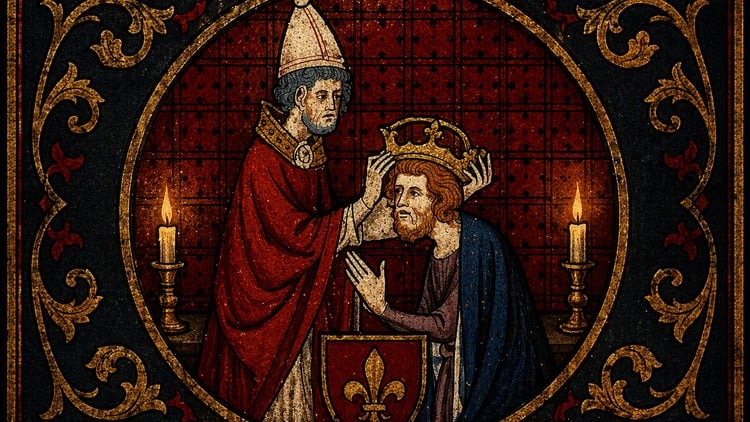
A complete journey through Medieval Europe: Vikings, Crusades, Byzantium, warfare, society, and the rise of kingdoms.
What You Will Learn:
- Understand the major political, cultural, and religious developments of Medieval Europe (500–1500).
- Analyze primary historical sources such as chronicles, charters, and firsthand accounts.
- Explain key systems like feudalism, manorialism, and the role of the medieval Church.
- Evaluate the causes and consequences of major events including the Crusades, Viking expansion, and the Black Death.
- Compare different regions of Medieval Europe, including the Latin West, Byzantium, and the Islamic world.
- Interpret how warfare, logistics, and strategy shaped medieval societies and conflicts.
Overview: Debugging the Middle Ages
Look, I spend my daylight hours managing cloud infrastructure and arguing about scalability. You’d think the last thing I’d want to do in my downtime is look back at 1,000 years of “dark ages.” But here’s the thing: “The History of Medieval Europe” is essentially the ultimate study in legacy systems. We’re talking about a thousand-year stretch where the “Western Roman Empire” server crashed, and everyone from the Vikings to the Byzantines tried to fork the codebase to build something new.
This isn’t a dry, dusty lecture series. It’s a deep dive into the foundational architecture of the modern world. Most history courses just give you the “what,” but this one focuses on the “why” and “how.” It treats the rise of kingdoms like a real-world project where the stakes were literally life and death. The course moves from the beginner to advanced level seamlessly, starting with the messy aftermath of Rome’s collapse and scaling up to the centralized bureaucracies of the late 1500s. If you’ve ever had to manage a complex merger and acquisition, watching the Carolingian Empire fragment will feel hauntingly familiar. It’s a masterclass in change management on a continental scale.
Prerequisites
The beauty of this curriculum is that there’s no high barrier to entry. You don’t need a background in Latin or a degree in archaeology. What you *do* need is the mental bandwidth for advanced critical thinking and a willingness to engage with complex datasets (historical records). If you’re used to certification prep that requires memorizing rigid protocols, you’ll need to shift gears here; history is more about pattern recognition than binary right-or-wrong answers. A basic understanding of European geography helps, but the course provides enough on-boarding to get you up to speed quickly.
Skills & Tools
While we aren’t using industry-standard tools like Python or AWS here, the “tech stack” of a historian is surprisingly relevant to any tech professional:
- Primary Source Analysis: This is essentially debugging. You’re looking at a 12th-century charter and trying to figure out why the “user” (the King) and the “provider” (the Church) are at odds.
- Comparative Geopolitics: Understanding the interoperability between the Latin West, Byzantium, and the Islamic world.
- Logistical Mapping: Analyzing the Crusades as a supply chain nightmare. How do you move 50,000 people across a continent without real-time data?
- Narrative Synthesis: The ability to take unstructured data from various chronicles and turn it into a job-ready presentation of facts.
Career Benefits & Job Roles
You might ask how Vikings and Feudalism translate to a career growth plan. It’s all about the soft skills and the “big picture” perspective. Understanding how societies rebuild after a total system failure (like the Black Death) is the ultimate lesson in business continuity and disaster recovery.
- Strategy & Leadership: Analyze the decision-making frameworks of figures like Charlemagne or Eleanor of Aquitaine.
- Intelligence Analyst: Using hands-on labs (document analysis) to spot misinformation—a skill that’s high-demand in today’s cybersecurity and media landscapes.
- Policy Advisor: Understanding the regulatory environment of the medieval Church helps in navigating complex modern corporate hierarchies.
- Project Manager: If you can understand the resource allocation required to build a Gothic cathedral over 100 years, you can manage a two-year software development lifecycle.
Pros
- Comprehensive Scope: It doesn’t just stick to the “great men” theory. It looks at manorialism and the economic infrastructure that kept the peasants (the end-users) alive.
- Non-Linear Insights: The course does a great job showing that progress isn’t a straight line. It’s full of pivots and iterations, much like a startup environment.
- Expert Instruction: The delivery is highly professional. It feels less like a school lecture and more like a high-level industry briefing.
Cons
If I have one gripe, it’s that the logistics and warfare sections can get a bit granular. While I appreciate the technical specifications of a trebuchet, sometimes the tactical deep-dives slow down the momentum of the broader political narrative. If you’re looking for a quick “greatest hits” summary, the mid-course deep dives might feel like a bit of a bottleneck.