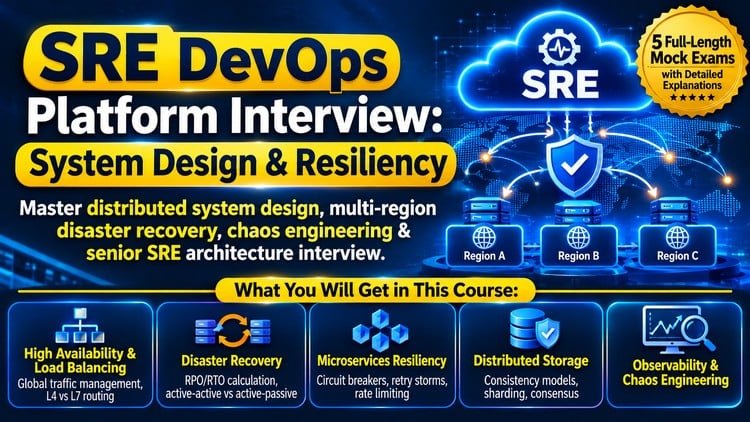
Master distributed system design, multi-region disaster recovery, chaos engineering & senior SRE architecture interview
What You Will Learn:
- Design high-availability distributed systems, multi-region active-active architectures, and fault-tolerant cloud infrastructures.
- Architect disaster recovery plans, RPO/RTO strategies, database replication topologies, and cross-region failover automation.
- Implement microservices resiliency patterns including circuit breakers, retry storms prevention, rate limiting, and bulkheads.
- Ace senior SRE, DevOps, and Platform Engineering system design interview rounds with structured architectural frameworks.
Alright, let’s talk about the ‘SRE DevOps Platform Interview: System Design & Resiliency’ course. If you’re seriously looking to level up your game in the SRE, DevOps, or Platform Engineering space, particularly when it comes to navigating those notoriously tough system design interviews, then you’ve likely stumbled upon this one. Having been through a fair share of these myself, I can confidently say this course isn’t just another theoretical snooze-fest; it’s a focused, impactful dive into the architectural mindset needed to succeed in senior roles.
My take? This isn’t a course for the faint of heart or someone just dipping their toes into infrastructure. This is for the engineer who’s already got some miles on them and is ready to solidify their understanding of how truly resilient, scalable, and fault-tolerant systems are built and, crucially, how to articulate that knowledge under pressure. It bridges the gap between knowing *what* high availability is and understanding *how* to meticulously design for it across complex, distributed environments. You’re not just memorizing patterns; you’re internalizing the strategic decisions and trade-offs that senior architects make daily. Think less “what is a microservice?” and more “how do I design a multi-region active-active microservice platform with stringent RPO/RTO requirements while avoiding a retry storm?” It’s about building a robust mental framework for tackling real-world, high-stakes scenarios.
Prerequisites
Look, don’t walk into this expecting a gentle introduction. This course assumes you’re not entirely new to the cloud or distributed systems. You should ideally have at least 2-3 years of hands-on experience with cloud platforms (AWS, GCP, Azure – doesn’t matter which, but general familiarity helps) and a solid grasp of basic networking, Linux fundamentals, and perhaps some exposure to microservices architecture. While it’s structured enough to guide you, having a foundational understanding of concepts like load balancing, databases, and general infrastructure components will allow you to extract maximum value. Without that intermediate experience, you might find the pace a bit challenging, as it quickly moves into advanced architectural considerations rather than dwelling on basics.
Skills & Tools
This program does an excellent job of equipping you with a comprehensive toolkit, not just a list of buzzwords. You’ll master various design patterns for high-availability and learn to articulate them using structured frameworks, which is gold for interviews. Expect to delve deep into multi-region active-active architectures, understanding the nuances of synchronization, conflict resolution, and seamless failover. Practical aspects of disaster recovery planning become second nature, from defining clear RPO/RTO strategies to implementing various database replication topologies and cross-region failover automation. You’ll also get proficient with critical microservices resiliency patterns, including the proper implementation of circuit breakers, preventing retry storms, effective rate limiting, and employing bulkheads. While not explicitly “hands-on labs” in every module, the design exercises push you to apply these concepts as if you were working on real-world projects, leveraging industry-standard tools and methodologies.
Career Benefits & Job Roles
If your goal is significant career growth and moving into more senior or even principal engineering roles, this course directly targets that ambition. It’s tailor-made to provide the job-ready skills needed to not just pass, but genuinely *ace* those demanding senior SRE, DevOps, and Platform Engineering system design interview rounds. Beyond interview success, the knowledge gained is directly applicable to actual work, empowering you to architect more robust, scalable, and resilient systems in your current or future roles. This course effectively serves as a crucial component for your ongoing certification prep for architect-level exams, even if it’s not a direct cert track. Roles like Senior SRE Engineer, Principal DevOps Engineer, Cloud Architect, or Platform Engineering Lead are precisely where this expertise shines, helping you to confidently tackle complex distributed systems challenges and drive significant architectural decisions.
Pros
- Interview-Centric Focus: The course is laser-focused on providing the mental models and structured architectural frameworks required to excel in senior-level system design interviews. It’s not just theory; it’s about presenting solutions clearly and confidently, anticipating interviewer questions.
- Depth in Resiliency & DR: It goes beyond basic high-availability to really dig into advanced disaster recovery plans, multi-region active-active architectures, and sophisticated microservices resiliency patterns. This isn’t superficial; it provides a comprehensive understanding of preventing and recovering from real-world failures.
- Practical, Senior-Level Insights: The content is clearly crafted by experienced practitioners. It tackles nuanced trade-offs and complex scenarios that you only encounter at a senior level, making it highly relevant for those looking to advance. It truly feels like gaining mentorship from an experienced architect.
- Comprehensive Skill Building: From foundational distributed system design to cutting-edge chaos engineering principles, the course provides a holistic view. It helps bridge concepts from beginner to advanced perspectives, tying everything together into a cohesive understanding of resilient architecture.
Cons
- Assumes Prior Experience: While marketed for “senior” roles, the pace and depth can still be quite intense. If you’re not coming in with at least intermediate experience in cloud infrastructure and distributed systems, you might find yourself scrambling to keep up with the advanced concepts. It’s not a gentle ramp-up, which could be a hurdle for some.