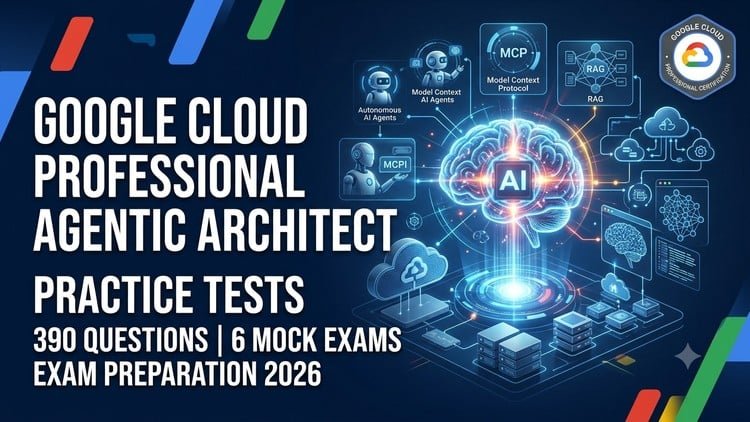
390 Practice Questions with Detailed Explanations on ADK, MCP, RAG, Agent Development and Security
What You Will Learn:
- Understand Google Cloud agentic AI architecture, core concepts, agent design patterns, and enterprise use cases.
- Evaluate agent development approaches using ADK, MCP, RAG, tools, APIs, and multi-agent orchestration.
- Assess agentic workflows through testing, evaluation, observability, deployment, and production monitoring strategies.
- Apply security, governance, IAM, data protection, and responsible AI principles to enterprise agentic systems.
Alright, let’s talk about the ‘Google Cloud Professional Agentic Architect Practice Tests.’ As someone who’s navigated the labyrinthine paths of cloud certifications and bleeding-edge AI, I can tell you that a good set of practice questions isn’t just a nice-to-have; it’s often the make-or-break for solidifying knowledge and passing that exam. This isn’t a full-blown course, mind you, but rather a robust set of 390 practice questions designed to drill you on what it takes to be a Google Cloud Professional Agentic Architect.
Overview
Stepping into the world of agentic AI on Google Cloud is like being handed the keys to a futuristic automation factory. It’s complex, it’s evolving fast, and it requires a deep understanding of how intelligent agents interact, make decisions, and operate within an enterprise-grade cloud environment. These practice tests aren’t here to teach you the basics from scratch. Instead, they serve as a critical checkpoint, a crucible to validate your understanding of intricate architectural patterns, deployment strategies, and, crucially, the nuances of `Google Cloud’s agentic AI ecosystem`. They’re designed to test your mettle across various dimensions, from leveraging foundational agent development kits (`ADK`) and multi-component pipelines (`MCP`) to implementing robust Retrieval-Augmented Generation (`RAG`) systems. Think of it as your final calibration before you dive headfirst into designing and deploying truly autonomous and intelligent systems.
Prerequisites
Let’s be brutally honest: if you’re a `beginner` to Google Cloud or even to foundational AI/ML concepts, this isn’t your starting line. This is a “Professional” level certification, and the practice tests reflect that. You absolutely need a solid background in core Google Cloud services, especially those related to AI and machine learning like Vertex AI. Familiarity with general `machine learning engineering` principles, `data engineering`, and distributed systems architecture is non-negotiable. An understanding of generative AI concepts, large language models (LLMs), and their operational challenges is also crucial. Without this groundwork, you’ll find yourself not just struggling with the questions, but likely missing the intricate architectural implications they’re testing. This is for professionals looking to enhance their `career growth` with a specialized skill set, not for someone just getting their feet wet.
Skills & Tools
The practice questions are meticulously crafted to probe your understanding of a sophisticated toolkit. You’ll be validating skills related to architecting with Google Cloud’s specific `ADK` for agent development, understanding how to construct and manage `MCP` for complex agentic workflows, and mastering the deployment of `RAG` systems for knowledge-augmented agents. Beyond these acronyms, you’ll solidify your grasp on `multi-agent orchestration` patterns, ensuring intelligent systems can collaborate effectively. The tests also delve deeply into `enterprise use cases`, demanding an understanding of how to apply these agentic concepts to real-world business problems. Expect to engage with questions touching on `industry-standard tools` for testing, evaluation, observability, deployment, and crucial `production monitoring strategies` within Google Cloud. You’re not just learning *about* tools here; you’re confirming your ability to integrate them into a coherent, high-performing `agentic architecture`.
Career Benefits & Job Roles
Earning a Google Cloud Professional Agentic Architect certification, backed by a strong understanding from these tests, isn’t just a feather in your cap – it’s a strategic career move. The demand for professionals who can design, implement, and manage intelligent agentic systems is exploding. This certification directly translates into highly sought-after `job-ready skills` for roles such as:
- AI Architect: Designing the overarching strategy and blueprint for agentic solutions.
- Senior ML Engineer (Agentic Systems): Focusing on the development and deployment of intelligent agents.
- Solutions Architect (AI/Cloud): Guiding clients through the adoption of agentic AI on Google Cloud.
- Lead AI/ML Developer: Overseeing teams building advanced AI applications leveraging these patterns.
This specialization offers significant `career growth` potential, positioning you at the forefront of AI innovation and enabling you to contribute to cutting-edge `real-world projects` involving automation, intelligent decision-making, and personalized experiences across various industries. It signals to employers that you understand not just *how* to build agents, but *how to architect them responsibly and securely* at scale.
Pros
- Comprehensive and Relevant Coverage: The 390 questions are incredibly thorough, directly mapping to the outlined exam topics including ADK, MCP, RAG, and critical security aspects. This isn’t just generic AI; it’s specifically tailored to Google Cloud’s nuanced approach to agentic systems. It’s excellent `certification prep` material.
- Detailed Explanations: This is where the real learning happens in practice tests. Each question comes with a `detailed explanation`, not just stating the correct answer but elaborating on *why* it’s correct and why other options are not. This helps solidify complex concepts and clarifies potential misunderstandings.
- Realistic Exam Simulation: The format and difficulty level genuinely simulate the actual professional exam. This is invaluable for building confidence, practicing time management, and getting comfortable with the type of questions you’ll encounter, from scenario-based problems to technical deep dives.
- Identifies Knowledge Gaps: By tackling such a broad range of questions, you’ll quickly pinpoint areas where your understanding is weak. This allows for highly targeted study, ensuring you don’t waste time reviewing concepts you already grasp, making your `beginner to advanced` learning journey more efficient.
Cons
- Not a Standalone Learning Resource: This is crucial to understand: these are *practice tests*, not a comprehensive course. If you haven’t already dedicated significant time to `hands-on labs`, official documentation, and perhaps other training courses covering Google Cloud’s AI services and agentic principles, these tests alone won’t suffice. They’re designed to *validate* and *reinforce* existing knowledge, not to teach it from the ground up. Treat them as the final sprint, not the marathon itself.