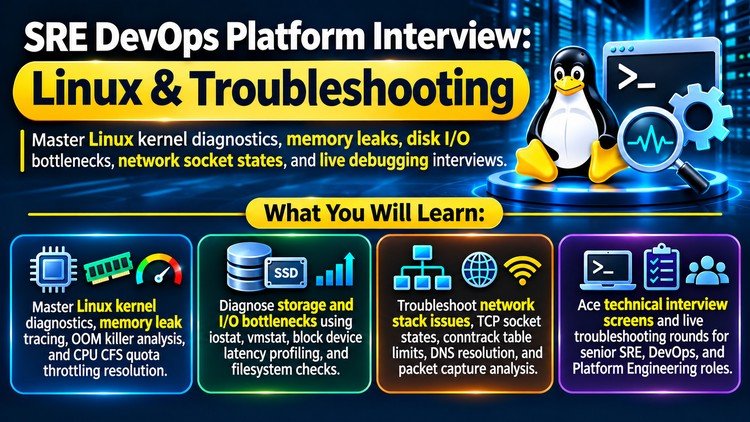
Master Linux kernel diagnostics, memory leaks, disk I/O bottlenecks, network socket states, and live debugging interview
What You Will Learn:
- Master Linux kernel diagnostics, memory leak tracing, OOM killer analysis, and CPU CFS quota throttling resolution.
- Diagnose storage and I/O bottlenecks using iostat, vmstat, block device latency profiling, and filesystem checks.
- Troubleshoot network stack issues, TCP socket states, conntrack table limits, DNS resolution, and packet capture analysis.
- Ace technical interview screens and live troubleshooting rounds for senior SRE, DevOps, and Platform Engineering roles.
Overview: Beyond the Basics of System Administration
If you have spent any time in the tech industry, you know there is a massive gulf between “knowing Linux” and being able to handle a high-pressure SRE technical interview. I have sat on both sides of the interviewing table, and I can tell you that most candidates fail not because they lack knowledge, but because they lack a systematic approach to failure. The ‘SRE DevOps Platform Interview: Linux & System Troubleshooting’ course is a refreshing departure from the cookie-cutter tutorials that dominate the market. It doesn’t waste time explaining how to create a directory; instead, it dives headfirst into the messy, chaotic world of kernel diagnostics and real-world projects where things actually break.
What I appreciated most was the focus on the “why” behind system behavior. When a production server starts crawling, a junior admin might just restart the service. An expert SRE—the kind this course aims to build—looks at CPU CFS quota throttling or conntrack table limits. This course effectively simulates those high-stakes moments, moving you from beginner to advanced levels of system intuition. It treats troubleshooting as a forensic science, which is exactly how top-tier firms like Google, Netflix, and Uber expect their Platform Engineers to think.
Prerequisites: What You Need Before Diving In
This isn’t a course for someone who hasn’t touched a terminal before. To get the most out of these hands-on labs, you should have a solid grasp of the Bash command line and a fundamental understanding of what an operating system actually does. You don’t need to be a kernel developer, but if you don’t know the difference between a process and a thread, you might find the pace a bit intense. This is ideally suited for mid-level sysadmins, aspiring DevOps engineers, or developers who want to move into Platform Engineering and need to sharpen their job-ready skills for the senior-level circuit.
Skills & Tools: The Modern SRE Toolkit
The curriculum is packed with industry-standard tools that are essential for any serious production environment. You aren’t just reading man pages here. The course walks you through:
- Performance Monitoring: Deep dives into
iostat,vmstat, andtopto identify whether your bottleneck is compute, memory, or disk-bound. - Kernel Diagnostics: Analyzing OOM killer logs and understanding the intricacies of the Linux kernel to prevent recurring crashes.
- Networking Mastery: Moving beyond
pingto analyze TCP socket states, DNS resolution latency, and usingtcpdumpfor packet capture analysis. - Resource Management: Understanding how cgroups and CFS quotas affect containerized workloads, which is vital for anyone working with Kubernetes.
The focus is on live debugging, ensuring that you can articulate your thought process while navigating the /proc and /sys filesystems under the watchful eye of an interviewer.
Career Benefits & Job Roles
Let’s be honest: the primary goal for most people taking this course is career growth and a higher salary. In the current market, “Senior” titles are hard-earned. By mastering these Linux troubleshooting techniques, you position yourself as a “force multiplier” who can solve problems that keep the rest of the team stumped. This course serves as an unofficial certification prep for the “University of Hard Knocks,” making you a prime candidate for roles such as Senior Site Reliability Engineer, Cloud Architect, or Infrastructure Engineer. Completing these modules gives you the confidence to talk through complex scenarios, which is often the deciding factor in securing six-figure compensation packages.
Pros: Why This Course Stands Out
- Authentic Interview Scenarios: The course specifically targets the “live troubleshooting” round, which is the most dreaded part of the SRE interview process. It teaches you how to think out loud and stay calm.
- Granular Detail: It doesn’t gloss over the hard stuff. Explaining memory leak tracing and block device latency profiling in a way that is digestible but technically rigorous is no small feat.
- Practicality Over Theory: Everything taught is immediately applicable to a production environment. These aren’t just academic exercises; they are the exact problems you will face when a distrubuted system goes sideways.
Cons: The Honest Truth
If I have one gripe, it’s that the labs can be quite demanding on your local hardware or cloud budget. Troubleshooting disk I/O bottlenecks and running multiple containers to simulate network stack issues requires a decent setup. It’s not a “watch while you commute” kind of course—you need to be at your desk, ready to break things, or you’ll lose half the value. It’s a steep learning curve that requires a significant time investment, but for those serious about their career growth, it’s an investment that pays off.