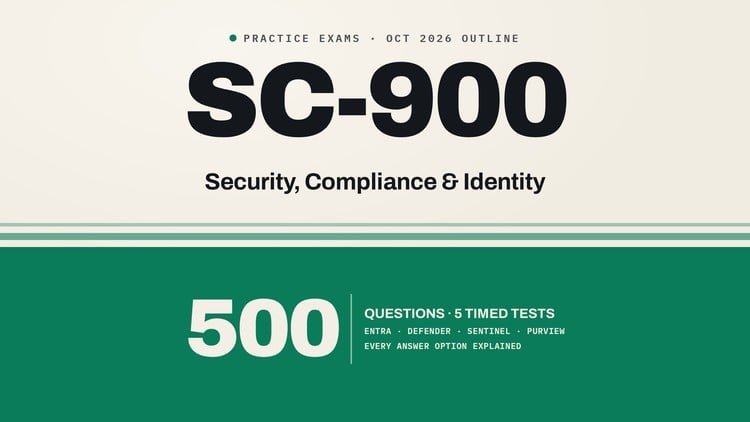
Entra ID, Defender XDR, Sentinel and Purview: 5 x 100 questions with an explanation for every answer option
What You Will Learn:
- Test your knowledge across all four SC-900 domains with 500 questions weighted to the October 2026 study guide
- Tell apart services that candidates confuse, such as Conditional Access and ID Protection or Sentinel and Defender XDR
- Learn from an explanation for every answer option plus a summary with a link to the Microsoft Learn source
- Work from basic concepts to full-length scenarios and finish with a timed simulation that shows if you are ready
- Find your weakest domain from the per-domain score and target your revision where it pays off most
- Use current product names: Microsoft Entra ID, Defender XDR, Microsoft Threat Intelligence, the Purview portal
Alright, let’s dive into this SC-900 Security, Compliance & Identity: 500 Questions course. I’ve been in the trenches of IT security for a while now, and frankly, the sheer volume of Microsoft’s security offerings can be a bit overwhelming. This course promises to cut through the noise for the SC-900 exam, and after putting it through its paces, I’ve got some thoughts.
Overview
The headline here is the 500 questions, broken down into 5 sets of 100, covering Entra ID, Defender XDR, Sentinel, and Purview. This isn’t just a “cram-em-in” question dump. The real value, in my opinion, lies in the explanation for every answer option. This is crucial. It forces you to understand *why* the correct answer is correct, and more importantly, why the incorrect ones are wrong. This is where you start to untangle those tricky distinctions, like the difference between Conditional Access policies and Identity Protection – a common stumbling block for many. They’ve also committed to using current product names, which is a breath of fresh air given how rapidly these services evolve. The weighted question distribution aiming for the October 2026 study guide is also a smart move, giving it a decent shelf life for certification prep.
Prerequisites
Honestly, for the SC-900 itself, you don’t need a whole lot of prior experience. This course, however, will be most effective if you have a basic understanding of IT concepts and perhaps some familiarity with cloud computing. If you’re brand new to the Microsoft security stack, you might find yourself doing a bit of supplemental reading alongside the explanations. But for anyone with even a year or two under their belt, it’s a solid starting point.
Skills & Tools
This course is laser-focused on building foundational knowledge of key Microsoft security services. You’ll get a deeper understanding of Microsoft Entra ID (formerly Azure AD) for identity management, the breadth of Microsoft Defender XDR for threat detection and response, the SIEM capabilities of Microsoft Sentinel, and the data governance and compliance features within the Purview portal. While it doesn’t replace hands-on labs entirely, the scenario-based questions and the timed simulation do a commendable job of preparing you for how these concepts are applied in real-world projects.
Career Benefits & Job Roles
Passing the SC-900, and by extension, mastering the content in this course, opens doors to several entry-level and junior roles in IT security and cloud administration. Think roles like Security Operations Analyst, Cloud Administrator with a security focus, or Compliance Specialist. It provides the industry-standard tools and knowledge base that hiring managers look for. This certification prep is a stepping stone for significant career growth, equipping you with the foundational skills needed for more advanced Microsoft certifications down the line.
Pros
- Deep Dive Explanations: The explanations for *every* answer option are the star of the show. This is where the real learning happens, moving beyond rote memorization to true comprehension of service differentiations.
- Current and Relevant: Using current product names and aligning with the October 2026 study guide ensures you’re learning up-to-date information, which is critical in the fast-paced world of cybersecurity.
- Progressive Difficulty: The blend of basic concepts, full-length scenarios, and a timed simulation provides a well-rounded approach to test preparation, gradually building your confidence and identifying weak areas.
- Targeted Revision: The per-domain scoring is invaluable for identifying your weakest domains and focusing your revision efforts where they’ll have the most impact, making your study time efficient.
Cons
My one honest critique is that while the course covers 500 questions, it’s still a supplementary resource. For those aiming to be truly job-ready with deep, practical skills, this course absolutely needs to be paired with actual hands-on experience in a lab environment or through real-world projects. The questions are excellent for testing knowledge, but they can’t fully replicate the nuance of configuring and troubleshooting these services in a live production environment.