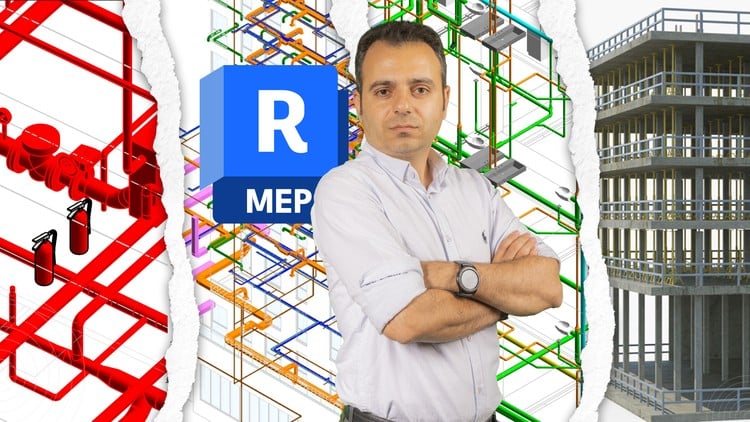
HVAC, Plumbing, Drainage, Firefighting, Architectural & Structural Projects + MEP System Design Workflow in Revit 2026
What You Will Learn:
- Revit MEP Interface and Tools – Understanding MEP Environment, Templates, and System Setup
- Architectural and Structural Integration – Linking Architectural Models for MEP Coordination
- HVAC System Modeling in Revit – Creating Duct Networks, Air Terminals, and Equipment Layouts
- Plumbing and Sanitary Design – Modeling Drainage, Vent, and Water Supply Systems in Revit
- Firefighting System Modeling – Designing Fire Box Networks, Risers, and Equipment Placement
- Heating and Cooling Systems – Connecting Radiators, Package Units, and Ducted Split Units
- Pipe and Duct Routing Techniques – Managing Levels, Slopes, and Clashes for Efficient Layouts
- Fixture and Equipment Placement – Integrating Sanitary, Kitchen, and HVAC Devices into the Model
- Show more
Alright, let’s talk shop about the ‘Revit MEP Full Course – Zero to Advanced Project Modeling.’ As someone who’s been knee-deep in BIM for a while, I’ve seen my share of courses promising the moon. This one, however, actually delivers quite a bit of stellar content, especially if you’re serious about diving into the world of mechanical, electrical, and plumbing (MEP) design using Autodesk Revit.
Overview
My first impression is that this isn’t just another button-clicking tutorial. This course takes you on a comprehensive journey from understanding the very basics of the Revit MEP interface and setting up your environment, straight through to tackling complex, integrated project modeling. We’re talking about a holistic approach to `MEP system design workflow`, covering everything from intricate HVAC duct networks and air terminal placements to detailed plumbing, drainage, and even firefighting systems. The commitment to using `Revit 2026` immediately tells me it’s current, which is crucial for staying competitive with `industry-standard tools`. It’s not just about modeling components; it’s about learning how these systems actually integrate, avoiding clashes, and contributing to a well-coordinated `BIM model`. If you’re looking to get a firm grasp on how MEP systems come together in a digital environment, this course pretty much covers the critical ground needed for `real-world projects`.
Prerequisites
Honestly, the “Zero to Advanced” in the title is largely accurate. You don’t need to be a Revit guru coming in. A logical mind and perhaps a general interest in how buildings work are probably more valuable than prior software experience. That said, if you have a foundational understanding of basic building systems – what a duct is, how water generally flows, the purpose of a fire sprinkler – it will certainly help you grasp the concepts faster. But don’t let a lack of an engineering degree deter you; the course is structured to build knowledge progressively. You will, of course, need a decent computer capable of running Revit 2026 smoothly and the software itself. Beyond that, bring your willingness to learn, because there’s a lot to absorb.
Skills & Tools
By the time you wrap this course up, you’re not just going to know how to open Revit. You’ll gain some serious `job-ready skills`. Expect to become proficient in modeling a wide array of MEP systems: designing robust HVAC networks, meticulously planning plumbing and sanitary layouts (drainage, vent, water supply), and even architecting firefighting systems. More importantly, you’ll learn the crucial skill of `architectural and structural integration`, understanding how to link models for effective `MEP coordination` and `clash detection`. This isn’t just about making pretty pictures; it’s about creating functional, coordinated, and constructible designs. The primary tool, naturally, is `Revit 2026`, but you’ll also be leveraging BIM methodologies to manage levels, slopes, and equipment placements efficiently.
Career Benefits & Job Roles
This course is a definite accelerator for `career growth`. Mastering Revit MEP puts you in a sweet spot in the construction and design industry. You’ll be equipped with the practical, `hands-on labs` experience necessary for `real-world projects`, which is exactly what employers are looking for. For those eyeing `certification prep`, the comprehensive content covers many areas tested in the Autodesk Revit Certified Professional exams. In terms of specific roles, you’ll be well-prepared for positions like a Junior/Intermediate MEP Modeler, BIM Technician specializing in MEP, an entry-level MEP Designer (working under supervision), or even an Assistant BIM Coordinator. The ability to articulate and implement detailed MEP designs in a collaborative BIM environment is a highly valued asset today.
Pros
- Truly Comprehensive Scope: This isn’t a half-baked course. It covers HVAC, plumbing, drainage, and firefighting in depth, offering a `full-stack MEP` education. This broad coverage is a huge win, saving you from stitching together multiple niche courses.
- Project-Based, Practical Learning: The emphasis on `hands-on labs` and tackling `real-world projects` transforms theoretical knowledge into actionable skills. You’re not just watching; you’re building, designing, and troubleshooting, which is critical for going from `beginner to advanced`.
- Up-to-Date Software: Learning on `Revit 2026` means you’re being trained on the latest `industry-standard tools`. This ensures your skills are immediately relevant and sought after in the market, without the need to “unlearn” outdated methods.
- Strong Focus on Integration and Coordination: The course goes beyond isolated system design, teaching you the vital importance of `architectural and structural integration` for seamless `MEP coordination`. This is a non-negotiable skill in modern BIM workflows.
Cons
- Intensive Pacing and Volume: While incredibly comprehensive, the sheer volume of content and the pace required to cover so many disciplines from `zero to advanced` can feel quite demanding. Absolute beginners, particularly those without any prior engineering or construction context, might find it overwhelming at times, requiring significant dedication and self-study to truly master everything.