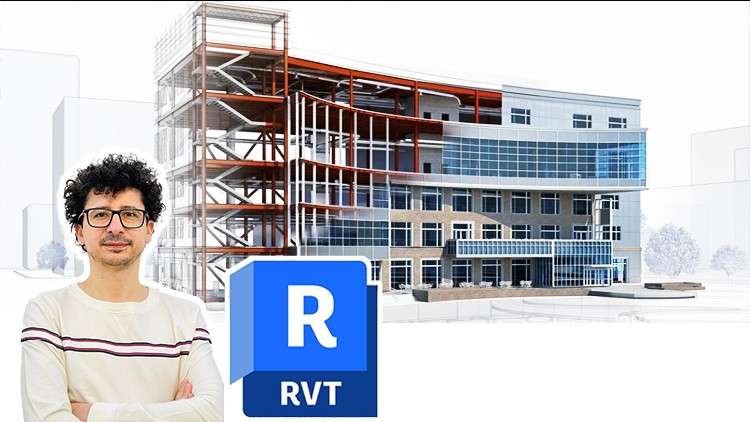
Become a Proficient Structural Designer: Comprehensive Revit Course for Steel and Concrete Structures
What you will learn
Master Structural Design and BIM Modeling Techniques
Steel and Concrete Structure
Structural Walls, Columns and Beams
Apply Industry Standards for Steel Connection Design
Reinforcement Modeling and Rebar Detailing
Truss and Brace Families
Dynamo for Revit Structure
Structural Analysis
Shop Drawings and Sheets
U-Boot & Metal Deck and Waffle Structure Modeling
Description
Note: The main difference in this course compared to others is that we have not confined ourselves to explaining simple techniques. Instead, we have conveyed the subject through challenging projects and specific tricks, which are the result of numerous experiences.
- Curious about Building Information Modeling (BIM) for structural design?
- Ever wondered how professionals create impressive steel and concrete structures using Revit?
- Looking to enhance your expertise in structural Bim modeling?
This comprehensive course is designed to take you from a beginner to an advanced level in utilizing Revit Structure for Steel and Concrete structures. Whether you’re new to Building Information Modeling (BIM) or looking to enhance your skills, this course covers everything you need to know.
You’ll gain hands-on experience with various examples of projects, witnessing the entire project delivery process to the client. From mastering walls, columns, beams, and floors to understanding intricate design details, this course equips you with the knowledge and skills to excel in creating robust structural designs using Revit.
Headlines:
- Master Structural Design and BIM Modeling Techniques
- Steel and Concrete Structure
- Structural Walls, Columns and Beams
- Apply Industry Standards for Steel Connection Design
- Reinforcement Modeling and Rebar Detailing
- Truss and Brace Families
- Dynamo for Revit Structure
- Structural Analysis
- Shop Drawings and Sheets
- U-Boot & Metal Deck and Waffle Structure Modeling
If you are currently a BIM modeler or planning to become one, it is essential not to limit yourself to any form. You should be able to manage any architectural design in the BIM process And in the end, you will be the hero of this training. Please watch this course and feel free to ask me any questions you have while watching it. Additionally, during the learning Autodesk Revit, ask me questions so that I can guide you.
Content
Introduction
Difference Between Revit Structure, Advance Steel and Tekla
What is the Meaning of Design in Revit Structure
Revit Structure Templates
Drawing Levels
Drawing and Setting Grids
Axis Numbering with Dynamo
Creating Tools with Dynamo
Axis Dimension with Dynamo
Modeling and Setting Structural Columns
Modeling Columns Based on Excel and AutoCAD with Dynamo
Modeling Structural Column Family
Modeling and Setting Beams
Modeling and Setting Beam System
Modeling Joist Family
Modeling Stepping Beam
Modeling Roof Polystyrene Family
Joist and Polystyrene Placement
Beams Modeling by Using Dynamo Based on AutoCAD File
Modeling and Setting Brace
Modeling U-Boot Family
U-Boot Placement by Using Dynamo
Modeling Cobiax Family
Modeling Metal Deck Family
Modeling Waffle Family
Structure Tab
Modeling and Setting Structural Floor
Modeling and Setting Structural Wall
Wall Connection Technique by Using Dynamo
Floor Construction by Using Dynamo
Modeling and Setting Truss
Modeling Truss Family
Modeling and Setting Structural Foundation
Basic Rebar Setting
Placement, Setting and Modeling Rebars Family
Steel Tab
Placing Rebar with Dynamo
Techniques for Executive Modeling
How to Link Advance Steel and Robot Structure to Revit
How to Link ETABS to Revit
Project Documentation Tools
Precast Tools
Having navigated the evolving landscape of architectural, engineering, and construction (AEC) industries for years, I’ve seen firsthand how crucial Building Information Modeling (BIM) has become. So, when I came across the ‘BIM- Revit Structure Full Course- from Beginner to Advanced’, I was intrigued. The promise of becoming a “Proficient Structural Designer” via a “Comprehensive Revit Course for Steel and Concrete Structures” is a bold one, and frankly, a much-needed skill set in today’s market. After diving deep into its content, I can confidently say this course largely delivers on that promise, offering a robust learning path for anyone serious about elevating their structural design and BIM modeling techniques.
Overview
This isn’t just another click-and-model tutorial. What sets this course apart is its comprehensive approach, guiding learners from the fundamental principles of setting up a project in Revit Structure all the way to intricate detailing and analysis. Instead of merely showing you where the buttons are, it instills a deep understanding of why certain workflows are adopted in BIM modeling. You’ll move beyond generic shapes to intelligently design and model everything from complex steel and concrete structures to specialized elements like U-Boot & Metal Deck and Waffle Structure Modeling. The inclusion of Dynamo for Revit Structure is a significant value-add, pushing you towards automation and parametric design – a true game-changer for efficiency. It’s a well-structured journey that simulates the kind of challenges you’d encounter in real-world projects, making it an excellent resource for anyone aiming to be truly proficient.
Prerequisites
While the course boldly states “from Beginner to Advanced,” a genuine beginner might find the initial pace quite swift. I’d recommend having at least a foundational understanding of basic structural engineering concepts – things like how beams, columns, and slabs function. Familiarity with any CAD software (even basic AutoCAD) would also be beneficial, as it helps in understanding spatial relationships and drafting conventions, though it’s not strictly necessary. Ultimately, the most important prerequisite is a strong willingness to learn and commit time to practicing the hands-on labs, because Revit is a beast that demands repetition.
Skills & Tools
By the end of this journey, you won’t just know Revit; you’ll *master* it as an industry-standard tool for structural design. Here’s a snapshot of what you’ll be adept at:
- Proficiently using Revit Structure for modeling all types of structural elements, including Structural Walls, Columns and Beams.
- Applying industry standards for steel connection design, moving beyond theoretical knowledge to practical application.
- Performing detailed reinforcement modeling and rebar detailing, critical for concrete structures.
- Creating and utilizing custom families like Truss and Brace Families to enhance modeling efficiency.
- Leveraging Dynamo for Revit Structure to automate repetitive tasks and create complex parametric designs.
- Understanding the basics of Structural Analysis within the Revit environment, linking design to performance.
- Generating professional Shop Drawings and Sheets, essential deliverables in any construction project.
Career Benefits & Job Roles
This course is a direct pipeline to enhancing your career growth in the AEC sector. The skills taught here are in high demand and directly translate into highly sought-after roles. Completing this course equips you with tangible, job-ready skills that employers are actively looking for. You’ll be well-prepared for roles such as:
- Structural Designer: Capable of modeling and detailing complex steel and concrete structures.
- BIM Modeler/Coordinator: Leading or participating in BIM execution plans for structural components.
- CAD Technician (with BIM specialization): Transitioning traditional drafting skills into intelligent 3D modeling.
- Structural Engineer: Augmenting your engineering knowledge with powerful visualization and coordination tools.
The comprehensive nature of the content also provides excellent groundwork for various certification prep processes related to Autodesk Revit, giving you a competitive edge in the job market.
Pros
- Comprehensive Coverage: Truly moves from beginner to advanced, covering a vast array of topics from basic elements to complex detailing and automation with Dynamo. It doesn’t skimp on the critical aspects of both steel and concrete.
- Practical, Industry-Relevant Skills: Focuses heavily on workflows and techniques used in real-world projects. Learning how to apply industry standards for steel connection design and generate quality Shop Drawings and Sheets is invaluable.
- Dynamo Integration: The inclusion of Dynamo is a huge plus, teaching automation and parametric design which is a future-proof skill in BIM. It adds a layer of sophistication often missing in similar courses.
- Structured Learning Path: The progression feels logical and builds knowledge incrementally, making even complex topics manageable with dedicated effort.
Cons
- Volume of Information & Pace: For someone with absolutely zero prior exposure to any CAD or structural concepts, the sheer volume of information and the pace at which some advanced topics are introduced might feel overwhelming without consistent practice and supplementary self-study. It demands significant time commitment to truly internalize every concept and technique.
In conclusion, if you’re serious about mastering Revit Structure and want to become a proficient structural designer capable of tackling diverse projects, this course is an exceptional investment. It delivers the technical depth and practical insights needed to thrive in today’s BIM-centric engineering world.