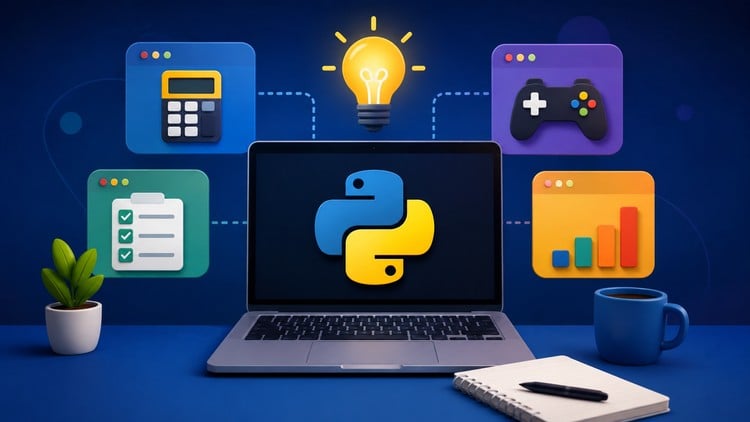
Learn Python from scratch with hands-on coding, essential concepts, and 4 beginner-friendly projects
What You Will Learn:
- Write and run Python programs from scratch using Python and VS Code.
- Use variables, data types, operators, and user input to build interactive applications.
- Create decision-making programs with conditional statements and logical operators.
- Automate tasks using for loops and while loops.
- Build reusable code with functions, parameters, and return values.
- Store, access, and manage data using Python lists and common list methods.
- Show more
Course Review: Python for Beginners: Learn Coding with 4 Projects
As someone who’s been in the tech trenches for a while, I’m always on the lookout for courses that can genuinely move the needle for aspiring developers. When I saw “Python for Beginners: Learn Coding with 4 Projects,” I was cautiously optimistic. Could this really deliver on its promise of taking someone from zero to coding with real-world projects? After diving in, I’ve got some thoughts to share.
Overview
This course sets out to do what many beginner Python courses aim for: provide a foundational understanding of the language. What differentiates this one, though, is its unapologetic focus on hands-on labs and, crucially, real-world projects right from the get-go. Instead of endless theoretical explanations, you’re writing and running Python programs using industry-standard tools like VS Code almost immediately. The curriculum smartly builds upon itself, introducing core programming concepts like variables, data types, and operators, then layering in conditional logic and loops. The emphasis on creating interactive applications and automating tasks feels genuinely job-ready skills focused, rather than just academic exercises. The inclusion of functions and lists as data structures further solidifies the path towards building more complex, albeit still beginner-friendly, applications.
Prerequisites
Honestly? Zero. This course truly lives up to its “for beginners” title. You don’t need any prior coding experience. If you can operate a computer and have a willingness to learn, you’re good to go. No need to worry about being overwhelmed by jargon or complex setups before you even start writing your first line of code.
Skills & Tools
- Core Python programming fundamentals (variables, data types, operators).
- Conditional logic (if/elif/else) and logical operators.
- Looping structures (for and while loops) for automation.
- Functions, parameters, and return values for code reusability.
- List manipulation and common list methods.
- Python 3.
- VS Code (Visual Studio Code) for development.
- The ability to write, run, and debug basic Python scripts.
Career Benefits & Job Roles
This course is an excellent stepping stone for anyone looking to pivot into tech or enhance their current skillset. While it won’t make you a senior developer overnight, it equips you with the foundational knowledge crucial for roles like:
- Junior Python Developer
- Junior Software Engineer
- Data Analyst (entry-level)
- Web Developer (front-end or back-end basics)
The certification prep potential is there too, as a solid grasp of these fundamentals is often tested in entry-level certifications. It’s about building a solid base that enables further career growth into more specialized areas like data science, machine learning, or advanced web development.
Pros
- Project-Driven Learning: This is the standout feature. By building four distinct projects, you see the practical application of every concept learned. It’s incredibly motivating and helps solidify understanding in a way lectures alone cannot.
- Industry-Standard Tooling: Using VS Code from the start is a smart move. It introduces you to a professional development environment, which is a massive advantage compared to courses that use simplistic, built-in editors.
- Clear Progression: The course structure is logical, gradually introducing complexity. You’re not thrown into the deep end; concepts are built upon steadily, making the learning curve manageable and rewarding.
Cons
The only significant drawback I found is that while the projects are excellent for beginners, they do remain at a fairly introductory level. Once you complete them, you’ll likely need to seek out more complex challenges or subsequent courses to truly push your skills towards a more advanced, production-ready level. The “real-world” aspect, while present, is still within a carefully curated beginner environment.
Overall, “Python for Beginners: Learn Coding with 4 Projects” is a highly recommended starting point. It successfully bridges the gap between theory and practice, making Python accessible and, dare I say, enjoyable for newcomers. If you’re looking for a no-nonsense, project-focused introduction to coding that provides genuine job-ready skills, this is definitely worth your time.