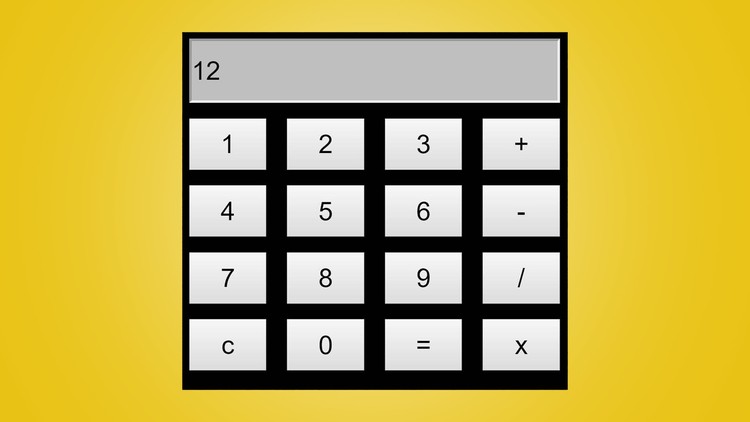
Learn to Build a Simple Calculator using HTML, CSS and Javascript
What you’ll learn
- Downloading & Installing Notepad++
- Basic Calculator Functionality
- Fixing Some Problems in Calculator Project
- Calculator Design (CSS)
Requirements
- Should have the minimum basic Knowledge of HTML, CSS and Javascript
Description
Build a Simple Calculator using HTML, CSS and Javascript
In this Course you will learn how to build a simple calculator using HTML, CSS and Javascript,
This course is divided in to four parts,
In the first part you will learn how to download and install Notepad++,
In the 2nd part you will learn to build the Basic functionality of calculator
Note➛ Make sure your 𝐔𝐝𝐞𝐦𝐲 cart has only this course you're going to enroll it now, Remove all other courses from the 𝐔𝐝𝐞𝐦𝐲 cart before Enrolling!
In the 3rd Part you will learn to fix some problems in Calculator Project
and finally in Last Part you will focus on Design Part (CSS)
Pre- Requirements: Basics of HTML, CSS and Javascript
Who this course is for:
- who want to learn Building a Simple Calculator using HTML, CSS and Javascript
English
Add-On Information:
- Course Overview
- Dive into a practical, project-based learning experience that bridges the gap between theoretical coding and real-world application by constructing a fully functional digital calculator.
- Explore the seamless integration of the “big three” web technologies, seeing exactly how structure, style, and logic cooperate to create a responsive user interface.
- Follow a structured workflow that mimics professional development cycles, starting from a blank canvas and ending with a utility tool that handles complex arithmetic operations.
- Understand the significance of the Document Object Model (DOM) as the primary bridge that allows JavaScript to manipulate and update what the user sees on the screen in real-time.
- Focus on writing clean, readable, and maintainable code that adheres to modern web standards, ensuring your project is both efficient and professional.
- Requirements / Prerequisites
- A fundamental grasp of how to create and save basic HTML files and a curiosity about how the internet functions under the hood.
- Access to a modern code editor, such as Visual Studio Code or Atom, and a stable web browser for testing and debugging your application.
- A very basic understanding of mathematical concepts, specifically the four primary operations: addition, subtraction, multiplication, and division.
- The ability to follow step-by-step instructions while maintaining an experimental mindset to tweak and customize the design as you progress.
- Skills Covered / Tools Used
- Advanced CSS Layouts: Utilizing CSS Grid or Flexbox to create a perfectly aligned button pad that remains responsive across different screen sizes.
- Event Handling: Mastering the use of addEventListener to capture user clicks and translate physical interactions into digital data.
- Conditional Logic: Implementing if-else statements and switch cases to determine which mathematical operation to perform based on user input.
- State Management: Learning how to store, update, and clear temporary data variables to keep track of the current total and the next operator.
- Display Rendering: Techniques for updating the inner text of HTML elements to show calculations and results instantaneously to the end user.
- Benefits / Outcomes
- Boost your developer portfolio with a classic “rite of passage” project that demonstrates your ability to handle user input and logical processing.
- Develop a “programmer’s mindset” by breaking down a complex problem into small, manageable coding tasks.
- Gain the confidence to tackle more advanced JavaScript projects, such as weather apps or to-do lists, by mastering the core principles of interactivity.
- Acquire a deeper appreciation for UI/UX design, learning how button placement and color schemes affect the usability of a simple tool.
- PROS
- Immediate Visual Gratification: See the results of your code changes instantly in the browser, which keeps the learning process engaging and fun.
- Practical Math Application: Greatly improves your understanding of how computers process numbers and strings differently.
- Versatile Skillset: The logic used to build a calculator is foundational to almost every interactive application on the modern web.
- CONS
- Scope Limitation: This course focuses primarily on front-end logic and does not cover back-end data storage or advanced framework implementations like React or Vue.
language
Found It Free? Share It Fast!