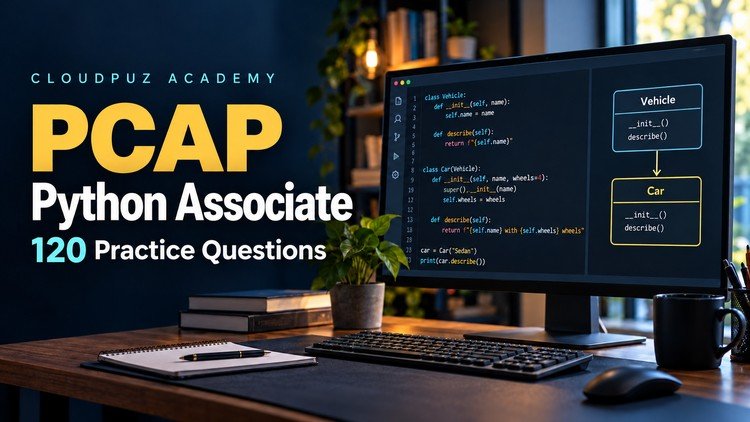
Two original Python 3 practice tests with code scenarios and explanations for every answer option
What You Will Learn:
- Trace Python imports, module behavior and exception handling using original code-based practice questions.
- Analyze classes, inheritance, method resolution and object state in practical Python scenarios.
- Evaluate strings, comprehensions, lambdas, closures and file operations with explanations for every option.
- Identify knowledge gaps across PCAP-31-03 topics using two distinct 60-question practice tests.
Alright folks, let’s dive into something that’s been on my radar for a while now: the ‘PCAP Python Associate: 120 Explained Practice Questions’ course. If you’re like me, you’ve probably seen a million and one ways to “learn Python,” but when it comes to actually passing a certification like the PCAP (which, let’s be honest, is a legitimate benchmark in the industry) or just proving you’ve got more than a surface-level understanding, it’s a different ballgame. This course promises to bridge that gap with 120 practice questions, split into two full-length tests, and critically, explanations for *every single option*. That’s a big deal in certification prep, believe me.
Overview
My initial take on this resource? It’s a laser-focused tool for PCAP certification aspirants, and honestly, it’s a smart one. Instead of rehashing basic Python syntax (which you should already have a handle on), it zeroes in on the more intricate, often-tested aspects of the PCAP syllabus. We’re talking about the stuff that trips people up in exams: the subtle nuances of module imports and how they behave, the nitty-gritty of exception handling flow, and the sometimes-confusing world of object-oriented programming in Python – classes, inheritance, and crucially, method resolution order. The course also digs into areas like string manipulation, comprehensions, lambdas, and file I/O, all presented through these practical, code-scenario-based questions. What I appreciated most is the commitment to explaining *why* each option is right or wrong. This isn’t just about pattern recognition; it’s about building a deeper, more analytical understanding of Python’s internals, which is exactly what you need for those high-stakes exams and, more importantly, for building robust applications.
Prerequisites
Let’s be clear: this isn’t a “learn Python from scratch” course. If you’re brand new to programming, you’ll be lost. You should have a solid grasp of Python’s fundamentals: variables, data types, control flow (if/else, loops), functions, and basic data structures like lists and dictionaries. A foundational understanding of object-oriented concepts (classes and objects in general) would also be a significant advantage, though the course does touch upon them in the context of the PCAP syllabus. Think of it as the bridge from “I know Python” to “I can pass the PCAP and demonstrate mastery.”
Skills & Tools
The primary skill this course hones is diagnostic reasoning within Python code. You’ll become adept at tracing execution paths, predicting output, and understanding the implications of different code constructs. Specifically, you’ll sharpen your skills in:
- Module and Package Management: Understanding `import` statements, their scope, and potential pitfalls.
- Exception Handling: Mastering `try`, `except`, `else`, and `finally` blocks, and how exceptions propagate.
- Object-Oriented Programming (OOP) in Python: Deep dives into class definitions, inheritance hierarchies, polymorphism, and instance/class state.
- Advanced Language Features: Effective use of string formatting, list/dict comprehensions, lambda functions, and closures.
- File System Interaction: Proficiently handling file operations and their associated errors.
The main “tool” here is your Python 3 environment. You’ll be writing and debugging code, so having a reliable IDE or text editor (like VS Code, PyCharm, etc.) and a functional Python installation is essential. No fancy external libraries are required for the course itself, just your brain and a code interpreter.
Career Benefits & Job Roles
For anyone eyeing the PCAP certification, the benefits are obvious: it’s a direct path to passing the exam. But beyond the credential, this course helps build the job-ready skills that employers actually look for. Demonstrating proficiency in these advanced Python topics can open doors to roles such as:
- Junior/Mid-Level Python Developer
- Backend Developer
- Software Engineer
- Data Analyst (with a Python focus)
- Automation Engineer
In today’s tech landscape, a solid grasp of these fundamentals is key for career growth, enabling you to tackle more complex real-world projects and contribute effectively within teams using industry-standard tools and practices.
Pros
- Targeted Exam Preparation: This course is laser-focused on the PCAP exam, covering specific topics in depth. It’s not a general Python tutorial; it’s a strategic tool for certification.
- In-Depth Explanations: The commitment to explaining *every* answer option is its strongest suit. This moves beyond rote memorization and fosters true understanding, which is invaluable for both the exam and practical application.
- Practical, Code-Based Scenarios: The questions are presented as code snippets, mirroring the actual exam format and providing hands-on experience with challenging Python concepts.
Cons
The biggest drawback, and it’s a significant one if you’re not careful, is that it assumes a certain level of prior knowledge. If you try to tackle this as your first introduction to Python, or even your first introduction to advanced Python, you’re going to get frustrated quickly. It’s a practice test *course*, not a foundational learning platform. You need to have the groundwork laid before you can effectively leverage the insights and explanations offered here.