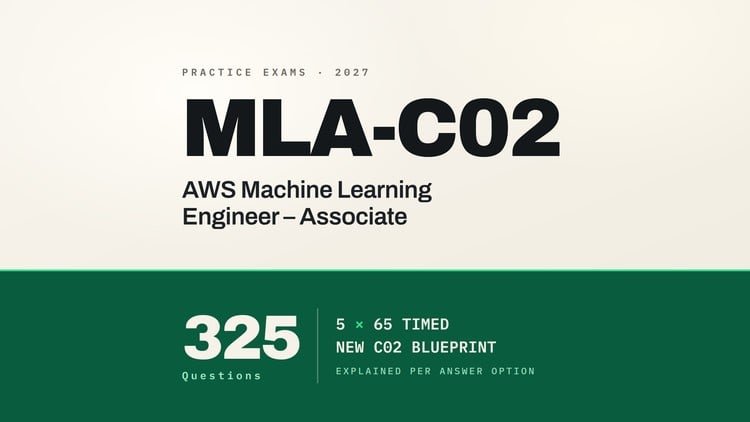
325 questions on SageMaker AI, Bedrock, RAG, MLOps and ML security, with an explanation on every answer option
What You Will Learn:
- Tell apart the AWS services and features the exam deliberately confuses, from Firehose and Kinesis to RAG and fine-tuning.
- Answer 325 MLA-C02 style questions across all four exam domains in the official 28/24/24/24 weighting.
- Read a scenario and spot the one requirement that decides the answer when two options both look correct.
- Recall the parameter values, service limits and API field names that the implementation questions turn on.
- Work through a rising difficulty curve, from single-concept recall to a timed full-length exam simulation.
- Learn from every attempt through an explanation on each individual answer option plus a linked AWS documentation source.
Overview: Why This Isn’t Just Another Practice Test
If you’ve been tracking the AWS certification landscape lately, you know the MLA-C02 AWS Machine Learning Engineer – Associate is the new heavyweight. It’s replacing the old Specialty exam, but don’t let the “Associate” tag fool you. This isn’t a vocabulary test. After spending a solid week grinding through these 5 practice exams, I can tell you that the shift toward Generative AI and MLOps is front and center. What I appreciate most about this specific course is that it doesn’t just throw 325 questions at you; it prepares you for the “AWS way” of thinking.
Most certification prep materials fail because they focus on what a service is, rather than how it behaves under pressure. This course targets the nuances—the “gotchas” where AWS deliberately pits Kinesis Data Firehose against Kinesis Data Streams in a scenario where only one actually meets the latency requirements. For anyone looking to develop job-ready skills, the value here is in the logic. You aren’t just memorizing; you’re learning to architect. The transition from beginner to advanced levels feels earned as you move through the five sets, eventually hitting a full-length simulation that feels remarkably close to the actual testing center experience.
Prerequisites
While the course starts with some foundational concepts, I wouldn’t recommend jumping into these practice exams completely cold. To get the most out of these 325 questions, you should have:
- A foundational understanding of AWS infrastructure (think Solutions Architect – Associate level).
- Basic literacy in Python and data science libraries like Pandas and Scikit-Learn.
- Familiarity with the Machine Learning Lifecycle, from data ingestion to model monitoring.
- A basic grasp of what Large Language Models (LLMs) are, though the course does a great job of teaching the Bedrock and RAG specifics as you go.
Skills & Tools You’ll Master
This course acts as a deep dive into industry-standard tools that are currently dominating the market. You’ll spend a lot of time in the Amazon SageMaker AI ecosystem, but it goes much deeper than just opening a notebook instance. You will gain hands-on mental models for:
- Amazon Bedrock: Learning when to use fine-tuning versus Retrieval-Augmented Generation (RAG).
- MLOps Frameworks: Using SageMaker Pipelines and Step Functions to automate real-world projects.
- Data Engineering: Mastering AWS Glue, Lake Formation, and Kinesis for robust data pipelines.
- Security & Compliance: Implementing IAM roles for ML, encryption at rest, and VPC configurations for secure model training.
- Governance: Using SageMaker Model Monitor and Clarify to check for bias and drift.
Career Benefits & Job Roles
Passing the MLA-C02 isn’t just about a badge for your LinkedIn; it’s about career growth in a market that is pivoting toward AI Engineering. This course prepares you for high-stakes roles such as MLOps Engineer, AI Architect, and Data Scientist. Because the questions focus heavily on cost-optimization and production-grade deployments, you’re picking up the kind of knowledge that saves a company thousands of dollars on their AWS bill—a skill that is always in demand. It bridges the gap between theoretical knowledge and the hands-on labs experience needed to handle enterprise-level cloud environments.
Pros
- The “Why” Behind the Answer: Every single option—including the wrong ones—has a detailed explanation. This is crucial. Understanding why Amazon Kendra is better than OpenSearch for a specific RAG use case is where the real learning happens.
- Surgical Accuracy on Topics: The weighting matches the official 28/24/24/24 domain distribution. You won’t find yourself over-studying ingestion while neglecting the critical ML Security domain.
- Implementation Depth: It doesn’t skip the “boring” stuff. You’ll be tested on API field names, service limits, and parameter values. These are the exact things that trip up even experienced engineers during the certification prep process.
Cons
- Heavy Reading Load: The scenarios are long. By the time you get to exam five, your brain will be fried. It’s a realistic simulation of the actual exam’s fatigue, but it makes it difficult to “snack” on these questions; you really need to carve out dedicated blocks of time.