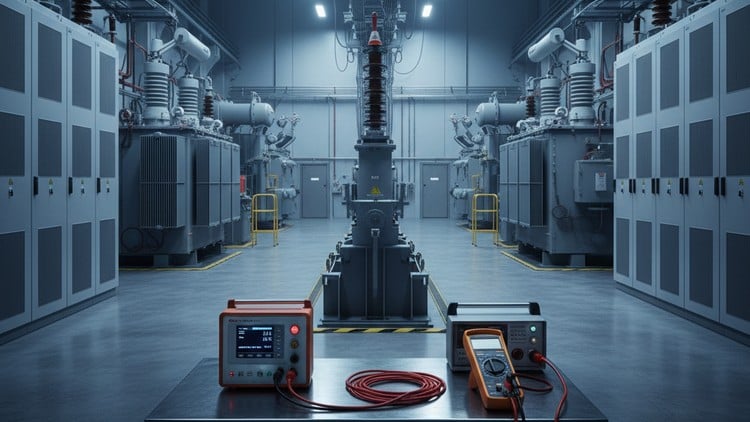
Comprehensive MCQ Review for Electrical Testing Technician
What You Will Learn:
- Understand high voltage testing
- Interpret exam-style scenarios
- Apply maintenance principles
- Improve multiple-choice accuracy
Overview
Let’s be honest: you can be the most brilliant technician on the plant floor, but if you can’t navigate a high-pressure multiple-choice exam, your career growth is going to hit a ceiling faster than a tripped circuit breaker. I’ve spent years in the field, and I’ve seen incredibly talented guys fail their NETA or NICET certifications simply because they didn’t know how to “test the test.” That’s where the MCQ Drill Course for Electrical Testing and Commissioning comes in. This isn’t your standard, dry academic lecture series. It’s a tactical, high-intensity bridge between the grit of the field and the clinical precision of certification prep.
What I appreciated most about this drill-down is that it doesn’t just give you the answers; it explains the “why” behind the “what.” In the world of commissioning, a wrong guess isn’t just a point lost—it’s a potential arc flash or a destroyed multi-million dollar transformer. This course approaches job-ready skills by forcing you to think like a troubleshooter under the clock. It moves fluidly from beginner to advanced concepts, ensuring you aren’t just memorizing facts but are actually learning to prioritize safety and accuracy in a simulated testing environment. It’s about building that mental muscle memory so that when you’re sitting in that exam center, the questions feel like second nature.
Prerequisites
You don’t need to be a Ph.D. in electrical engineering to get value here, but you shouldn’t be walking in completely green either. To really soak up what this course is offering, you should have a baseline understanding of:
- Basic electrical theory (Ohm’s Law, Kirchhoff’s Laws, and power triangles).
- Familiarity with industry-standard tools like insulation resistance testers and multimeters.
- A foundational grasp of AC/DC machinery and power system components.
- An ambition to move into high-voltage environments or specialized commissioning roles.
If you’ve spent at least six months as a helper or a junior tech, you’re in the sweet spot to maximize this certification prep.
Skills & Tools
While this is a digital drill course, it focuses heavily on the application of industry-standard tools used in real-world projects. You’ll be mentally calibrating your approach to:
- VLF (Very Low Frequency) Testing: Understanding the nuances of cable insulation diagnostics.
- Transformer Turns Ratio (TTR): Interpreting results to identify internal faults before they become catastrophic.
- Protection Relay Testing: Learning the logic behind secondary injection testing without the fear of tripping a live bus.
- Ground Grid Testing: Navigating the complexities of Fall-of-Potential methods.
The course does a fantastic job of simulating the decision-making process you’d encounter in hands-on labs, forcing you to choose the right tool for the specific protective device or apparatus described in the scenario.
Career Benefits & Job Roles
If you are looking for a way to fast-track your career growth, this is it. The electrical testing industry is currently starving for qualified individuals who can pass the gatekeeper exams. Completing this drill course positions you perfectly for roles such as:
- Electrical Commissioning Technician: Ensuring new installations meet design specs.
- Protection and Control (P&C) Technician: Focusing on the brains of the power system.
- Field Service Engineer: Traveling to diverse real-world projects to perform maintenance.
- High Voltage Specialist: Working in utilities or heavy industrial environments.
By sharpening your test-taking speed and accuracy, you’re not just getting a certificate; you’re gaining the job-ready skills that command higher hourly rates and better per diems in the field.
Pros
- No Fluff Logic: The explanations for each MCQ are punchy and grounded in field experience, not just textbook theory.
- Progressive Difficulty: It scales beautifully from beginner to advanced, keeping you challenged without feeling overwhelmed.
- Exam Simulation: The interface mimics the pressure of actual certification prep, which is 90% of the battle when you’re in the hot seat.
- Versatile Content: It covers everything from safety protocols to complex relay logic, making it a comprehensive 360-degree review.
Cons
- Lack of Physical Hardware: While the scenarios are great, nothing beats hands-on labs with actual breakers and relays; this course is strictly a mental drill, so you’ll still need to find a way to get your hands dirty elsewhere.