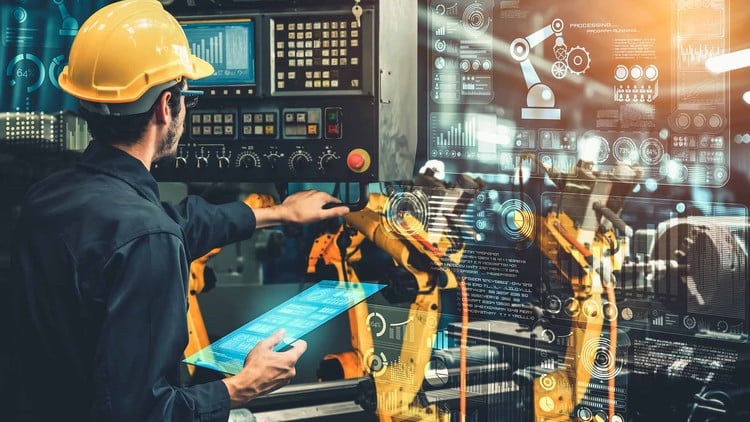
Engineering Introduction to Industry 4.0 and Smart Manufacturing
⏱️ Length: 3.5 total hours
⭐ 4.49/5 rating
👥 2,017 students
🔄 May 2025 update
Add-On Information:
Note➛ Make sure your 𝐔𝐝𝐞𝐦𝐲 cart has only this course you're going to enroll it now, Remove all other courses from the 𝐔𝐝𝐞𝐦𝐲 cart before Enrolling!
- Course Overview
- Analyze the historical transition from traditional automation to the Fourth Industrial Revolution, examining how decentralized intelligence is replacing legacy hierarchical control systems.
- Explore the architectural framework of the Smart Factory, focusing on how modular production units enable hyper-flexibility and rapid reconfiguration of assembly lines.
- Investigate the concept of IT/OT Convergence, bridging the gap between shop-floor operational technology and enterprise-level information systems for seamless data flow.
- Examine the role of Additive Manufacturing and 3D printing in a smart ecosystem, particularly its impact on on-demand spare parts production and waste reduction.
- Discuss the Socio-Technical dynamics of the modern workplace, evaluating how human workers interact with collaborative robots (cobots) in a shared physical environment.
- Review the Circular Economy model within Industry 4.0, using real-time tracking to improve product lifecycle sustainability and resource efficiency.
- Understand the Global Supply Chain 4.0, where transparency and traceability are enhanced through distributed ledger concepts and smart logistics.
- Evaluate Mass Customization strategies that allow factories to produce unique, personalized items at the same cost and speed as traditional mass production.
- Requirements / Prerequisites
- A foundational understanding of general manufacturing workflows, including basic knowledge of assembly lines, quality control, and inventory management.
- Basic computer literacy and an awareness of how software applications interface with hardware components in an industrial setting.
- An analytical mindset capable of interpreting technical diagrams and conceptualizing complex system interactions.
- Familiarity with basic engineering principles is helpful, though the course is designed to be accessible to those moving from management into technical leadership.
- No prior programming experience is required, as the focus remains on the strategic implementation and architectural understanding of technology.
- A keen interest in disruptive technologies and their potential to reshape the competitive landscape of global manufacturing.
- Skills Covered / Tools Used
- Master the Strategic Digital Mapping technique to identify technological gaps in current production facilities and prioritize digital upgrades.
- Utilization of Edge Computing architectures to process critical data locally, reducing latency and bandwidth usage compared to traditional cloud models.
- Implementation of Predictive Maintenance (PdM) frameworks that use vibration and thermal sensors to prevent catastrophic equipment failure.
- Design of Advanced Human-Machine Interfaces (HMI) that utilize data visualization to provide operators with actionable real-time insights.
- Application of Cyber-Physical Security protocols specifically tailored to protect industrial control systems (ICS) from external hacking and internal vulnerabilities.
- Exploration of the Digital Thread, ensuring that data from the design phase follows the product through manufacturing, delivery, and end-of-life.
- Integration of Manufacturing Execution Systems (MES) with modern cloud databases to ensure high-fidelity reporting and regulatory compliance.
- Selection and deployment of Smart Sensor Networks capable of environmental monitoring and energy consumption optimization.
- Benefits / Outcomes
- Develop a holistic digital transformation roadmap that can be presented to stakeholders to justify investments in smart technology.
- Gain a distinct competitive advantage in the job market by acquiring the vocabulary and technical background required for high-level “Factory of the Future” roles.
- Bridge the inter-departmental communication gap between mechanical engineers and IT specialists, acting as a technical translator within your organization.
- Achieve operational excellence by learning how to eliminate data silos and improve the “Total Equipment Effectiveness” (OEE) through digital monitoring.
- Prepare for future-proof leadership by understanding how to manage hybrid teams of humans and automated intelligent systems.
- Identify new revenue streams through the “Product-as-a-Service” model, enabled by the continuous connectivity of smart industrial assets.
- Foster a culture of continuous innovation, allowing your company to pivot quickly in response to volatile market demands or supply chain disruptions.
- PROS
- Reflects the most current industry standards following the comprehensive May 2025 curriculum update.
- The 3.5-hour duration is optimized for busy professionals, providing high-density knowledge without unnecessary fluff.
- Maintains a strong 4.49/5 student rating, proving the effectiveness of its pedagogical approach for an engineering audience.
- Features real-world case studies from leading automotive and aerospace firms to illustrate the practical application of theories.
- Provides foundational clarity on complex topics, making it the perfect stepping stone for more specialized technical certifications.
- CONS
- As a foundational course, it focuses more on architecture and strategy rather than providing hands-on coding labs for specific PLC brands.
Learning Tracks: English,Teaching & Academics,Engineering
Found It Free? Share It Fast!