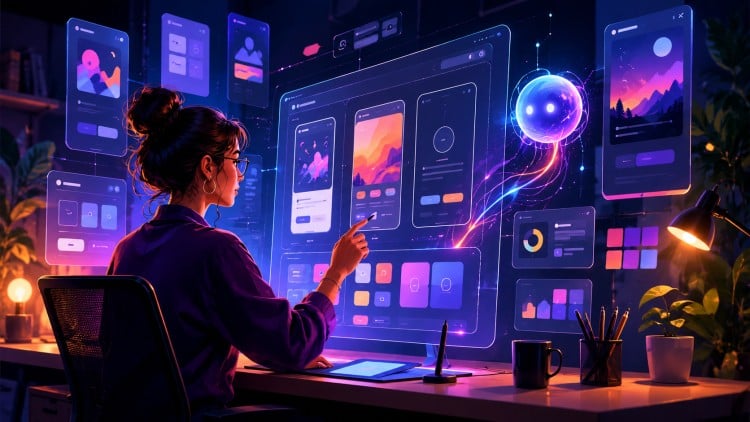
Design stunning Landing Pages, Apps & Dashboards with Google Stitch AI — no design experience needed.
What You Will Learn:
- Understand what Google Stitch is and how its AI-powered design generation is transforming the way UI/UX professionals work
- Access and navigate Google Stitch to start creating professional-quality UI designs immediately from day one
- Build a complete Landing Page with Google Stitch, customize its theme, and export it to both HTML/CSS code and Figma
- Design a multi-screen Food Delivery App UI and export it to Figma for a full professional design handoff workflow
- Create a News Website using Standard Mode and master prompt editing techniques for precise, accurate design output
- Create a News Website using Standard Mode and master prompt editing techniques for precise, accurate design output
- Use Experimental Mode with image inputs to generate a polished Login Interface with full control over visual style
- Build a complete Dashboard UI using Experimental Mode, image references, and advanced custom prompt strategies
- Export any Google Stitch design to clean HTML/CSS or Figma, ready for real-world development or client delivery
Alright, let’s talk about this ‘Master Google Stitch: Build UI/UX 10x Faster with AI’ course. As someone who’s been deep in the trenches of tech for a good while, I’m always a bit skeptical when something claims to revolutionize workflow. AI in design? Been hearing that for ages. But this Stitch course… it’s got my attention. It’s not just another fluff piece; it actually dives into a tool that’s genuinely showing promise for accelerating the UI/UX process.
Overview
The core of this course hinges on Google Stitch, a platform that leverages AI to generate UI/UX designs. The promise is significant: no prior design experience required, and the ability to churn out professional-grade interfaces at an unprecedented speed. What stood out to me is how the course doesn’t just showcase the tool but trains you to *integrate* it into a professional workflow. It’s less about being a magic button and more about understanding how AI can augment human creativity and efficiency. The ability to generate code (HTML/CSS) and handoff assets to Figma directly from the AI output is a huge deal for bridging the gap between concept and development. It’s about democratizing design to a degree while still equipping users with the skills to refine and manage those AI-generated assets.
Prerequisites
Honestly, the bar is set pretty low here, which is a good thing for accessibility. You don’t need to be a seasoned designer. However, having a basic understanding of digital interfaces and what makes a good user experience is definitely helpful. Think of it like this: if you can navigate a website or app without getting lost, you’ve got the foundational awareness. For those aiming for true career growth, having some familiarity with general web development concepts and maybe a peek at design principles will amplify what you get out of this, especially when it comes to refining the AI’s output.
Skills & Tools
This course aims to equip you with job-ready skills directly applicable to modern design and development pipelines. You’ll learn to:
- Navigate and leverage Google Stitch AI for rapid UI generation.
- Understand and implement prompt engineering for precise design control.
- Customize themes and visual styles of AI-generated designs.
- Seamlessly export designs into industry-standard tools like Figma.
- Generate clean HTML/CSS code for immediate prototyping or development.
- Work with both ‘Standard’ and ‘Experimental’ modes for varied design challenges.
The primary tool, of course, is Google Stitch itself. Complementary skills involve understanding how to articulate design intent to an AI and how to take an AI-generated output and make it your own. It’s about learning the new language of AI-assisted design.
Career Benefits & Job Roles
This is where the rubber meets the road. For anyone looking to boost their career growth, this course offers a significant advantage. The ability to build UI/UX designs faster translates to higher productivity and quicker project turnaround times. It’s particularly beneficial for:
- UI/UX Designers looking to accelerate their workflow and explore more design iterations.
- Web Developers who want to prototype UIs quickly or get a head start on front-end implementation.
- Product Managers who need to visualize product ideas rapidly.
- Entrepreneurs and small business owners looking to create professional-looking interfaces without a massive design budget.
The skills learned here could be a stepping stone towards roles like AI-Assisted UI Designer, Prototyping Specialist, or simply making you a more valuable asset in existing roles by demonstrating proficiency in cutting-edge tools.
Pros
- Unmatched Speed and Efficiency: The core promise holds true. The AI generation capabilities can drastically cut down the time spent on initial design concepts and even detailed layouts. This is a genuine game-changer for rapid prototyping and iterating.
- Accessibility for Non-Designers: The “no design experience needed” claim isn’t hyperbole. The platform is intuitive enough that individuals without a formal design background can start creating functional and aesthetically pleasing interfaces from day one.
- Seamless Handoff to Development: The direct export to HTML/CSS and Figma is a massive win. It minimizes friction between the design and development phases, making it ideal for real-world projects and collaborative environments.
- Practical, Project-Based Learning: The course isn’t just theoretical; it walks you through building actual projects like landing pages, apps, and dashboards. This hands-on approach ensures you’re not just learning the tool, but how to apply it effectively.
Cons
My main honest take is that while the AI is fantastic for rapid ideation and initial builds, the nuances of truly bespoke, highly strategic UI/UX can still require significant human refinement. The AI provides a strong foundation, but for designs that need deep emotional connection, complex micro-interactions, or highly specific brand storytelling, you’ll still need an experienced designer to polish and elevate the output. It’s a powerful co-pilot, not an autopilot for every single aspect of a complex project.