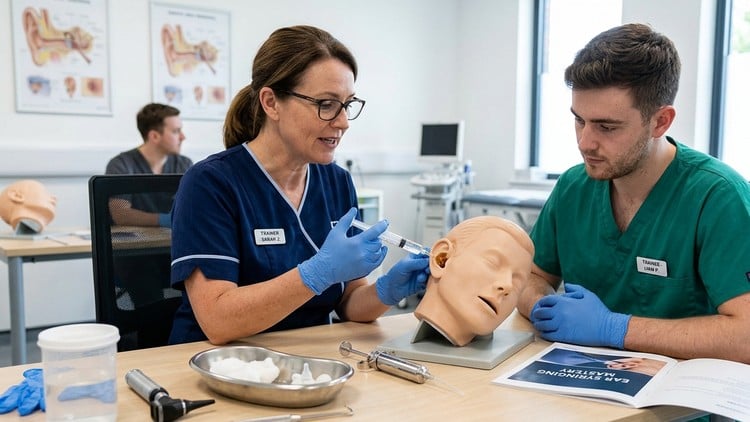
Professional ear syringing skills, remove ear eax protocols, & complications management. Work safely, efficiently
What You Will Learn:
- Follow a clear, repeatable assessment framework, so you stop guessing and start making confident decisions about who is suitable for ear syringing – who is not
- Watch the procedure broken down into logical micro‑steps, with the “why” behind each action, so the technique is easy to remember under pressure.
- Learn how to use positioning, angulation, and flow control to protect the ear canal and tympanic membrane while still achieving effective wax clearance.
- Practise phrasing you can use immediately with nervous or sceptical patients, using language proven to increase trust, compliance, and satisfaction.
- See what real‑world complications look like, how to spot them early, and how to respond calmly and professionally.
- Build the documentation habits and clinical record-keeping skills that protect you, your patient, and your practice if your technique is ever questioned.
- Show more
The Reality of Expanding Your Clinical Toolkit
Let’s be honest: in the current healthcare climate, relying on a single stream of expertise is a risky bet. Whether you are a nurse, a pharmacy tech, or an aspiring healthcare entrepreneur, the shift toward private clinical services is where the real career growth is happening. I’ve spent years vetting technical and medical training modules, and most “how-to” guides for ear care are either dangerously oversimplified or buried in academic jargon that doesn’t translate to a real patient sitting in your chair. The “Master Ear Syringing Course: Generate Income with Safety” hits a sweet spot that I rarely see. It treats ear syringing not just as a manual task, but as a high-stakes technical procedure that requires a beginner to advanced progression mindset.
What I appreciate most here isn’t just the “how,” but the obsessive focus on the “why.” In my experience, most practitioners fail not because they lack the physical dexterity, but because they lack a repeatable assessment framework. This course stops the guesswork. It moves you from “I think this is okay to syringe” to “I am clinically confident this is the correct protocol.” This shift is the difference between a thriving side-hustle and a potential liability nightmare. It’s essentially a certification prep powerhouse for anyone looking to add a high-demand, high-margin service to their professional repertoire.
Prerequisites
While this course is designed to take you from a baseline level to job-ready skills, it’s not for the absolute layperson with no medical context. To get the most out of this, you should have:
- A foundational understanding of human anatomy (specifically the head and neck).
- Basic experience in a clinical or care-giving environment.
- Access to an otoscope and a manual or electronic irrigator for hands-on labs (simulated practice is key).
- A commitment to meticulous record-keeping and professional ethics.
Skills & Tools You Will Master
This isn’t just about water and wax; it’s about mastering industry-standard tools and the soft skills that drive patient retention. You will dive deep into:
- Clinical Otoscopy: Identifying landmarks of the tympanic membrane and recognizing contraindications like perforations or grommets.
- Irrigation Technology: Using electronic ear irrigators with precise flow control and pressure management.
- The Micro-Step Technique: Breaking down the procedure into logical phases to ensure safety and efficiency.
- Professional Documentation: Mastering the clinical record-keeping habits that protect your license and your practice.
- Patient Psychology: Using specific phrasing and scripts to manage nervous patients and build immediate trust.
Career Benefits & Job Roles
The ROI on this course is remarkably clear. As many public health sectors scale back on “non-essential” ear care, the private market is exploding. By acquiring these job-ready skills, you position yourself for several lucrative paths:
- Private Clinic Owner: Add a specialized ear care wing to an existing pharmacy or aesthetic clinic.
- Mobile Ear Care Specialist: Launch a low-overhead, high-demand mobile service visiting elderly patients or care homes.
- Enhanced Role in Primary Care: Increase your value within a GP surgery or community clinic by taking over complex wax management.
- Occupational Health: Integrating ear health assessments into workplace wellness real-world projects.
Pros
- Micro-Step Breakdown: The video modules are incredibly granular. Instead of one long, confusing demo, you see the procedure dissected, making it much easier to replicate under pressure.
- Risk Mitigation Focus: I’ve seen too many courses gloss over what happens when things go wrong. This course stares at complications head-on, showing you exactly how to spot and manage them.
- Commercial Viability: It doesn’t just teach the skill; it frames it as a way to generate income. The inclusion of patient communication scripts is a brilliant touch that turns a clinical skill into a business asset.
- High-Level Documentation: The emphasis on “defensive” record-keeping is worth the price of admission alone. It builds the habits necessary to protect your reputation in a litigious environment.
Cons
- Hardware Dependency: While the theory is top-tier, you really need to invest in your own high-quality industry-standard tools (like a Propulse irrigator) to practice alongside the videos. The course can’t give you the “feel” of the water pressure—that only comes with physical practice.