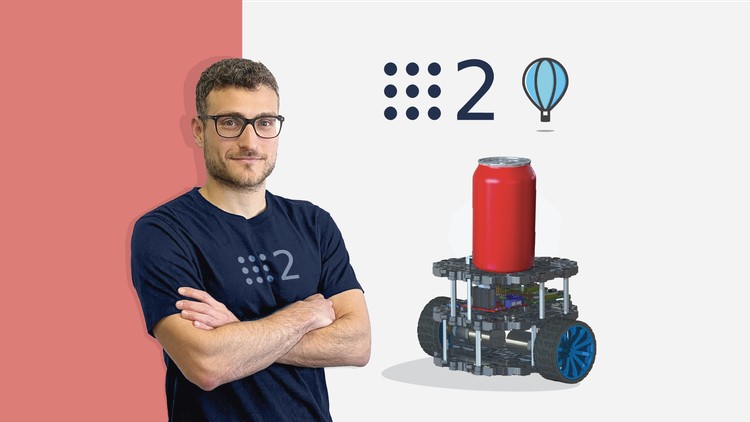
Create a ROS2 based Self-Driving robot and learn about Robot Localization and Sensor Fusion using Kalman Filters
What you will learn
Create a Real Self-Driving Robot
Mastering ROS2, the last version of the Robot Operating System
Implement Sensor Fusion algorithms
Simulate a Self-Driving robot in Gazebo
Programming Arduino for Robotics Applications
Use the ros2_control library
Develop a Controller
Odometry and Localization
Kalman Filters and Extended Kalman Filter
Probability Theory
Differential Kinematics
Create a Digital Twin of a Self-Driving Robot
Master the TF2 library
Why take this course?
🚀 Course Headline:
Master Self-Driving Technology with ROS 2 – Dive into Odometry & Control! 🤖🚗
Course Description:
Are you ready to embark on an exhilarating journey into the world of self-driving vehicles and robotics? With “Self-Driving and ROS 2 – Learn by Doing!” you’ll transform from a curious learner into a confident practitioner in autonomous navigation and sensor fusion. This course, led by the expert instructor Antonio Brandici, is your ticket to mastering Robot Operating System (ROS) version 2, the cutting-edge framework for robot perception, localization, and decision-making.
🚧 What You’ll Learn:
- The fundamental principles of autonomous navigation in real-world applications.
- How to implement Odometry & Localization with a practical approach using Kalman Filters.
- The intricacies of ROS 2, the most advanced version of ROS, through hands-on experience.
🛠️ Course Philosophy:
“Learning is an active process. We learn by doing – only knowledge that is used sticks in your mind.” – Dale Carnegie
We believe in learning by doing. This course follows a structured approach, with each section broken down into three key parts:
- Theoretical Foundations: Gain a solid understanding of the concepts and functionalities within ROS 2.
- Practical Application: Apply your knowledge in simple, controlled examples to reinforce learning.
- Real-World Integration: Bring your skills to life by integrating what you’ve learned into building and programming a real self-driving robot!
🧠 Skill Enhancement:
- Develop your programming prowess using both Python and C++, the languages most in-demand by robotics professionals.
- Choose to focus on one language or become proficient in both, enhancing your versatility as a Robotics Software Developer.
🔍 Course Highlights:
- Engage with industry-relevant projects that will prepare you for the challenges of real-world robotics applications.
- Follow a Learn by Doing approach to solidify your understanding and application of ROS 2 concepts.
- Tackle topics like sensor fusion, localization, and autonomous navigation from a practical standpoint.
🎓 Why Choose This Course?
- Gain a deep understanding of the technologies behind self-driving robots and ROS 2, opening up a world of opportunities in robotics.
- Learn from the comfort of your home or on the go, at your own pace.
- Join a community of like-minded learners and professionals who are as passionate about robotics as you are!
Enroll now to turn your fascination with self-driving technology into expertise with ROS 2. This course is your chance to lead the future in autonomous navigation and beyond! 🛣️🚀
Alright, let’s talk about the “Self Driving and ROS 2 – Learn by Doing! Odometry & Control” course. As someone who’s been deep in the robotics trenches for a while, I’ve seen a lot of courses come and go. Some are great, some are… well, less so. This one? It’s got some serious legs, especially if you’re looking to get your hands dirty with ROS 2 and the nitty-gritty of autonomous navigation.
Overview
What struck me immediately about this course is its unapologetic emphasis on practical application. It’s not about theoretical musings; it’s about building a functional, ROS 2-powered self-driving robot. The “learn by doing” tagline isn’t just marketing fluff here. They dive straight into creating a real-world robot, which is a huge plus for anyone aiming for job-ready skills. The inclusion of Arduino programming bridges the gap between high-level ROS 2 logic and the low-level hardware control, a crucial skill that’s often overlooked in purely simulation-based courses. The focus on odometry and control, including the use of the ros2_control library, is exactly what you need to understand how robots actually move and how to make them do what you want them to. Sensor fusion, particularly with Kalman Filters, is another area where this course really shines, offering a solid foundation for robot localization – a cornerstone of any autonomous system. They even manage to weave in Gazebo simulations, which is essential for testing and development before deploying to hardware, offering a nice blend of virtual and real-world scenarios.
Prerequisites
To get the most out of this, a decent grasp of Python is pretty much a given. You’ll be writing a lot of ROS 2 nodes, and Python is king there. Some familiarity with C++ would also be beneficial, especially if you want to dive deeper into performance-critical parts or understand the inner workings of some ROS 2 packages. Basic understanding of Linux is also a must, as ROS 2 lives and breathes in that ecosystem. If you’re coming from a complete beginner standpoint without any programming experience, you might find the initial ramp-up a bit steep, but it’s definitely manageable with a bit of extra self-study on the programming fundamentals.
Skills & Tools
This course is a veritable buffet of industry-standard tools and techniques. You’ll master ROS 2 (the latest versions, which is critical for staying current), get hands-on with Gazebo for simulation, and learn to program Arduino for hardware interfacing. The implementation of sensor fusion algorithms and the development of controllers using ros2_control are key takeaways. Expect to gain practical experience in odometry estimation and localization techniques. It’s the kind of curriculum that builds real-world projects into your portfolio.
Career Benefits & Job Roles
Let’s be blunt: the demand for robotics engineers, especially those proficient in ROS 2, is skyrocketing. This course directly addresses that need. The skills you acquire are directly applicable to roles like Robotics Engineer, Autonomous Systems Developer, Mechatronics Engineer, and even roles in areas like AI/ML in robotics. It’s excellent preparation for anyone aiming for certification prep or simply looking to elevate their standing in the job market. This isn’t just learning; it’s investing in your career growth.
Pros
- Hands-on Hardware Focus: The emphasis on building a physical robot is a massive differentiator. It forces you to confront real-world challenges that simulations can’t fully replicate.
- Comprehensive ROS 2 Coverage: It doesn’t shy away from the core ROS 2 concepts and libraries, including the crucial
ros2_controlframework, which is becoming the standard for hardware abstraction. - Practical Sensor Fusion & Localization: The deep dive into Kalman Filters and their application in sensor fusion provides a robust understanding of critical navigation concepts.
- Bridging Software and Hardware: The inclusion of Arduino programming is a smart move, creating a more holistic understanding of robotic system integration.
Cons
My only honest quibble is that the pace, while excellent for learning by doing, can feel quite demanding for absolute beginners. If you’re truly starting from zero with programming and robotics concepts, you might need to pause and do supplementary learning on basic concepts to keep up. It’s more of a “fast-track immersion” than a gentle introduction, which is great for motivated learners but could be a hurdle for some.