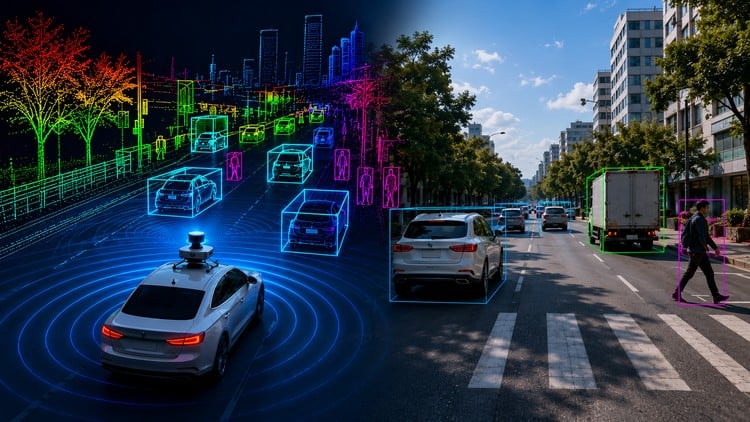
Master Image & LiDAR Annotation, Bounding Boxes, Quality Check, and Real-World AI Data Labeling Using CVAT
What You Will Learn:
- Beginners who want to learn Image Annotation and LiDAR Annotation from scratch.
- Students interested in Artificial Intelligence (AI) and Computer Vision
- Anyone looking to start a career in Data Annotation or AI Training Data.
- Professionals who want to understand how AI datasets are created and labeled
My Honest Take: Why Data Labeling is the Unsung Hero of 2026
Let’s be real for a second: everyone and their neighbor wants to be an “AI Engineer” these days, but very few people actually want to get their hands dirty with the data that makes AI work. I’ve spent years in the tech space, and if there is one thing I’ve learned, it’s that a model is only as good as the pixels and point clouds fed into it. That is exactly why the LiDAR & Image Annotation Course for Beginners 2026 caught my eye. It doesn’t promise you’ll build the next Skynet; instead, it focuses on the “ground truth” — the actual, manual work of teaching machines how to see.
Most introductory courses stop at simple 2D bounding boxes. This course, however, leans heavily into the 2026 industry shift toward spatial awareness. We are moving past basic photo recognition and into the world of autonomous drones, self-driving logistics, and advanced robotics. By including LiDAR (Light Detection and Ranging), this curriculum addresses a massive skill gap in the current market. If you’re looking for job-ready skills that actually translate to a paycheck in the AI training data sector, this is a pragmatic starting point that avoids the usual fluff.
Prerequisites: What You Actually Need
The beauty of this course is that the barrier to entry is low, but the ceiling for mastery is high. You don’t need a PhD in Mathematics or a background in Python. Here is the reality of what you need to bring to the table:
- A Solid Workstation: Since you’ll be handling 3D point clouds and high-resolution imagery, a decent GPU and a stable internet connection are non-negotiable.
- Attention to Detail: If you’re the type of person who gets annoyed by a pixel being out of place, you’ll actually excel here. Quality Check (QC) is a huge part of the curriculum.
- Basic Tech Literacy: You should be comfortable navigating browser-based tools and managing large file formats.
- Patience: Data annotation is a marathon, not a sprint. This course requires a “builder” mindset.
The Toolkit: Industry-Standard Tools & Technical Skills
I was impressed to see CVAT (Computer Vision Annotation Tool) as the primary focus. In the professional world, we don’t use “toy” apps; we use industry-standard tools that allow for scaling. This course moves you from beginner to advanced by covering:
- 2D Annotation: Master polygons, polylines, and semantic segmentation for traditional computer vision.
- 3D LiDAR Labeling: This is the “meat” of the course. You’ll learn how to navigate 3D environments, adjust cuboids, and label objects in a point cloud space.
- Quality Assurance Frameworks: Learning how to spot errors is just as important as labeling. You’ll dive into Quality Check protocols used by top-tier AI firms.
- Data Lifecycle Management: Understanding how raw data transforms into real-world projects through systematic export and formatting.
Career Benefits & Emerging Job Roles
Let’s talk about career growth. The “AI boom” isn’t just for coders. There is a massive, growing ecosystem of Data Annotation and AI Training roles. By completing this certification prep level course, you are positioning yourself for roles such as:
- Data Labeling Specialist: The entry-point for most, focusing on high-accuracy output.
- LiDAR Analyst: A more specialized, higher-paying role within the autonomous vehicle and mapping industries.
- Quality Assurance (QA) Lead: Overseeing teams of annotators to ensure the dataset meets real-world AI standards.
- MLOps Support: Helping bridge the gap between raw data collection and model deployment.
The Pros: What They Got Right
- LiDAR Integration: Most “beginner” courses ignore 3D data because it’s hard to teach. Including LiDAR annotation makes this course significantly more valuable than your average Udemy find.
- Hands-on Labs: You aren’t just watching videos; you’re actually inside CVAT performing real-world AI data labeling. This “learn by doing” approach is the only way to build muscle memory.
- Focus on Accuracy: The course emphasizes that “close enough” isn’t good enough for AI. The focus on Quality Check prepares you for the strict requirements of professional data vendors.
The Cons: An Honest Critique
If I have one gripe, it’s that the work can feel repetitive. Data annotation is inherently tedious, and while the course tries to keep it engaging, there’s no getting around the fact that you’ll be drawing thousands of bounding boxes. If you’re looking for high-octane excitement, this isn’t it—this is a “blue-collar” tech skill that requires discipline and focus.