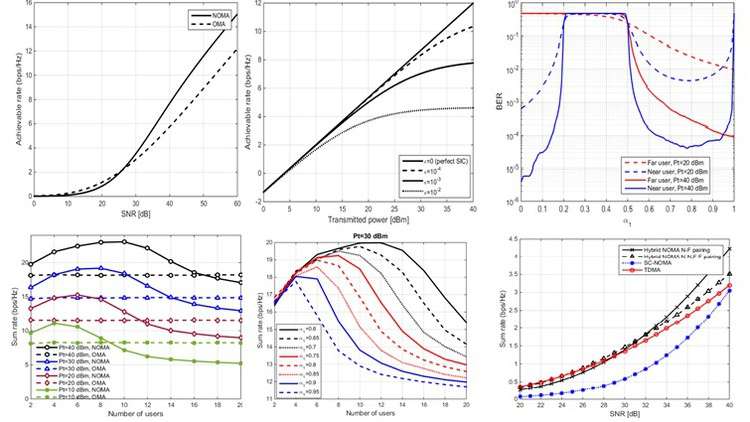
A step by step the Matlab codes for capacity, BER, and outage probability estimations for NOMA communication system
What you will learn
What is meant by NOMA with respect to OMA systems?
What is the achievable rate offered by the NOMA, and OMA systems?
What is the effect of imperfect SIC on the downlink NOMA rate capacity?
What is the effect of the NOMA fixed power allocation on the BER performance?
What is the number of users that NOMA can support?
What is meant by the user paring in NOMA?
How to perform fixed and dynamic power allocation in NOMA?
How to estimate the BER, capacity, and outage probability of NOMA communication system over a Rayleigh fading channel?
Why take this course?
🚀 Course Title: 5G Communication System Using MATLAB
🎓 Course Headline: A Step-by-Step Guide to Mastering MATLAB Codes for Capacity, BER, and Outage Probability Estimations in NOMA Communication Systems
About the Course:
🚀 Who is it for?
This comprehensive course is meticulously crafted for undergraduate and postgraduate students within the Electronics and Communications Engineering domain. It is a treasure trove of knowledge that can save you months of rigorous study, offering a concise yet thorough understanding of 5G communication systems using MATLAB.
📚 What You’ll Learn:
- Theoretical Foundations: Dive into the intricacies of 5G communication systems, with each module providing a solid theoretical background supported by practical MATLAB code examples.
- Practical MATLAB Skills: Master the art of using MATLAB to simulate and analyze the performance of various communication systems, including the latest advancements in Non-Orthogonal Multiple Access (NOMA) technology.
Course Outline:
🔍 Module 1: Channel Capacity Estimation
- Learn how to apply Shannon’s formula to estimate channel capacity, a cornerstone in information theory.
📈 Module 2: Achievable Rate Analysis
- Explore the achievable rate for both uplink and downlink communication in NOMA and Orthogonal Multiple Access (OMA) systems.
⚙️ Module 3: Impact of Imperfect SIC in NOMA
- Investigate how imperfect Successive Interference Cancellation (SIC) affects the rate capacity in a downlink NOMA system.
📊 Module 4: BER Performance with Fixed Power Allocation (FPA)
- Analyze the impact of FPA on the Bit-Error-Rate (BER) performance in NOMA systems.
🤔 Module 5: Users Support Analysis
- Determine the number of users that can be supported by NOMA as compared to OMA techniques.
🤝 Module 6: User Pairing Implementation
- Understand and perform user pairing in NOMA systems, a technique crucial for optimizing system performance.
⚡ Module 7: Power Allocation Strategies
- Learn about fixed and dynamic power allocation in NOMA systems and validate their performance through simulations.
📌 Module 8: BER and Capacity Estimation over Rayleigh Fading Channels
- Estimate the BER and achievable capacity of a NOMA system over a Rayleigh fading channel, providing insights into real-world performance under fluctuating channel conditions.
🎉 Outcome:
By completing this course, you will have a solid grasp of the principles of 5G communication systems with a focus on NOMA, and you’ll be equipped to perform detailed simulations using MATLAB to estimate key performance indicators like capacity, BER, and outage probability.
Why Choose This Course?
🔍 Hands-On Learning: Engage with practical MATLAB code examples that complement each module’s theoretical explanations.
🚀 Cutting-Edge Topics: Explore the latest advancements in NOMA technology and their applications in 5G communication systems.
🤝 Expert Instruction: Learn from Dr. Khaled Ramadan, an instructor with expertise in advanced communication systems and MATLAB simulation techniques.
📈 Real-World Applications: Gain the skills needed to apply your knowledge directly to real-world scenarios, enhancing your employability in the field of telecommunications.
Enroll now to embark on a journey towards mastering 5G communication systems with MATLAB! 🌟
Overview: Beyond the 5G Hype and Into the Code
Let’s be real for a second: the 5G revolution is often buried under layers of marketing buzzwords, but for those of us in the trenches of telecommunications engineering, the real magic happens at the physical layer. If you’ve been looking for a way to actually simulate and visualize how 5G handles massive connectivity, the ‘5G Communication System Using Matlab’ course is a bit of a hidden gem. Instead of drowning you in 200-page whitepapers, this course focuses heavily on Non-Orthogonal Multiple Access (NOMA), which is essentially the “secret sauce” for increasing spectral efficiency.
What I appreciated most about this curriculum was its refusal to play it safe. It dives straight into the comparison between OMA (the traditional way we’ve done things) and NOMA. It doesn’t just tell you that NOMA is better; it makes you prove it through hands-on labs. You’ll spend a significant amount of time looking at Successive Interference Cancellation (SIC). In the real world, SIC is never perfect, and I loved that this course tackles the “imperfect SIC” scenario head-on. It’s that kind of real-world project mindset that separates a mediocre tutorial from a high-value certification prep resource. Whether you are a student or a working professional looking for career growth, seeing the actual capacity curves and BER (Bit Error Rate) performance move in response to your code changes is incredibly satisfying.
Prerequisites: What You Need Before Hitting ‘Play’
This isn’t a “coding for babies” class. To get the most out of these industry-standard tools, you should come prepared with:
- A fundamental understanding of Matlab syntax (arrays, loops, and plotting are essential).
- Basic knowledge of wireless communication concepts like Signal-to-Noise Ratio (SNR) and the difference between bits and symbols.
- A high-level grasp of linear algebra; you don’t need to be a math wizard, but you should understand how matrices represent channels.
- Familiarity with the concept of fading—specifically Rayleigh fading—as that’s the playground where your simulations will live.
Skills & Tools: Your New Technical Arsenal
By the time you wrap up these modules, you won’t just have a certificate; you’ll have a portfolio of job-ready skills. You will master:
- Matlab Scripting for 5G: Writing clean, efficient code for complex communication iterations.
- Monte Carlo Simulations: Learning how to estimate BER and Outage Probability by running thousands of iterations—a must-have for any RF Engineer.
- Power Allocation Strategies: Designing both fixed and dynamic power allocation algorithms to balance user fairness and total system throughput.
- Channel Modeling: Implementing Rayleigh fading channels to simulate realistic urban environments.
- Performance Metrics: Generating and interpreting Capacity vs. SNR graphs that are standard in R&D departments globally.
Career Benefits & Job Roles: Leveling Up
We are currently seeing a massive push for 6G research, and NOMA remains a pivotal part of that conversation. Mastering these simulations provides a significant boost to your career growth. I’ve seen technical interviewers ask candidates to explain the trade-offs of SIC or how user pairing affects NOMA performance. Having hands-on labs experience allows you to answer those questions with confidence.
Potential job roles where this knowledge is a game-changer include:
- 5G Systems Engineer: Designing the next generation of high-capacity networks.
- Wireless Research Scientist: Testing new protocols for 6G and beyond.
- Signal Processing Engineer: Developing algorithms for noise reduction and interference cancellation.
- Telecommunications Consultant: Helping firms optimize their existing spectrum assets using advanced multiple access techniques.
The Pros
- Practical Code Focus: You aren’t just watching slides; you are building real-world projects from scratch. The step-by-step Matlab breakdown is excellent for visual learners.
- Nuanced SIC Analysis: Most courses assume “Perfect SIC.” This course gets honest about imperfect SIC, which is what you’ll actually encounter in hardware.
- Beginner to Advanced Path: It starts with the “why” of NOMA and builds up to complex outage probability estimations, making the learning curve manageable but rewarding.
The Cons
- Math Intensity: While the code is the focus, the underlying math for Rayleigh fading and capacity estimations can be quite dense. If you are allergic to formulas, you might need to pause and supplement with some external reading to fully grasp the “why” behind the code logic.